Showing posts with label Letter: Z. Show all posts

Tuesday, 9 January 2024

Zombie Rampage (1989)


Director: Todd Sheets

Screenplay: Erin Kehr & Todd Sheets

Cast: Dave Byerly as Tommy / Mime, Erin Kehr as Dave, Stanna Bippus as Sheila, Beth Belanti as Sherry, Brian Everad as Pusshead, Deric Bernier as Hammerspike, Lisa Cottoner as Fox, Laura Young as Tracy, Larry Hodges as Piggy, Danon Park as George, Jason Ayers as Roger, John Welch as Jason, Ed Dill as Brian

A Night of a Thousand Horror (Movies)


Kicking off with a metal cover of Norman Greenbaum's Spirit in the Sky as rival gangs of punks, one in a suit, beat each other up, it is for Todd Sheet's feature length debut, after a series of shorts, a good opening to a career which lasted for decades. Whether the original cut or the Director's Cut I had watched, I do think however, with sincerely, even he might view this as a mess. As a veteran micro budget director who visually showed improvements over time from this first film, even if it has the perfect (and goofy) opening to a career, it is an acquired taste to witness despite the fact this actually has some higher production value, and at least locations in use, than some of the films he made later on. It is an erratic film to say the least.

Premise wise a gang leader, looking like a white collar middle manager in a tie and grey suit, but with a prominent left ear ring, acquired a book to be able to resurrect a recently slain member from the graveyard, even if it cost the group their beer money. The other gang they were against, with another copy of the book, make the mistake instead to use the text, this accidently causing an undead epidemic. Even though this is set up, Zombie Rampage does not properly established the undead hordes appearing until abruptly into itself part of the way through, and does feel like huge chunks of the plot are missing. My younger self would have called this one of the worst films ever made, and even now able to appreciate this and micro budget cinema in its flaws, this one definitely requires a patience to be able to appreciate this as it feels like a mass of ideas and fragments placed together.  Clearly, Sheets had some production value it hand with this, with extensive scenes in a variety of buildings and streets, unlike ones in the few years after confined to one location, but it also feels like a stream of consciousness. The loose nature of micro budget cinema, when allowed to drift, is felt at an extreme here when even the zombie outbreak central to the film is abruptly introduced, instead focusing on a side character we will never see again go on a deranged tangent about his dog named Butthead.

I will be more sympathetic to Sheets’ debut than most, unlike the first time I saw this, as much because I have seen him over his career climb in terms of craft with these films, and also because, with no expectations, there is a joy I can now have watching a film like this which is literally a collage of pieces which jut and stick out from each other. This feels like it had to be improvised over weekends, and was a mad editing nightmare, with audibly noticeable voice over added for dialogue and harsh edits which feel, even in a battered VHS copy, as if the tape was failing. The cool Italian horror inspired synth in the score notwithstanding, it feels like a half remembered film, half dreamt, in ways I have to honestly say in the negative if I am still going to say positively I still enjoyed this. A lot of this is because, despite the zombies being the centre of the film, this feels like a disconnected take on its own premise, even in mind that zombies are an easy premise for any low budget film to work with. It was ambitious beyond its means, and thus becomes a barely cohesive form, where it will be a struggle for those who would appreciate later Todd Sheets work like Moonchild (1994) where the technical quality and pacing, still with the homemade quality, are noticeably improved. This debut’s ambition goes as far as even taking advantage of the public domains status of Night of the Living Dead (1968) to borrow its radio announcer, but in wanting to recreate the ending of Return of the Living Dead (1985) without access to stock explosion footage, you also see the flaws when you have the most abrupt conclusion possible too.

A random serial killer of women is among the cast, random figures will talk about their arguments with family about inheritance whilst in fear of their lives from zombies in a basement, and grandpa will be talked of having chewed on grandma, all whilst this begins Todd Sheets’ use of organ meat from butchers, combined with the fake blood to the point here it would permanently stain wash denim bloody red. Random abrupt nudity, when an older female patron offers herself to a bar keep to pay the tap, who has no interest, and Todd Sheets gets to rock out his metal hair as a rival gang leader despite his gang disappearing from the film entirely. There is one moment which is pretty striking, in which a mother with her baby in a pram are got by zombies, which is pretty extreme even for this type of cinema, but tonally the rest of Zombie Rampage is goofier, intentionally and not, for its length. There are also plenty of things which are pretty random, such as the mime faced guy in a baseball cap, possible based on the baseball furies from The Warriors (1979), which just emphasises the chaotic mix of the resulting product. Zombie Rampage is not a film I would recommended unless you were used to Todd Sheets’ work, as I am, and prepared for its messy nature. Sheets would return to this theme of zombies in other films, so he was able to rework this as his skills would improve. This is just a curiosity which proves that everyone begins somewhere, and your first attempt can sometimes show this.

Tuesday, 1 August 2023

The Zero Boys (1986)


Director: Nico Mastorakis

Screenplay: Nico Mastorakis

Cast: Daniel Hirsch as Steve Kerski; Kelli Maroney as Jamie; Nicole Rio as Sue; Tom Shell as Larry; Jared Moses as Rip; Crystal Carson as Trish

A Night of a Thousand Horror (Movies)


From Greek director Nico Mastorakis, The Zero Boys is about survival game enthusiasts. The opening is cool, a battle between war game enthusiasts with paintballs, even if one of the participants is disconcertedly in Nazi regalia, another inexplicably wandering the battlefield with a giant boa constrictor snake around his shoulders in the combat zone. The Zero Boys, the winners of this, intend to celebrate their win by going to the woodland to train and party with their girlfriends, having with them Jamie (Kelli Maroney), the woman won in the opening competition, not impressed by this herself and the Zero Boys themselves aware of the shitty circumstances are. Considering her boyfriend (the one in the Nazi regalia) put her on the line, everyone including their leader Steve (Daniel Hirsch) wants to make her participation more welcoming to sooth the awkwardness.

Since this is a horror film though, this is not a melodrama about the terrible nature of people, and their best virtues through team games and friendship, as a scream and the sight of a running woman is a warning even if it is dismissed by the prospect of an empty cabin they can have a party and stay within. This is, from this point, a pretty standard slasher film from this era, if with the distinction that this looks different from those of the early eighties as a later eighties one, from the lighting and the hairstyles. It is conventional, if with an advantage of these older films that there is no contrived back story that undercuts the creepiness of the unknown, as with finding a section of human vertebrae only to dismissed as a coyote, a bad sign of what is to come as a pure spectacle horror film.

That presents more menacing results in a conventional template, playing to the fear of rural Americana with the more sinister idea of the disposability one can find oneself in within pure isolated woodland with no one to call too, something more prominent at a time when technology was not readily available to communicate to the civilized world. The owners of the cabin are sociopaths and they reflect that Nico Mastorakis first made the notorious Video Nasty Island of Death (1976). It is a tamer film in comparison, surprisingly so, but there is still a head in a freezer, and a moment which reflects a nastier edge where the torment of a victim involves a plastic bag on her head. An obsession with technology is also clear with Mastorakis as, between Blind Date (1984) using video games, and com for Murder (2002) about the internet, there is a menacing here idea of video tape technology allowing one to record the murders one commit to watch them over and over, which of course Henry: Portrait of a Serial Killer (1986) would be the most provocative take on in one of its most notorious scenes the same year of this. Among the countless films from the time, and following their narrative beats, here – involving Chekov’s taser – The Zero Boys is at least compelling is a slight thing.

Friday, 23 June 2023

Zyzzyx Road (2006)


Director: John Penney

Screenplay: John Penney

Cast: Leo Grillo as Grant; Katherine Heigl as Marissa; Tom Sizemore as Joey

Ephemeral Waves


Zyzzyx Road‘s name is already a curious one, a title which you would automatically find near the bottom of a list of all cinema alphabetically unless you included films in their original Russian and Indian languages. The tale of this one – produced, written and directed by John Penney - has the additional twist that this low budget film had a cinema release in the United States, and only grossed $30.00. That is a weird touch to this film, made by the screenwriter of Return from the Living Dead III (1993) and other horror genre films beforehand, to any film. The tale goes how, screening for a whole seven days, at Dallas' Highland Park Village Theater, with a single screening each day at noon, only six people went and it earned $30.00 against a budget of $1.2 million1. Truthfully even this theatrical screening was not really meant to happen, fulfilling a Screen Actors Guild agreement that permitted low-budget films to pay actors a lower rate as long as the film gets a domestic theatrical release1; as a production produced by lead actor Leo Grillo’s company, the focus for him was instead on non-domestic distribution of the film in other countries like Bulgaria1, and in truth the story of all this does not really talk about what the film actually is.

In this particular case, you have in the centre three people - Leo Grillo himself, an actor who made his name more in animal rights; Katherine Heigl, working on the film as she was starting in the television series Grey’s Anatomy (2005-), and before she made films like Knocked Up (2007), and Tom Sizemore, who had a lengthy career beforehand but had also unfortunately had a reputation off camera for his legal and drug issues, which came to the fore here as he was arrested before he was meant to be shooting this film, violating his parole with a drug arrest, but still able to continue on the shoot with no delays1. What it is, with these three people at the film’s centre, was a genre hybrid you could have actually depicted as a theatre production with a few touches changes, all centered around an older married man named Grant (Leo Grillo) and a young woman Marissa (Katherine Heigl) who, whilst she is more curious about Justin Bieber and Britney Spears’ romance at the time, have been having an affair. Driving at night, their affair may compromise his marriage with his wife, leading to his daughter being taken in the divorce, but there is an additional problem that they have to hide the body of Joey (Tom Sizemore) that is in the trunk, going to the titular Zyzzyx road and the road to nowhere.

Joey, unfortunately, is not quite dead, and even then there are a lot of twists which undercut the reality and subjective reality in what is a tale of a supposedly dead body hat needed to be buried in the desert. The plot goes in some obvious twists following what we begin to learn: how Grant is also hallucinating and having headaches; how Joey’s story is a strange figure seemingly wandering around like a spirit, with the absurd aspect he was brained to death with a giant vibrator/back massager to even get to this point; and how Marissa even represents the folly of a man’s midlife crisis without her being the cause of all this anxiety but merely a bystander caught in the crossfire, someone likely eighteen or younger, which is against the law, and in an unfortunate position for Grant unload all his neurosis over. It is a chamber piece in a desert, where the secrets come out, and it is insanely obvious where this is going to go with some idiosyncratic touches. One such touch, worth a slight plot spoiler warning, is how it touches upon full blown supernatural paranoia based on the fear of women between two men, especially as there is no explicit reference to what she actually is by name to them as an apparently no-human figure, emphasizing the paranoia.

The real issue with Zyzzyx Road however is that, from its initial set up to becoming a slasher in its finale, there is not a lot more to the production to flesh out the basics. It is a film which could have elaborated on its content more than it has, where barring some use of post digital effects and some idiosyncratic use of colour saturation to show levels of reality, there is not a lot which sticks out from a skeleton which you could have done more with. That is not to be taken as an insult against its director-writer either, as this was his debut helming a film as well as write one, and it would have been an obstacle to climb to even get the production completed with hope that later films would develop his voice. Unfortunately, the infamous $30 box office gross gave this production its legacy which would have not helped in the initial aftermath of its theatrical screenings. An article published by a website named CHUD, What If They Released a Movie and Nobody Came?, written by Devin Farcaci about the film on 1st January 20071b would have allowed the ball to start rolling in terms of, optimistically, a wider interest but sadly this became a case of a film, when I had first heard of it, was only known for its theatrical screening and nothing about the content within the feature.

It is a film where all of it has interest, including the titular road. Zzyzx is a real place, outside of Las Vegas in the middle of the Mojave Desert, just off of Interstate 15, where a man named Curtis Howe Springer caught wind of the local springs in the area and in the 1940s established a spa where he sold "miracle cures" using the spring's fabled water. With the name coined by him from being “the last word” in health, his place there becoming popular until April 11th 1974 when he was forcibly removed from the land by the Bureau of Land Management, as he did not actually own the land at the formerly named "Soda Springs" but merely claimed the right to mine in the land, which was different from occupying or developing on it2. That could have added flavor to this story about deceptive reality, as alongside the fact that, alongside the California State University's Desert Studies Center to study the desert’s ecology and geology, there are remnants of the old days, including abandoned buildings and even advertisements for Springer’s old mineral miracle cures2, which is free surrealism for even a low budget film to have used.

Even in terms of its notoriety, in 2011 it would be outmatched by The Worst Movie Ever!. Written, produced, directed by, and starring Glenn Berggoetz, it ended up by accident despite its name getting just $11 during its premiere from one person3. Befitting the legacy of a film starring Santa Claus and Abe Lincoln together for the first time, it was nonetheless not a great scenario for Berggoetz’s film to have ended in as well, and in that case it did due from from struggles in terms of being able to promote the production3. In that case, a few years later, that infamy helped when people began to write about the incident, alongside 70,000 people watching the film’s trailer on YouTube during August 2016 so it came out as a badge of honor3. As a result it leaves Zyzzyx Road in a weird place, where John Penney thankfully directed more, but with an infamy for his debut directorial feature which could have done a little bit more, whilst with virtues I admired, and tied to an aforementioned infamy that does not even factor in whether you can appreciate the film, but the perils of film distribution.

=======

1) How 'Zyzzyx Road' only grossed $30.00, written by Rob Brunner for Entertainment Weekly, published on February 9th 2007.

1b) What If They Released a Movie and Nobody Came?, written by Devin Farcaci for CHUD.com, posted 1st January 2007.

2) The Story Of Zzyzx, The Eerie Ghost Town Along A Dead-End Road In The Middle Of The California Desert, written by Erin Kelly (and edited by Maggie Donahue) for All That’s Interesting, published on May 9th 2023 with June 7th updates.

3) "The Worst Movie Ever!" Lives Up to Its Name with Epically Bad Grosses, written by Matt Singer for IFC, and published August 26th 2011.

Monday, 17 April 2023

A Zed & Two Noughts (1985)


Director: Peter Greenaway

Screenplay: Peter Greenaway

Cast: Andrea Ferreol as Alba Bewick; Brian Deacon as Oswald Deuce; Eric Deacon as Oliver Deuce; Frances Barber as Venus de Milo; Joss Ackland as Van Hoyten; Jim Davidson as Joshua Plate; Agnes Brulet as Beta Bewick; Guusje Van Tilborgh as Caterina Bolnes; Gerard Thoolen as Van Meegeren; Ken Campbell as Stephen Pipe; Wolf Kahler as Felipe Arc-en-Ciel; Geoffrey Palmer as Fallast

An Abstract Candidate


Is leglessness a form of contraception?

Peter Greenaway's first theatrical length film was The Falls (1980), his debut an incredible production but structured like the work he did for the Central Office of Information (COI) alongside his short films, a fake document told as a fictional catalogue using multimedia. The Draughtsman's Contract (1982) and A Zed & Two Noughts are his "first" films in terms of setting up how he would fully introduce narratives and characters alongside his obsessions. This, set up with two women dying when a swan hits their car, is a narrative first but, as mentioned, his obsessions with lists and references stays and is amplified. The grieving twin brothers, working at a zoo, are trying to rationalise this tragedy and start with an obsession with photographing decay whilst fixating on the one survivor from the crash, the female driver Alba Bewick (Andrea Ferreol), left permanently disabled as a result of the crash. It is, with a word of warning, a bleak film as a result, just in how real animal carcasses (even a dog) were acquired and are seen documented like stop motion in their decay. Thankfully, it is a film, even if you need to be willing to tackle its subject matter of death, contrasted by Greenaway's profane, perverted, joyous, libidinous, witty and profane dialogue and tone to his work.

His work is very peculiar, not just because of the subject matter, or the decision to make the leads Brian Deacon and Eric Deacon twins, predating David Cronenberg's Dead Ringers (1988) from the era, or the small role by British comedian Jim Davidson as a zoo keeper, an odd inclusion as the former game show how and contentious un-pc stand-up comedian sticks out here at an early part of his career. It is because how, even with its ruminations on life and death, as the brothers are watching a David Attenborough documentary serial about the beginnings of life, the corpse humour and obsessions with the transgressive contrast this. It is a gleeful film at times about the bleak subject, as eccentric as they come even next to Greenaway's later work, just as much from how, whilst more sexually explicit work would come, his trademarks including the subjects of desire and lust feel even more exaggerated in context of its zoological and metaphorical themes. Whether wondering about what colour a woman's underwear is to the sex worker Venus de Milo (Frances Barber) and her erotic animal themed tales, this film has a foot in life explicitly as with death, a reoccurring trend throughout Peter Greenaway's career.

There are also the tonal choices and the other obsessions. Greenaway never left his former work with documentaries even into his veteran years, and you can go to something like The Sea in Their Blood (1983), attempting to catalogue the entirely of the British coast, their culture and centuries of existence in a short film, and you see the tone and stylistic choices stayed. It literally has a narrator listing what British coastal seaweed and Welsh lobster is edible among its ethereal score by Michael Nyman, a barrage of lists and images contrasted already by Greenaway's pitch perfect sense of humour, such as the idea that people once thought geese came from barnacles, and calling them out as "credulous". With Alba's daughter listing animals from A to Z, to the Attenborough dictionaries starting at the beginning of Charles Darwin's' theories of evolution, by microbes, and climbing upwards, Greenaway fixates on structures and lists as his narratives usually contrast to the characters themselves. They may be able to catalogue the world, but human flaws and their inability to control the worlds around them is in vast contrast. Then there are the eccentric touches, in his interest in art abruptly appearing here as well, as the surgeon working on Alba, fixated and wishing to keep her even if it means taking both legs; he is obsessed with Dutch painter Johannes Vermeer and sees Alba as the ideal Vermeer woman to recreate from the canvases. Already the film has its playfulness, such as one brother in his grief releasing anything from flamingos to, on Christmas, a short sighted rhino to the anger of their boss, but Greenaway's work can be even more proudly imaginative on the subject in the vibrancy of the dialogue to the style of them.

Greenaway's style would stay with him long after cinematographer Sacha Vierny and composer Michael Nyman, huge figures in creating Greenaway's films, left but their contributions are necessary to consider with his eighties to late nineties productions equally. Vierny's work is striking here, Greenaway as a fan of his work on Last Year at Marienbad (1961), able to work with an idol on multiple films which were as much Vierny's in style as they were Greenaway's own in composition. Michael Nyman was the other clear voice, whose compositions over potentially distressing images, the decomposition of a swan, is contrasted by the life and ethereal grace of his pieces, someone who contributed so much to Peter Greenaway even if the later continued to show his talents as a director-screenwriter where the partnership separated. A Zed & Two Noughts in terms of standing out, even among its creator's other work, has many virtues; knowing this would only begin the diverse career of Peter Greenaway, who would continue from this and expand upon themes and ideas here, makes the film's virtues more pronounced, as its snail ridden ending could have been enough of a capstone to a career that never got off the ground after this, instead become one of the many images that linger in the director-writer's career that went onwards.

Abstract Spectrum: Eccentric/Meticulous

Abstract Rating (High/Medium/Low/None): Low

Monday, 30 January 2023

Zombiez (2005)


Director: Zachary Snygg

Screenplay: Zachary Snygg

Cast: Jenicia Garcia as Josephine; Jackeem Sellers as The Dr.; Randy Clarke as Steve; Raymond Spencer as Terry

A Night of a Thousand Horror (Movies)


I don’t want to hurt you…I just want to cut your fucking heart out!

Director “ZWS” begins Zombiez with the history of the undead explained over hip hop bears and white text on a black screen. The irony is that, with full spoilers ahead of time, these are not really zombies, eventually getting confused or suggesting that these members of the undead are the smartest in existence, when it reality they look like a horde of cannibals with a few with a severe case of decayed acne. I am not going to undermine Zachary Snygg for this – who has gone under multiple pseudonyms including John Bacchus, where he was a prolific director in the early DVD era of softcore that starred figures like Misty Mundane – though this will prove your tradition straight to DVD zombie movie that does not eventually stay a zombie movie.

Twenty miles away from the opening zombie attack, working for Purgatory Demolition Crew, is our lead Josephine (Jenicia Garcia), who already had to put up with being the one woman around male arseholes, but will eventually have to worry about cannibalistic figures chasing anyone in sight and playing with their severed organs, especially as these ones can run and use tools, somehow even in the middle of an industrial era finding sickles of all things, less likely to be found in brown land industrial environments unless an antique store was broken into than the woodland environment Josephine will eventually enter to find her beau, kidnapped by these evil hordes.

The one thing to note with Zombiez, and this could sound so patronizing to bring up, especially as the writer of this is a white male and realizes just how so it could be, is that this is a film with a predominantly black cast, including a rare case of a black female lead. This was still something that had to be brought up decades later as, even with voices like Jordan Peele directing films as a black genre filmmaker in the 2010s, representation in horror and genre cinema in English language films, from non-white directors/writers or just with non-white leads and largely non-white casts, was still not as common even if improving at the time. It really raises a perturbing thought of how this subject is still with a sense of a minority voice that I even have to bring this up, but credit to Zombiez, it is a film about a largely black cast, with a black female lead in Jenicia Garcia, regardless of how most people view it critically as a zombie film. Garcia, who stars in a trilogy of these films from Snygg – this, Vampiyaz (2004) and Bloodz vs. Wolvez (2006), alongside a crime film called Hood Copz (2004) – was an associate producer on this and Bloodz vs. Wolvez (2006), so there was an investment for her in general to bring these films to be. A director like Zachary Snygg is not brought up in talk in cult cinema, but his is a fascinating career with its pockets, from his late eighties no-budget oddities to his softcore career, with this period of low budget films with prominent black casts. With an obsession with ending titles in “Z”, these are interesting to point to, as much for the cast themselves here, and that this is a film with a predominantly large cast, with all the major roles, but no one has to raise this, entirely for the better that the tone is that of a zombie film where this is not a topic that even has to be raised.

The bigger concern instead is that this is still a low budget zombie film, which you will ever run away from like the plague or appreciate. Realizing Bacchus/Snygg made this, and it comes to mind that a zombie film and a softcore erotic film are not that different in that they have their tropes and narrative beats. There is no malice to these words but a growing appreciation for figures like him from the straight to DVD era of cinema, or his casts, who make their careers working over the decades in these low budget genre films, but there is an irony to how many films in both genres were being made at the time that zombie films, despite being less likely to be placed on the adult shelf in a second hand DVD store, are probably with a greater disadvantage for me now decades later. Softcore, and why it and hardcore is still being made on mass, least has the advantage that there will always be an audience for titillation, but zombie films, even with mind to zombie film obsessives collecting titles like this alongside big titles, have the issue that, from this period on, there was a boom period in zombies in pop culture even in Hollywood, and that also means there is a greater issue of how many tropes, clichés and conventions have been repeated in just a short period for one horror subgenre.

As a result, not a lot even in terms of micro budget zombie cinema is “original” here, more so considering how even more zombie films came long after this one, which was made at a time when it was Land of the Dead (2005), Danny Boyle’s “infected” running hordes in 28 Days Later (2002) and the 2004 Dawn of the Dead remake, not including straight to video or non-English films. By 2005 onwards when Zombiez would be released, the undead would slowly become a pop cultural phenomenon, one which refused to die over the decades on but with the added danger of malaise. Zombiez feels the weight of this now, even if you could appreciate its low budget schlock, entirely because so much of this films’ stock scenes of fleeing and zombie attacks would be found even in large Hollywood films, which is not something you would have to worry about with an Erotic Witch Project, just to given an example of another film from the director, which could be sold on its softcore scenes even if making a parody of the Blair Witch will leave a lot of confused audiences who are not old enough to have seen that 1999 film nowadays.

Unlike some films, and with credit to this one, this low budget film keeps shots longer than a minute, even with the camera in motion, which is distinct among the requisite dialogue scenes and would have been a potential obstacle to include on a shooting schedule. In fact the sense of hard work here, for a type of film which would have been casually dismissed over the years, can be found in how even the camera operator, let along the cast, have extended scenes of running. There is unintentional humour – accidentally causing a car to crash so bad someone’s already cut stomach slops out a few organs – and there is the curious decision ZWS had in having dictionary level explanations for terms. There is something weird about having a term like “fear” – “A passive emotion or passion excited by the expectation of evil and impending danger.” – which, with the white text over black screen, is could be seen as a weird creative decision from him, but also causes one to realize how many of us viewing the film, maybe even  Zachary Snygg himself, knew what this word we all instinctively “get” meant without opening a dictionary like someone did for these text sequences.

There are also a lot of scenes of actress Jenicia Garcia moving or fleeing onscreen which is likely to put people off this. This is not a hyper lurid film in terms of gore or anything else, even keeping in mind to the director’s background with very explicit nudity, as beyond imagining the one actress here happy to do full nudity but laid on a cold table with fake blood sloshed onto them, this is mostly a tame film. The violence is working around its limitations and barely exists, more fritters of meat and fake blood with the zombie extras having to pretend to chew a person’s stomach out. The fact, for the most part, these come off as ghouls in their nature, with few zombie makeup effects and more extras in regular street clothes, is going to disappoint someone who wished to have zombies. This is more so as, even before the boom that came to be in the 2000s onwards, you could have no-budget films in the period beforehand post-George Romero just thanks to figures like Todd Sheets in his hyper low budget films, made in the late eighties and nineties when zombies were less popular, where they had zombie makeup and more gore even if homemade and usually real butcher store animal guts.  I come to this film having viewed it an obscurity which is not seen as “good”, with thankfully the right frame of mind to appreciate this and enjoy it; just bear in mind that, for any film to actually get made, that is an achievement, but expect a lot of lengthy scenes of fleeing, and not a lot of luridness like an Italian zombie film, or, in mind to the weight now forced onto this film after all the zombie films and television shows made after, all the content even found in big mainstream productions which are surprisingly violent.

That it becomes more of a cannibalistic group who sell human meat as Smiling Daves meat pies will further a disappointment for quite a few people, but thankfully, just right at the end when the film has felt its length, suddenly Zombiez does develop a strange sense of humor, something again to bear in mind with its director. It comes out of nowhere mostly, which will baffle some, but from he who made an erotic Blair Witch Project and over two of the films had a man in a cheap gorilla suit as a reoccurring joke character, it makes sense for me myself. There is a sense of this once beforehand – zombies who throw rocks are unique and funny, as barring concussions and potential lost eyes, something so childish is not what you expect from flesh eaters – but it is as if the film openly shifts to the ridiculous. A person in a chicken suit as target practice, casually walking to and fro flapping their arms as real bullets are fired at them, an emphasis this, whilst this is not auteur theory, Zachary Snygg clearly finds people in cheese costumes funny, as he does bickering, in this case the lackey who demands an operation name and thinks “Operation Gumbo II” is cheesy much to the rage of the main villain. The fact that one musical track is xylophone and brass, as if suddenly turning into a Tom Waits song, makes up for a lot of padding to a film, which is mostly a straight-to-video low budget zombie film, struggling with limitations, who thankfully rewarded someone like me coming in with an open mind with this gleefully shift to quirk.  

Wednesday, 13 April 2022

The Zodiac Killer (1971)


Director: Tom Hanson

Screenplay: Ray Cantrell and Manny Cardoza

Cast: Hal Reed as Jerry; Bob Jones as Grover; Ray Lynch as Sgt. Pittman; Tom Pittman as Officer Heller

Ephemeral Waves


Numerous Plot Spoilers Throughout

The Zodiac Killer is literally a film made to catch the real Zodiac killer. Why not begin the review with the truly infamous aspect of a production even when it is screened? Helmed and created by director Tom Hanson, there was even included a prize of a motorbike which was designed to catch the killer during screenings. Whilst the Zodiac Killer was still out there terrorising San Francisco, Hanson, who had previously owned a chain of Pizza Man restaurants1, decided to enter cinema, the same year Dirty Harry (1971) came with a Zodiac killer stand, with the attempt to catch the figure that would be ultimately uncaught. Considering that Dirty Harry with its "Scorpio" killer came to theatres six months later1 to The Zodiac Killer adds the cherry on the cake of this film's deeply strange origins. Well, that and Paul Avery, the journalist famous for investigating the Zodiac killings, who was even brought in as a consultant at one point1, so this strange film has even further links to the real killer. The entire aura of this figure never captured for their murders, which many will know in cinema through David Fincher's Zodiac (2007) from decades later, has left its mark on cinema, and a production like The Zodiac Killer deserved preservation for how idiosyncratically part of the history it is, even if it also happens to be a bizarre crime narrative in itself.  

Unlike another film from this era riffing on real killers, Another Son of Sam (1977), which has nothing to do with the Son of Sam murders later in the seventies, The Zodiac Killer neither lingers, starting with random murders whilst the killer monologues that he could be the person next door and the regular person on the street. It is also the miserable life of a mailman named Jerry (Hal Reed), a bizarre melodrama of one who hates people, hates women but loves rabbits, weeping at their graves of why bad people still live when the bunnies die. He is also effectively Satanist, least in iconography though the logic to his killings is revealed later. The true Zodiac killer as depicted in this world, with the spice of Reed's melodramatic acting performance in depicting strange rollercoaster of characterisations throughout, openly improvises on this elusive figure of real crime in its own logic. Nowadays this would be a more contentious and controversial thing to do in a film, and none would be able to get away with depicting an ongoing spree of murders without moral outrage online, but seen in the modern eye, it is strange and Something Weird Video approved, Something Weird where this film was preserved with before being inherited by the American Genre Film Archive in collaboration.

The Zodiac Killer is of its time in many ways, as a fascinating cultural item, but also because casual misogyny is up the wazoo here, with everyone sexist or even misogynistic as a man; one older man's rant of younger women turning in crabbing older ones is exemplifying this, especially calling for "leftovers" from Jerry's courting. Some of this dialogue is undefendable, but it does have more to it even accidentally. All the toxic masculinity is still un-pc - where if you do not like girls, you're the f word, and they prefer "dumb" women, even use the paper bag metaphor for physical appearance - but it is noticeable none of the misogynists are good people. Jerry is revealed to be the Zodiac killer, whilst his friend Grover the truck driver, when not wearing a ridiculous fake wig to impress the ladies on dates, is a detestable man who gets mistaken as the killer to his doom. Due to his violent outbursts, caught in a domestic antagonism with his ex-wife, waving a handsaw of all tools to have acquired, before dying in a pool by the police, Grover looks the buffoon and the deviant especially nowadays with his misogynistic language.  


A female diner waitress, an older woman, when she chides Grove for calling her cheap in drunken comments the day after really exemplifies it was also clearly meant for point, as much as this is the dated nature of the film, especially as she is soon after a victim of the Zodiac killer. With the purpose of the film meant to catch the real one, it feels on point for Tom Hanson and his screenwriters to create one, alongside a maelstrom of conflicting emotions, to have this rancid attitude to people in him. It also presents the erratic nature of these types of films, of their slips in tone and whimsical music cues. Shot as an independent American production, it is a weird film. It recreates the Lake Berryessa killing among others, which David Fincher did in Zodiac, only with the killer in an all-black costume with a white target on his chest to be instantly recognised by; inherently the Zodiac killer in their attitude, with cryptic codes sent the newspapers, is a strange concept, yet one entirely real as a figure who was doing this, but this film manages to go further with the same film, recreating murders like this, having an extended sex gag of this killer being dragged into a house by a lusty woman, or leaving zodiac signs in salty on a bar counter.

The film's qualities are definitely in mind to its lacksidasical pacing and tone, a curiosity whose notoriety in what it was made for is matched by how odd it is onscreen to, especially when Jerry the postman posits a new theory of the Zodiac Killer, that of having killed people so they became his followers in the afterlife when Atlantis rises again. That was made up, confirmed when in an interview decades later the director summed this as "made-up shit,"1, but even this adds to this as a cultural item as, made in the early seventies, occultism is naturally here too. This includes the Zodiac Killer talking about Atlantis, one of his female victims claiming to be psychic, or when Mr. Castro the psychic briefly makes an appearance, a character brought in for one of the most surreal and best scenes; hired by the police, and also evoking the ESP psycho craze that would culminate with the likes of Uri Geller in popular culture, in this film Mr. Castro in his short time onscreen, a David Lynch character who never was, has credible powers to add more to the film's psychotronic strangeness.

Considering this is a film where anything can happen the next minute, the fact its history as a production as much as the content is as idiosyncratic makes this a true one-off even if some, understandable, may be put off by its chaotic nature. It befittingly stays this curious throughout its running time too. At its end we see the Zodiac Killer having the psychological conflict where his father is in a mental institution, Hal Reed's chewing the wall acting notwithstanding an attempt to humanise this real world killer, only to follow this with a disabled man being pushed down a hill like a Naked Gun gag. That just exemplifies the absurdity of this, and finishes this curiosity perfectly.

========

1) Taken from Zodiac Hunter: An Interview with Tom Hanson, a blog interview for the Temple of Schlock published on December 31st 2012. With a fragment included in the AGFA 2022 British release Blu-Ray as a booklet, the content related to the film's intentions, and the many possible brushes with the real killer, are as curious as the film's fictional content itself.

Saturday, 26 March 2022

Zombie Nightmare (1986)


Director: Jack Bravman and John Fasano

Screenplay: John Fasano and David Wellington

Cast: Adam West as Capt. Tom Churchman; Jon Mikl Thor as Tony Washington; Tia Carrere as Amy; Manuska Rigaud as Molly Mokembe; Frank Dietz as Frank Sorrell; Linda Singer as Maggie

A Night of a Thousand Horror (Movies)


Frank, let's not have any more high school kids turn up dead.

Zombie Nightmare does not have a great reputation. From the land of Canada, they have also produced some truly bizarre films, from the Things (1989) of the world to Science Crazed (1991), and in mind to Zombie Nightmare's reputation being so bad, it was chosen for a Mystery Science Theatre 3000 episode and everyone on the cast hated sitting through it, Zombie Nightmare is just conventional for me. It says a lot of me that I have seen more that I can consider far worse in horror films, and I came to this instead just being reminded that the eighties actually existed. I missed this era being born in 1989, and I can now look at it in films like this with curiousness, a time where Jon Mikl Thor can look resplendent as he does in the first act, but would be a dress sense viewed only in irony in the modern day.

Playing the son of a brave man killed protecting a young voodoo priest, Jon Mikl Thor, the cult Canadian heavy metal singer who used to bend bars in a muscle man stage act, can wander around with luxurious long hair, wearing mascara and almost looking feminine, things which have aged incredibly well in the modern day and would suit a look of people of any gender. He however also contrasts it with a muscle shirt that could not hide anyone's boobs, men's or otherwise, and would be mocked in the modern day by cynical film fans; in the era this film was made, only then would no one bat an eye on the choice of practical day wear to go to a convenience store in. Considering the hair on display even on psychopathic young male hoodlums, who realise killing Thor in an accidental hit and run is almost ecstasy, and are sex pests with knives, and you cannot help to see how each decade is rewarding to see in films, even ones with wavering quality, just to see that once everyone's hairstyle exploded in elaborate mountains of hairspray filled manes.

In mind that the main director later made Night of the Dribbler (1990), which is a poor horror comedy I struggled with, which makes Zombie Nightmare at least passable for trying at something more engaging. The music alone is of the era and also really interesting as a heavy metal fan to take in, where starting your opening credits with Motorhead's Ace of Spades, playing over the credit of cult actor Adam West's name on a green fingerprint, is memorable to say the least. When Thor dies, the young woman who his father rescued, a voodoo priestess whose actress does eat invisibly scenery when she can, resurrects him on his mother's behalf is just to get revenge on everyone in the car that ran him over. The interpretation of voodoo as less an actual religion, but a Western narrative's occult trope, is always problematic, something I accept more in a forties film like Voodoo Man (1944) as of the time, and just to see a cult actor like George Zucco playing bongos onscreen, but by the late eighties it is startling to see how far we did not progress with depicting the religion. Wes Craven, even in context of a horror film with a white outsider as the protagonist, is one of the only people in this genre with The Serpent and the Rainbow (1988) to have made a horror film which tackles actual voodoo beliefs, with few other prominent film afterwards made, and that is startling and looks terrible to even consider. Even here too, if the treatment of voodoo as a plot trope is just campy, you are stuck with the problem that eventually, decaying more and more, Thor is effectively replaced by a hulking actor who could have been anyone, in zombie makeup, shambling around with a baseball bat. He can twist a man's neck with his undead hands easily, but a beefy undead Jon Mikl Thor, who you could pick out just from that hairstyle at the start of the film, would have been a huge advantage for the film if just for camp purposes. The film's flaws, as a person with a tolerance for cinema which few might defend, is entirely for being conventional, where the aesthetic of being soaked in late eighties excess becomes the tonic.

You cannot help, least I do, still find a cheesy horror film like this fascinating when it is still about grief, the loss of love ones and revenge from the grave, still trying for high stakes drama, alongside the fact that most of the hit-and-ran culprits are scared young adults, one a young Tia Carrere, scared out of their minds and sympathetic, only to be picked off, whilst it is just the main member of the group whose psychopathic tendencies feels like a fifties juvenile delinquent character for a scuzzier age. The time stamp is compelling, especially because this is part of a wave of heavy metal horror films from the time. A lot of the music will be obscure for many, with bands like Fist I have never heard of, but with some curious choices, such as Girlschool, an all-female British band who collaborated with Motorhead, whose admiration for the band through Ian "Lemmy" Kilmister's helped the band in recognition as much as create a bond between both groups. My biggest disappointment in musical choices is that the Pantera in this film is one of the many Thor himself is involved with who contribute to the soundtrack. This is disappointing on a morbid level because, contrary to belief, the legendary Texas band were recording albums since 1983 and no one wants to admit everything before Cowboys from Hell (1990) exists. It would have been beautiful, even in a sick way, to hear when they were the comically cheesy glam metal band no one wants to admit once existed. Considering as well the film will be sold on Pantera, and not the right one, will make this even more disappointing.

The film tries as well to clearly not "look" and "sound" Canadian either, with the sense its biggest get Adam West is the older bankable American star to sell the film on. It is forty four minute in when West actually appears, but alongside how the film gets some additional drama with his back-story, anyone expecting (as I did) additional camp from the former Batman may be taken aback by what he does instead. Rocking a moustache, he plays a cynical cop with complete seriousness, which actually adds to the film for the better. Even for a film which has impalement with a steel baseball bat, its seriousness actually helps for the movie, with the unintentional cheesiness still able to have some meat to it because of an attempted sincerity. Again, my taste in films and knowledge means that I have seen so much worse that Zombie Nightmare is passingly entertaining and even charming. Truthfully, it was one of many horror films from this era, including from Canada, and this one just got the rotten luck of notoriety.

Saturday, 10 October 2020

Zombie Nosh (1988)


Director: S. William Hinzman

Screenplay: S. William Hinzman and Bill Randolph

Cast: S. William Hinzman as FleshEater; John Mowod as Bob; Leslie Ann Wick as Sally; Kevin Kindlin as Ralph; Charis Kirkpatrik Acuff as Lisa; James J. Rutan as Eddie; Lisa Smith as Kim; Denise Morrone as Carrie; Mark Strycula as Bill; Kathleen Marie Rupnik as Julie; Matthew C. Danilko as Tony

A Night of a Thousand Horror (Movies) #177


I'm going to drink you to death.

Some may laugh, but I had always wanted to see Zombie Nosh, just for that title. Not the original one FleshEater, but Zombie Nosh as it was titled in the United Kingdom on DVD; it was another I had read of in the DVD review section of a film magazine, a tiny little dismissive review in the bracket for all the straight-to-video releases dammed and deemed unworthy of a slightly bigger paragraph. It is also a Vipco release which is itself with cultural baggage. They are a company I saw adverts for in my childhood on channels like Sci-Fi Channel late at night, making their name for releasing Video Nasties in the VHS era even at the time when most were still being censored by the British Board of Film Classification. They no longer exist; they were replaced by distributors who would release most of their catalogue in uncut and even high definition form. Zombie Nosh was one of the ones even by the 2020s left to rot, deliberately going for the pun there.

What I did not know going into the film was its direct connection to George A. Romero, as director/main star S. William Hinzman is arguably an iconic figure. He is the first zombie seen in Night of the Living Dead (1968), shuffling on just after the iconic line "They're coming to get you Barbara!", thus arguably the gate opener for all the zombie related material that came to be because of that film. Zombies in folklore were usually of Haitian culture, though always in danger of exoticising it in colonial bias, based on the idea of poisoning a person, to the point they seemed dead and were buried, and then bringing "them back to life" as mindless slaves. I would not be surprised if there were zombies in films which were like Romero's before Night of the Living Dead, but Hinzman can be called the first of the new zombies. He, in his suit shuffling along, is a decaying flag bearer for the army of zombie media which is still marching on decades later.

That film's influence, and how it would lead to zombies in media existing, is profound but in mind of all the tangents director from Romero's Pennsylvanian born franchise, it is not a surprise the man who immediately shuffles onscreen as the first zombie also directed two films himself...most everyone involved with that film or the sequels probably did. Zombie Nosh itself is Night of the Living Dead adapted for a new audience, with none of the potential political commentary and instead a lurid mix of gore and, even as a film in context of a less restrictive era, a surprising amount of female nudity.

An ill-advised decision to move a stone, with ritualistic symbols and warning text carved into it, off land by a disgruntled farmer unleashes a zombie named the Flesh Eater (Hinzman himself). On a hay ride, a sea of denim jackets between them, is a group of young adults wanting to hang out in the countryside. It is also Halloween, which will lead to carnage when the zombies reach the nearest town. Beyond this, we have seen so many zombie films in the years and decades passing that this is wash and repeat, where the victims bitten become zombies too and multiply, with not a lot more in the narrative beyond that. Considering that children are bitten too, such as a young girl answering for trick or treaters, Zombie Nosh does swing for some shock value which differentiates it.

Why would one make a film like this though? An odd, even damning question to asking, but Zombie Nosh is definitely a case, in a slower paced film, purely made for its visceral content and for prurient content for the nudity of bared breasts and one actress, eventually becoming a zombie, willing to do full nudity. Bear in mind this was made in a period where zombie films were on a decline. They were still being made regardless of budget - ask someone like Todd Sheets, a micro budget filmmaker who made a few between 1989 to the mid nineties among others - so even that is a fallacy, but there is a period after George Romero's original trilogy of zombie films, causing a boom of them, that was a fallow period until the resurgence and eventual pop cultural domination of the undead into the 2000s. In the midst of this fallow period, what was the reason for Zombie Nosh to be made?

Truthfully, most cinema or culture in general is made for the visceral thrills, even if this is to be questioned. A zombie film like this also predates a lot of the reason these films became so common, beyond even the admiration for Romero's films or the films inspired by his from horror fans. Zombie films are so prolific in nature, and in pop culture in general, likely because they are cultureless, easy to grasp, and for films easy to make even in your back garden. When they lost the history to Haitian culture, a zombie could be anything you want, and I suspect as much their lasting popularity is that they became easy to digest in the visceral pleasures. Zombie Nosh has a lot more sexual content in the nudity but it has the aspects which make zombies appealing regardless; not even the gore, but the visceral nature of zombies attacking people, or people defending them off, becoming something taken further, even in the latter leading to uncomfortable politics being raised in later films of a survivalist mentality.

The notion of the flesh being bitten. The shock of missed head shots. The fact in spite of them being lumbering drones here, unless you sadly get the ones that run, they do not even have to have the basic symbolism of our fears of death but can be merely a mass of fiends in the background coming closer to feel adrenaline in the reaction of. They appeal clearly for gruesomeness but as much, like unicorns, we have abruptly decided zombies make anything better, even Jane Austin novels. They have a marketable freakishness whose dominance is by mass swarming, as both zombies but also as pop culture figures, and can be colourful in the types to show, an excuse for anyone to be an extra if they wish and be made up as one.

This has to be brought up - why make this film, and for me the viewer, why watch it - because Zombie Nosh belongs to that realm of horror cinema which is not going to be defended for its technical style or any depth. Obscurer for a horror film, it is a very slow paced film entirely based on the pleasures that could be seen as juvenile or, with the nudity, crass. I will argue that for a film which I let in willingly into my central nervous system and consciousness, the quirks are where the more rewarding details are. Of a higher budget than a micro-budget but still felt as homemade, the local flavour compelling even if this is very late in time for a regional horror film to be made. Life in the Pennsylvania countryside and small towns, of Halloween parties in barns and DJs on the radio heard over the full moon, is pretty banal but fascinating. All that denim worn by working class adults, sat in the woods with nothing to do but drink and even wander off in couples to have private fun.

A Halloween party here is not the elaborate ones of the Hollywood horror films I have seen even at this time or before Zombie Nosh, but a few people in costume sat on hay bales, the women lamented one of them is catching all the men's attention for a cheerleader's outfit, whilst the host is a drunk vampire getting more surly as he drinks and fumbles to put his plastic fangs in. I hoped the guy in the chicken costume became a zombie as, in one of this sub-genre's great virtues, you can a creative amount of zombies, even ridiculous ones, depending on the narrative because anything and anyone can be a zombie. We do get a zombie karate guy, for an example from this film, as this proves karate chops to a zombie's neck does not work.

Zombie Nosh is not a great film, subjectively, because it holds nothing profound nor is anything distinct. Probably the most effective scenes, actually "good", is the prolonged disposal of all the zombies. It turns into a lesser version of the ending of Night of the Living Dead, of guys with guns randomly shooting people even if they are not zombies, but at first, the prolonged and meandering disposal of all the zombies is significant. A monotonous task made worse as they, wandering around the countryside on mass, have to shoot young kids who have turned, or when someone has to watch on his colleagues in their shooting party dispose of his zombified daughter and cannot stop them.

Truthfully, most horror cinema was made with mind of the purely visceral, not even to create sequences like that one with an odd profoundness. On a heavily scratched disc I acquired, that I nearly would not play in the machine until I used another designed for multi region discs and can play anything, this is not even a film from an older time, when there were not so many zombie films being made, that can stand out as there are obscurer films from the eighties which are more striking. It exists for a primal sense of scariness, such as being impaled on a pitchfork shaft impaled in a zombie through the forks, and just the base obsession with scares and jolts.

I neither say that as dismissive either, just stating merely what Zombie Nosh is g. I mean, come on, that title was the selling point for me for years and nothing else. Vipco DVD releases for the most part were black with no images on the front cover, only their titles covering the whole of it emblazoned in giant gold letters. I came here unsure what to expect, only from that title, and got this film as a result, so I cannot complain.

Monday, 19 September 2016

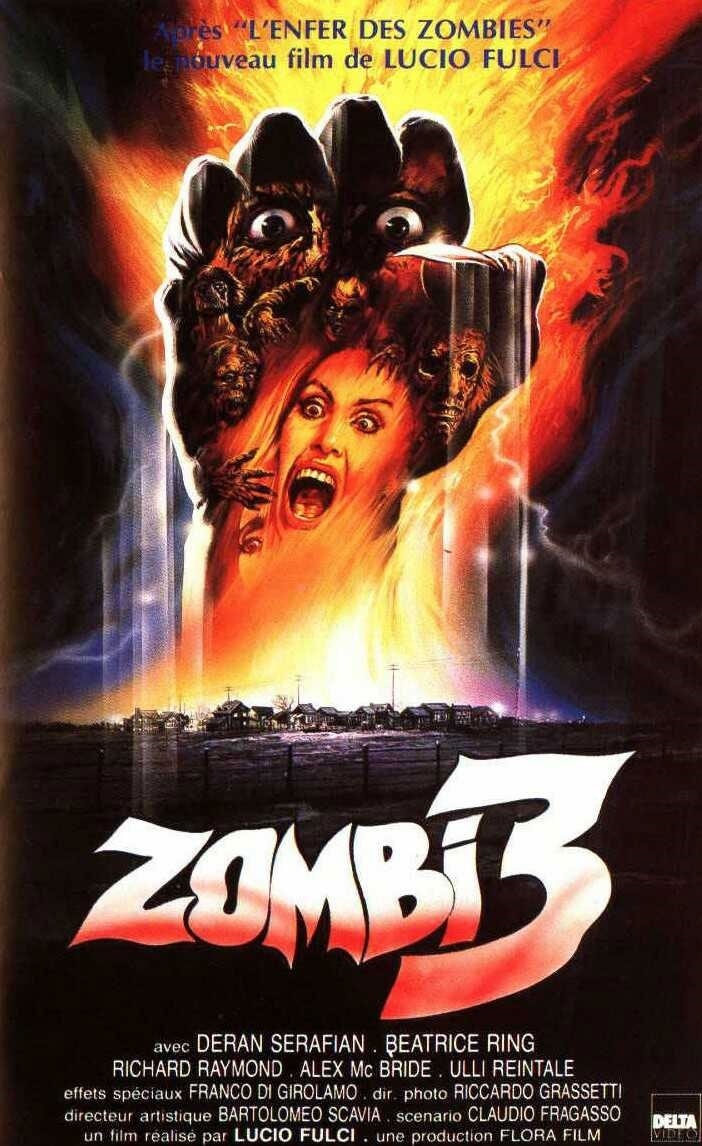
Zombi 3 aka. Zombie Flesh Eaters 2 (1988)

From https://lastroadreviews.files.wordpress.com
/2012/10/20121012-162213.jpg
Director: Lucio Fulci (with Bruno Mattei and Claudio Fragasso)
Screenplay: Claudio Fragasso
Cast: Deran Sarafian (as Kenny); Beatrice Ring (as Patricia); Ottaviano Dell'Acqua (as Roger); Massimo Vanni (as Bo); Ulli Reinthaler (as Nancy)
A Night of a Thousand Horror (Movies) # 25

Synopsis: A military project to resurrect the dead, a chemical contagion called Death One, breaks out into the public and even when the military themselves deal with it, their method of disposing of one of the bodies both makes the contagion stronger and spreads it over a wider area through the smoke created. In the midst of the resulting chaos and attempt to clamp down on the new epidemic, a group of soldiers, friends caught by the contagion infecting the wildlife, and a woman called Patricia (Ring) with her infected boyfriend find themselves having to survive the rampaging zombie hordes and the military trying to cover it up violently.

Zombi 3 is as much effected by your attitude to its production history as much as the content itself. At this point the Italian genre industry was in severe decline in the late eighties, though considering my opinion on this film, it wasn't that bad if you could still appreciate the cheese factor, the likelihood that whilst the industry could still churn out films it couldn't survive by the nineties, killing it off (sadly) to this day baring an occasional film getting into international festivals. Zombi 3's history is interesting in itself, and that's not even including the (unofficial) sequels to this afterwards that weren't necessarily even zombie films. For those that don't know, George A. Romero's Dawn of the Dead (1978) was co-produced by Italy in the midst of their genre renaissance,  recut for Italy and dubbed Zombi, doing extremely well and leading to an unofficial sequel called Zombi 2 (1979), known famously as Zombie Flesh Eaters in the UK. Made by Lucio Fulci it did extremely well around the world and lead to a boom of Italian zombie films into the eighties. By the later eighties there's not even that many zombie films in existence, barring one or two, from even the US and Fulci's career was slowing down as his health was declining. Fulci gets to make a sequel to his film, only for his health to be at its worse during the production shot in the Philippines, and the result Zombi 3 having to be drastically fixed to be releasable.

From http://4.bp.blogspot.com/_VXNWSr1UpT4/TI2e8ox-zjI/
AAAAAAAAE9g/mEnuWYsQkwc/s1600/Zombi+3+4.JPG
It varies how much Fulci actually shot for final work, but at least fifty minutes or so of what is seen is his work, the other thirty minutes having to be made in collaboration with screenwriter Claudio Fragasso and his longstanding colleague Bruno Mattei, having worked together many times before in the early eighties. It's confusing how to judge what was Fulci's work or not, as a Frankenstein creation of three different voices, because Fulci before Mattei even got hold of the footage decided to make an action horror film. The result feels like an odd sequel to one of Mattei's Strike Commando films with Reb Brown fighting zombies, a more manic tone as you have characters having to actually run away from an occasional undead who can run, alongside Return of the Living Dead (1985) enough evidence that the argument about whether zombies should run or not is pretty pointless even in terms of the historical canon of these films.

From http://i96.photobucket.com/albums/l171/kbegg/
reviews/zombi%203/zombi3cameos-1.jpg
Some of the old Fulci magic is still here, his obsession with fog machines and bold colour lighting reminiscent of his best horror films with their ominous moods; particularly with this film transitioning from a grimy Vipco release version I first saw to Blu-Ray quality, it's amazing how good the film looks despite the late eighties being when the money was bleeding out of the Italian film industry. What's a flaw is that it's not remotely scary or eerie, not even haunting or visceral like other Fulci films, instead the entertainment to be found in its various bursts of energy that defy the fact Fulci was violently ill during the entire production. Famously Zombi 3 is known for the zombie head in the refrigerator scene - utterly silly but succeeding by not caring about logic whatsoever - but there's plenty of manic moments throughout the film to like. Such as a zombie failing a machete about with surprising intensity or a gruesome, nicely set up shock with a pool of water behind a motel. Then there's the truly bizarre sequence, never evoked again in the narrative, of birds dying and coming back from the dead as zombified contagion carriers, clearly part of Fragasso's obsession with ecological issues throughout the film but a truly strange moment from Italian genre film history that, in hindsight, is one of the few cases of a zombie film showing non-human entities being infected.

From http://www.ivid.it/fotogallery/imagesearch/images/
zombi_3_deran_serafian_lucio_fulci_007_jpg_binb.jpg
The film does have a rollercoaster structure in terms of when its well paced and when it suddenly staggers along like a drunken men, its history visible in how messy the pace is, but when its paced well its amazingly swift in how the scenes play out. The other thirty or so minutes of Zombi 3 had to be built on by Claudio Fragasso and Bruno Mattei which is a lot of this reason. I once made a very cruel opinion of them, worse having barely seen the films of theirs, that they were amongst those responsible for killing the Italian genre industry. A lot of that was from suffering through the latter's Cruel Jaws (1995). Nowadays its clear they were working filmmakers who find themselves in the position of not being amongst the best (Dario Argento, Fulci, Mario Bava, even someone underrated like Enzo G. Castellari or Sergio Martino) but gaining a personality and reputation from their more infamous work, people who made films but were between them more drastically effected by their budgets then most and with Mattei notorious for using other people's material. Fragasso here at least comes off as an entertaining screenwriter who never feels boring, from the zombified birds to something he openly admits to taking from the carsploitation film Vanishing Point (1971), a blind African American radio DJ who is also the narrator in Zombi 3 as a strange stylistic quirk. He is, alongside Mattei, responsible for a lot of the moments, while fun, that, ironically their work to salvage the production leading to the tonal problems with additional footage of the military and frustrated scientists discussing the outbreak of Death One. The resulting footage is surprisingly naive in tone, such as the naming of the contagion written into these scene "Death One", a charm of a fifties b-movie in them which redeems them even those such scenes cause the film to loss its swift pace immediately. The other moments - action scenes and helicopter shots without the main cast - come off a lot better.

From http://1.bp.blogspot.com/-4n5Irca2UwQ/UNYeXMjnxYI/
AAAAAAAAAlc/rFmxt7M1Svs/s1600/zombi3_88_img1.jpg
Technical Details:
Not a great deal to go through as I've covered a lot of the production history already, but it's worth repeating how a Blu-Ray transfer really redeems a film many would call trash. It's not up to the aesthetic style of Zombi 2 but it's still distinct, its Philippine locations and tropical look giving it some distinction alongside the late eighties aesthetic.

The music as well is worthy of mention. Yes, the main glam metal song is utter gorgonzola, memorable if just for its mid-song voice echo, but Stefano Mainetti's score aside from this is a nice dread inducing synthesiser work that makes up for the lack of scares. I'll likely uncover some of the worst Italian genre films from this period and nineties, but generally there were always bad films from the country even in the golden period, usually ones never talked about or unlikely to get Blu-Ray treatment like Zombi 3 has. Particularly against some of the terrible horror films from this era not from Italy, than this is still a bar higher in quality than I first viewed it as. Its definitely better than some of the worst of zombie cinema within the last decade if anything.

From http://monsterhuntermoviereviews.com/wp-content/
uploads/2014/08/Zombi-3-02.jpg
Abstract Rating (High/Medium/Low/None): None
Abstract Spectrum: Grotesque
In terms of their collected filmographies, this is far from the weirdest film in either Fulci's or Mattei's careers. (I haven't seen enough of Fragasso's yet to make comment). The only true disappointment returning to this, and why I hated it originally, is that it has none of the strangeness of Fulci's best films even when it came to some of his none horror films. He had a knack for the irrational in his work that was compelling and incredibly well made, of decay and the illogical, that is almost non-existent here baring the briefest of moments.

Abstract Tropes: Body Parts Used in Inappropriate Ways; Decay; Fog; Rich Coloured Lighting

Personal Opinion:
Considering my original low opinion of Zombi 3, if you accept its flaws it's still an entertaining Italian genre film. I don't find it a disappointment like before, the fact that the genre industry of the country was declining no longer an issue now especially as, when these films are getting releases you couldn't fathom just a decade ago, I release that even on their declining period films like this one are still so much more entertaining and better made than more modern horror films in the same template.