Showing posts with label Ero Guro. Show all posts

Friday, 25 August 2017

Masters of Horror Season 1 Part 6: Imprint (2006)

From http://www.kennelco.com/wp-content/
uploads/2015/06/Imprint.jpg

Director: Takashi Miike
Screenplay: Daisuke Tengan
Based on a novel by Shimako Iwai
Cast: Billy Drago as Christopher; Michié as Komomo; Yûki Kudô as the Woman
A Night of a Thousand Horror (Shows) #14

There's the obvious hypocrisy, openly humorous, how the production of Masters of Horror gave their chosen directors carte blanche to film episodes with adult content, and not only hired Takashi Miike in the first place, considering his career by than included Visitor Q (2001) and Ichi the Killer (2001), but expected him not to create a transgressive story when given the chance out creative control. Miike has done commercial mainstream horror, like One Missed Call (2003), but when he was picked because of films like Audition (1999) which pushed boundaries, it's only the production staff for the series to blame when he brought back Imprint, pulled from US cable television for being too extreme. Even with concessions - all the lines of dialogue spoken in English awkardly by most of the cast, whilst Billy Drago "emotes" as an American named Christopher in period Japan going to a pleasure island looking for a geisha named Komomo (Michié) - Miike managed to pull off a paradox in this creative freedom but going too far.

It also reveals how, when J-horror became a commodity of interest for the US film industry, something was visibly lost in translation about Japanese horror storytelling. Another perfect example of this, within this same year or so, was when Miike inexplicably cameoed in Eli Roth's Hostel (2005); seeing him phonetically say a single line of dialogue about his enjoyment of something nasty and horrible, looking like a badass in his trademark shades whilst disappearing off screen never to be seen again, you could see how off the mark Roth was making immediate mirroring of his film and Japanese horror, regardless of the level of transgression in some of them, and missing the noticeable difference between them. Whilst films have been made that are gore for the sake of gore, there's some many differences in tone and content that makes the meeting between American horror and Japanese horror confused. Japanese horror in any medium beyond the gore and weirdness has a significantly different attitude. For every one that feels like a mainstream crossover in the tone of Hollywood, even mainstream films reflect reality through horror tropes (adultery, gender politics, the plight of hierarchy) that's synonymous in Japanese culture or are far more complex in their transgressive natures by way of the types of films they've been inspired by or clear genres like Ero-guro.

From http://horrornews.net/wp-content/uploads/2010/09/imprint_pic5.jpg

The irony with Imprint is that, beyond the notorious content that got it kicked off the air, the plot's pretty standard in both Japanese horror cinema and even in the likes of Kenji Mizoguchi melodramas. If this has been an episode of a Japanese horror anthology series, it would've been a solid six out of ten.  A little disappointing from Takashi Miike when you expect better, but perfectly solid and amongst some of the Masters of Horror episodes, standing out by a country mile to many of them in terms of quality. The plot's pretty simple to an advantage, built from well aged but reliable plot threads. Christopher wants to see Kimomo again, only to meet a disfigured geisha (Yûki Kudô) who not only says his love committed suicide, but is suspicious in the exact story she tells of how this came to be as well as in discussing her own life since birth. Mostly it's a chamber piece with a Rashomon like narrative where she's not a reliable narrator, the story changing as it keeps being questioned. Kudô, in an episode which honestly has poor acting throughout it, does actually commit to a good performance, arguably amongst some of the best through the series. I was surprised to discover she's in Jim Jarmusch's Mystery Train (1989) as one of the iconic pair of Japanese, rock and roll obsessed tourists in Memphis, pleasantly surprised to see her here fifteen or so years later. That her career has spanned English and Japanese speaking roles means she's actually able to create an interesting performance with nuance to her dialogue, this the first of Miike's ill advised attempts at an all-English language film with non-English speakers (Sukiyaki Western Django (2007)), and with Kudô the most comfortable out of everyone including Billy Drago in acting in English. The story does overstuff the twist ending with unnecessary inclusions, missing the point when the geisha herself is so much more interesting than what's done. Not only is Kudô's performance enough by itself, but the reveal of the level of her deformities is enough for a story without the random additional twists included.

Another factor of worth is knowing Imprint's source material is from a female author Shimako Iwai, complicating potential accusations of misogyny with the content particularly the notorious torture sequence halfway through, more so as Iwai herself plays the torturer trying to gain information from Komomo. Iwai sadly doesn't even have real articles on her in the English interweb let alone any published work in English, more so a disappointment as the little on her Wikipedia page suggests such a fascinating figure. An authoress, pornographic director, television celebrity and essayist, the sort of figure I'd be dying to be able to read any of her work of as, particularly as Imprint is seen usually as Miike at his most nasty and transgressive, realising its from a woman's voice originally does bring more depth to an otherwise adequate entry. A story consisting mainly of the voice of a woman (Kudô's character) telling of how women like herself are sold in sexual slavery and the various plights women in general suffer as a result. Even if her geisha character commits evil acts, she's someone created from a life of misery and having had to become controller of said life to avoid this misery further, a continuation of countless narratives like it in Japanese storytelling. It actually further, in a story where women are the predominant characters and the sole male one is a weak willed listener, that Drago's performance is as ridiculous as it is, unintentionally adding a lot to the powerlessness of Christopher in how wooden and hysterical the performance is.

From https://images-na.ssl-images-amazon.com/
images/M/MV5BN2YzYzBjMzMtZTE1NS00N2Qx
LTg2YmYtY2M5MWYxZjFmNjExXkEy
XkFqcGdeQXVyNTAyODkwOQ@@._V1_.jpg

Lastly, it's interesting for a series that I've mainly ignored the production side of the episodes, as it rarely stands out, that Imprint does stand out particularly in set and costume design. Costume designer Michiko Kitamura stands out immediately with her work giving a deliberate artificiality and sense of colour found in Japanese horror rare in Western stories, just in differing Yûki Kudô (even in the dyed colour of her hair) with blue against the other actresses playing geishas or the brothel Madame in stark red. Having the cinematographer of Gohatto (1999), Toyomichi Kurita, doesn't hurt either. Nor the general production, (be it art, production or set design), where as a period piece in stands more noticeably out than the other period stories in the series just for little touches which catch the viewer off guard. How, even when the disfigured geisha's childhood is retold with even more taboos on display, the shack she grew up in has colourful paper windmills on sticks in every version nearby in a dirt mound. For all the problems with Imprint, especially in its plot structure, it still manages to be more rewarding than other episodes because of this. Miike, even when he drops the ball, usually still creates a film of interest and only rarely in his insanely prolific career makes something completely unwatchable. This could've been a lot better, which is disappointing as one of the those die-hard fans of his, but it's in a class of its own to other Masters of Horror episodes not just because of it being the only banned from air time. 

From https://images-na.ssl-images-amazon.com/images/M/MV5BZWQzNDFlNmItZDE0MS
00OThiLTg4MjEtMmQyOTcyMmY5MjA5XkEyXkFqcGdeQXVy
NTAyODkwOQ@@._V1_SX600_CR0,0,600,337_AL_.jpg

Monday, 17 October 2016

Halloween 31 For 31: Midori (1992)

From http://www.trashmutant.com/uploads/1/0/9
/8/10984559/5197948_orig.jpg
Director: Hiroshi Harada
Screenplay: Hiroshi Harada
(Voice) Cast: Minako Naka (as Midori); Norihiko Morishita (as Wonder Masanitsu); Keinosuke Okamoto (as Koijirô Arashi); Kazuyoshi Hayashi (as Akaza); Yoshifumi Nomura (as Muchisute)
A Night of a Thousand Horror (Movies) #41
A 1000 Anime Crossover

Abstract Spectrum: Grotesque; Psychotronic; Weird
Abstract Rating (High/Medium/Low/None): Low

Midori is an infamous work, an animated adaptation of Suehiro Maruo's ero-guro manga Mr. Arashi's Amazing Freak Show (1984), where a young girl finds herself trapped as part of a travelling carnival freak show in nineteen twenties Japan, created by one man, the former industry animator Hiroshi Harada who became an underground filmmaker. The result here of years of hard work is split into two divisive halves. The first is the most transgressive, responsible for this film's notorious reputation, a variety of horrifying yet lovingly drawn images of the worst in humanity, mainly still images with bursts of fluid movement, realistic but with incredibly detailed colour and exaggerated carnival characters with various bodily deformities and distinctions.

The bookending experimentation with surreal narration and the second half, when salvation is available for the heroine, is where Midori crosses into the abstract, a fully formed short length narrative which becomes more coherent and interesting but one which is immersed in the experimental style the film from the beginning has. From the dream sequences to the body horror to scenes such as a character called Wonder Masanitsu, a dwarf magician with mesmerizing abilities, causing a mass hallucinatory freak-out on an unsuspecting audience, the animation has a creepy, unreal tone added to by music by J. A. Seazer and Hiroshi Harada's expert craftsmanship as an animator.

Personal Opinion:
For the full review of Midori, follow the link HERE.

From http://images.tcj.com/2013/05/63cbe79e-f21f-44d5-
9df0-3f08a9b834fe_zpse3fa25e5.jpg

Tuesday, 15 March 2016

Blind Beast (1969)

From https://s-media-cache-ak0.pinimg.com/736x/18/
b1/d7/18b1d7688455900c8525df4dd267b49c.jpg
Director: Yasuzo Masumura
Screenplay: Yoshio Shirasaka
Cast: Eiji Funakoshi (as Michio Sofu); Mako Midori (as Aki Shima); Noriko Sengoku (as Shino)

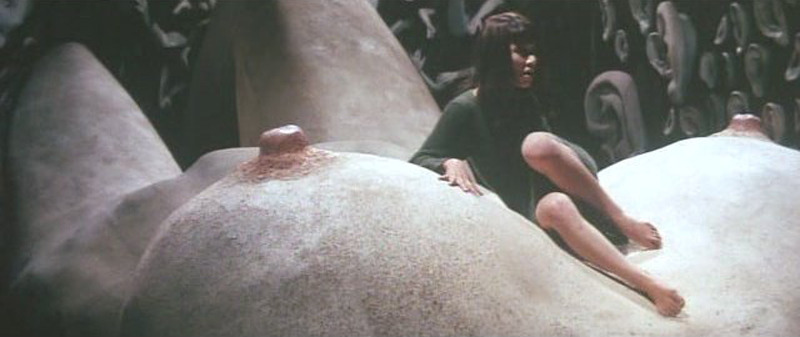
Synopsis: After posing for a series of erotic photographs and installation pieces, model Aki Shima (Midori) catches the attention of a man named Michio Sofu (Funakoshi). Blind since birth, with his mother Shino's (Sengoku) help he kidnaps Aki while posing as a masseuse, taking her captive in their home. Inside his studio as a budding sculptor, a shrine to the female form and its individual body parts depicted in sculpture, he desires to create art for the blind by the blind, Aki the most beautiful woman to him from touch and form, desiring to use her as his subject even against her will. In a studio with giant prosthetic limbs on the walls, from a wall of eyes to a wall of breasts, and two giant depictions of the female in the centre, Aki attempts to escape by manipulating his naivety with actual women, only to set off what will lead to the ultimate pleasure and the ultimate pain.

Ero-guro, or under its full title erotic-grotesque-nonsense ("ero guro nansensu"), denotes an artistic style that on opposite sides of the same coin the sensual and the horrible exist within the same moment. This could be a troubling artistic for some especially with modern standards of political correctness with its fetishisation of death and sex within one another but at the same time, fitting the apparent paradox of the concept, it could as much fit modern standards of attitude in the acceptance of such concepts and growingly accepted sexual fetishes such as S&M, only taken to its most extreme as fantasy pieces. The most important part - in manga, in music, in art - of this Japanese aesthetic style, as with body horror and transgressive styles from other countries, is that in its perfect state, the ideal, it's not an exhibit for misogyny or crass depictions of atrocity and perversion but depictions of sex (Eros) and death (Thanatos) which purposely cause reactions to provoke the viewer and is inherently gender neutral. Even if it's still offensive to some, the ideal version of ero-guro-nonsense for myself as a fan would be indiscriminate to gender, an equal opportunity aesthetic for male and female audiences to take reactions from without a bias in the content.

From http://4.bp.blogspot.com/-dBiI99q8ZOw/TsgwaSIhaEI/AAAAAAAACnM/
-f6Ykt_RjQA/s320/Yasuzo+Masumura+-+M%25C3%25B4j%25C3%25BB+%2528
Blind+Beast%2529+%25281969%2529.jpg
The other important factor, which Blind Beast also shows, is that it's not necessarily gore and intestines being thrown about that's ero-guro, something that becomes apparent even as an amateur in my knowledge of another culture's aesthetic concept. Deformity, the unnatural and the strange can qualify, which could also be used to disrupt views and biases in social contexts such as disability, something which as a style suited for horror could have a lot of great potential for provoking thought as well as pushing the bar in terms of squeamish content. It evokes as much films like Takashi Miike's satire Visitor Q (2001) as much as straightforward disturbing horror movies and comics. It is also important to note, if I'm to learn how to quote the term ero-guro properly, one individual whose published work is on my reading list and is central for the term, the legendary author Edogawa Ranpo. Ranpo, it must be stated, was famous beyond this genre, writing anything from children's stories to detective tales, all of which including his more grotesque material being adapted or referenced throughout Japanese pop culture. Teruo Ishii's infamous Horrors of Malformed Men (1969) is a great place to start just for trying to cram as many of his more infamous short stories into one narrative as possible, enough in its madness to encourage anyone to find any English translations of even his more sombre, audience friendly penmanship. 

From http://farm4.static.flickr.com/3162/2875409777_d5b66922da_o.jpg
A chamber piece - only three actors, minimal number of sets and the most elaborate, Micho's studio, a single giant warehouse - Blind Beast does exemplify the high artistic quality of even the most lurid of Japanese genre films between the sixties and seventies. Like the best of Italian cinema within the same era, there's a general technical quality that sets a good, competent base with the artistry helping with the story and content immensely. Very professional and talented individuals worked on these films with the best ones, like with the Italians, with no difference between sleaze and art in terms of treating it with the same level of professionalism. This is vital as Blind Beast is still incredibly strong in content, not as explicit as other films from the era but still surprising through subtle emphasis instead, the high artistic quality a necessary for this to have worked. A huge factor as to the best of ero-guro in what I've encountered is not the strength of the content in terms of visceral shock necessarily but strong artistic quality; these tales, despite their depravity and perversions, suit scenarios that provoke elegance, sensuality and high art because of their melding of two seemingly different attitudes, needing either a bold visual richness and/or period trappings such as samurai stories or the 1920s setting of pinku softcore film Marquis de Sade's The Prosperities of Vice (1988). Blind Beast is grim and grimy in places, of blood and food left to rot, but in a darkened environment for most of its mere eighty minute run there's still a tranquil tone to the content despite its transgressions.

From http://s3.amazonaws.com/auteurs_production
/images/film/blind-beast/w1280/blind-beast.jpg
The film's plot is exceptionally dark in content, more so in this decade, though while it includes risky content, such as Aki falling in love with her captor from force, the right balance of the transgressive subject matter means its equal opportunities transgression as ero-guro should be with both genders, where as a pulp sex horror story it's a cycle of the man and woman eventually becoming the equals. It avoids potential gender discrepancies and stereotypes which can affect work like this - see the Hanzo the Razor trilogy, which director Yasuzo Masumura made the first sequel of, for a more problematic example - as Aki manipulates Michio as much as he breaks her down, eventually both of them becoming sightless beings who can only communicate to each other through physical sex, eventually needing pain to be inflicted on each other for a greater sensual thrill.

From http://2.bp.blogspot.com/_pTvIRwDJyBs/TJLbc_ZmpcI/AAAAAAAAAFM/
0x4ochkMjl8/s1600/vlcsnap-2010-09-16-23h01m18s133.png
Taking its twisting little story seriously, the build up to this finale is entirely based on Michio's likely virginity and lack of knowledge of women beyond touch. The giant prophetic bodies, which the two lead actors have to crawl past and onto continually, are the infamous part of the film but significantly they also state his distance from actual femininity. Whilst his beloved sense touch lead to him, through his mother's help, to being able to touch women intimately and replicate their bodies in elaborate and accurate detail, his complete and utter lack of knowledge of female sexuality and women beyond his doting and protective mother becomes his hindrance, one which Aki can take advantage of to escape. Though he does dominate Aki and eventually rapes her at one point, starting their relationship after, immediately onwards from this act they switch between the dominant and the submissive continually with no gender being superior in their violence sexual passions, both equally lost writhing around their environments both suffering from their wounds given to each other but also thrilled by them. A triangle in the early part of the film between them and his mother is blatantly oedipal as well, thankfully because of the film's brisk length cutting out the need for teasing the fact; its explicitly said as, seeing the giant female bodies in the centre of the studio, Aki not long afterwards makes a comment about Michio having some form of obsession with when he was a baby held at his mother's breast. This builds up as much a strong issue of gender and relationships being skewered in its small story that prevents the film becoming tasteless without any justifiable reason behind such content.

From http://3.bp.blogspot.com/_pTvIRwDJyBs/TJLbiocYK3I/AAAAAAAAAFc
/tTCcTn8lNFg/s1600/vlcsnap-2010-09-16-23h03m01s194.png
Technical Detail:
The only thing that might've been interesting to see differently in terms of the aesthetic look is if Blind Beast was shot in monochrome rather than Daieicolor approved colour. Screenshots and posters exist that show the film in black-and-white that would've been incredibly bold if you had seen them moving, causing one to wonder whether the visual difference would have had a drastic effect on the mood especially in terms of the story's tone. Yasuzo Masumura would be as gifted in either case, the film as it stands perfect as it is; he was probably one of the only, if the only, Japanese directors to have been able to learn his craft at the Centro Sperimentale di Cinematografia in Italy with the potential likes of Michelangelo Antonioni, Federico Fellini and Luchino Visconti as teachers. The same level of quality to his more sombre World War II drama Red Angel (1966) is found here in Blind Beast, and can even be found in his own aforementioned Hanzo the Razor sequel.

The music is also memorable in terms of the combinations of genres used for effect. From jazz to classical pieces, it mixes and matches aptly for the shifts of tone in the story well. Sound is important especially for the final scene, metaphor with what you, the final grim act of the film only seen implied, the main star's ultimate act of destructive pleasure given a spine tingling edge that's still strong today from what you only hear. So strong in fact, watched on the same day with a modern film (Eli Roth's The Green Inferno (2013)) with over the top gore, that Blind Beast was the one instead that made me cringe more in its suggestion.

From http://40.media.tumblr.com/tumblr_mco6ueFcl51r7k0eco1_1280.jpg
Abstract Rating (High/Medium/Low/None): Medium
Originally this was going to be a "Low" due to how subdued and naturalistic the film is in contrast to its subject matter. However it's easy to ignore, when you've made a diet of films like this, how strong it would be to someone who hadn't encountered films like it before, how startling it is or scuzzy it is at times. Maybe even how absurd and silly it is, as the film openly courts being bizarre for the sake of it despites its clear themes. There's a more explicit and usually more honest viewpoint on the corporal living body in a lot of Japanese pop culture, which is scrutinised with only some censorship in what can be depicted, (mostly in terms of censoring genitals and pubic hair on both genders), but also in context of non physical notions such as sexuality. This would be more of a shock, let alone more profoundly weird, for a first time viewer, particularly as despite being limited in what actual content is seen, what is implied is still strong material in its frankness to digest.

And of course you're dealing with a psycho sexual drama mostly set in a room full of giant, prophetic breasts and arms, lovingly rendered in all shapes and sizes, sticking out of the walls with two individuals writhing around the floor in a state of delirious pain on the lap of a giant, headless woman. That's an image that's strange even for a veterans of this type of cinema and original still to this day.

Abstract Spectrum:  Grotesque/Psychotronic/Weird
Abstract Themes: Distortion and Emphasis of Boyd Parts; Giant prophetic limbs; Mutilation; References to Disability; Oedipal Complex; S&M and Sexual Fetishes; Bondage

From http://3.bp.blogspot.com/_pTvIRwDJyBs/TJLbkON-XGI/
AAAAAAAAAFk/nRvNn82rYxM
/s1600/vlcsnap-2010-09-16-23h03m24s90.png
Personal Opinion:
A real gem of Japanese body horror cinema, immensely stylish and imaginative in its concoction of body horror and drama which can be both treated as a serious, sombre drama but also a perverted erotic film. This blurring of the high and low art is also a factor of the rewarding of ero-guro I've been able to see; while it may seem wrong to find virtue in films like this that reveal in this type of content, and there are probably examples which are just tasteless that I'll thankfully not see, not only does it prove to be more rewarding to do so, but the quality of the best also brings out a real sincerity found in them. The obvious issue that my knowledge on this type of work is limited means that I need to take a film like Blind Beast as an example of learn what ero-guro should be as an aesthetic style in greater detail. It also means that something like this is much more cooler, the right term to use, and memorable as a cult film as its far removed from the words "safe" or "digestible". 

From https://elgabinetedeldoctormabuse.files.wordpress.com/
2010/06/moju-10.jpg?w=620

Wednesday, 10 September 2014

Blind Woman's Curse (1970)

From http://38.media.tumblr.com/1e2abc6d8bce2ca52f98ab0bca98f665
/tumblr_mlgepb80tT1qaz1ado1_1280.jpg

Dir. Teruo Ishii

It was fateful when the producers requested directed Teruo Ishii and co-screenwriter Chûsei Sone add a ghost cat subplot to their samurai film, as it was already being shot, drastically effecting full narrative cohesiveness. It's a testament though that the film it's director himself called 'nonsensical' still wraps together as a great genre film. In a gang-on-gang battle, leader of the Tachibana gang Akemi Tachibana (Meiko Kaji) blinds the sister of the other gang's leader mid-duel, a black cat appearing to lick up the victim's blood thus cursing Akemi. Along with this curse, a rival gang, through a traitor, intend to take over her territory, leading to desired revenge, murders and a carnival freak show. Blind Woman's Curse is one of the weaker Japanese cult films I've seen from the seventies or so, if only because I have to compare it to the best from Japan that I've seen. It's second or third tier, but it's still unbelievably well crafted and superior in comparison to others. This can be said with confidence considering that, barring the fact that the ghost cat subplot doesn't really make sense, the 'nonsensical' film is far more rationally explainable than you'd think. Certainly nightmarish and peculiar, with its house of horror moments and gore, but it's paradoxically awesome that Ishii viewed this as the nonsensical when his own, and superior, film Horrors of Malformed Men (1969), is utterly bizarre.

From http://www.rockshockpop.com/screencaps/BlindWomansCurse/01-1.jpg
What stands out the most with the film is that it's various pieces, whilst able to connect together, do also stand out individually. Everything is beautifully shot, like the opening sword battle, an eye for rich colour and setting, an air of artifice, bold throughout. The sword battles have considerable weight, added to by the traditional water hose pressure levels of bloodletting in the practical effects. The gang against gang ploy is interesting, of scuzzy villains and scuzzier goings-on with opium drugged, half naked women laying around outside the main villain boss's bedroom, another room just designed as an elaborate death trap and almost everything being shot in gel colour psychedelic lighting. The really memorable things are those that, ironically, were introduced as a result of the ghost cat having to be added to the narrative or fit together with it in the plot. Not only do you get to see an obviously fake cat being pulled along in a graveyard at one point because of this, but whilst a samurai film at heart, it leans greatly into horror cinema. It edges closely to the ero guro, erotic grotesque as critic Tom Mes believes the film does 1. The inspired motif of the dragon tattoo Akemi's gang has, she with the head and others with the fragments of one larger work, is given an added nastiness involving skinning of certain victims. The carnival that the blinded woman of the title getting revenge (Hoki Tokuda) and her hunchback assistant (Tatsumi Hijikata) are part of invokes Horrors of Malformed Men completely, bringing you images of a old man cooking fake limbs and dolls in a giant pan, bandaged and half naked "mutants", a woman as an improvised roof decoration and a severed head gag that strangely evokes Scooby Doo. Yes, it feels abrupt and along with the ghost cat plot feels bolted on, but it certainly adds an edge to the material, especially as the desire for revenge Tokuda 's character Aiko Goda  has against Akemi, ending the film with a sword duel under incredible twilight, vortex-like clouds in a night sky, does fit into the narrative very well.

From http://www.dvdactive.com/images/reviews/screenshot/2014/
3/blindwomanscursebdcap4_original.jpg
Surprisingly Meiko Kaji is off-screen for a large amount of the film, her first main role, but that doesn't stop her from being a charismatic lead who has made her reputation in cult cinema for justifiable reasons, able to emote with immense passion for dramatic scenes, to show sadness, to show joy, and as with the Female Prisoner Scorpion movies, show a death stare that looks like she can rip a man's throat out in a way that would make Sonny Chiba cower from her, let alone slash them up with a blade.  She's backed up by actors into the heroic leads that are just as charismatic. Makoto Satô as the main heroic lead so laidback that he can casually block a person without breaking a sweat or change his expression. A comedy male sidekick who lusts after the women and openly makes comments about his giant set of front teeth in a sword battle, looking like he could bite someone's head off with them whilst using a blade with skill at the same time, interacting with Akemi's fanclub of women who will gladly die for her like a lustful teenager they are apathetic to. Butoh dance founder Tatsumi Hijikata gets another role here, while significantly smaller than his main role in Ishii's Horrors of Malformed Men, as a hunchback ally to the vengeful blind woman, bringing the clear influence of his own dance ideology to his character's movements and behaviour whilst contributing to the more ghoulish aspects of the narrative strands narratively. Even a character who has no point for said narrative, like the one played by Ryôhei Uchida, is memorable, both for the fact that a man in a bowler hat, gold buttoned vest and wearing only a red thong under the waist is incredibly memorable, but also because the actor makes the character a suitably amusing comedic character everyone can smell from a distance and is not as able to back up his threats as physically as he says verbally. No one in this film, nonsense or not, can be said to not be interesting at all.

From http://37.media.tumblr.com/ac7f7fc7cf58c15073daf12646ab127c/
tumblr_n7xo9cOjS41qmemvwo1_500.jpg
Blind Woman's Curse is still pretty unconventional for a samurai film from what I've viewed. It's narrative is awkwardly put together on paper, but it viewing it this is not the case, the moments that don't add a spice that adds to its qualities. As literally happens, you go from a scene of two people being sent back to Akemi's gang in caskets, everyone saddened, followed by one of their members suddenly jumping into shot claiming to be possessed by a ghost cat and smashing his head into a window, with suitably green, eerie lighting for effect. It makes no rational sense, but the great thing about Ishii's film is that the samurai content is sane enough to balanced out the unrational material like this perfectly, thus giving you your good pulp narrative and the purely lurid at the same time. The entire film is put together perfectly, looking like a lurid coloured, horror film, set in its own world.

From http://stigmatophiliablog.files.wordpress.com/2014/05/
vlcsnap-2014-05-15-18h40m18s25.png
Abstract Rating (High/Medium/Low/None): None
It is a strikingly unconventional film, but it's surprising that Blind Woman's Curse, which has its moments of lurid content, does fit together it's various pieces snugly enough to not really feel abstract enough for the list. It is not Horrors of Malformed Men - as perverse, strange or liable to still be suppressed from being seen in its home country - and won't be added to the list for this reason. It creeps towards it at points, especially with moments as a character coming back from the grave in a very macabre way, but not enough.

Personal Opinion:
The film itself is utterly entertaining. In a moment where a song plays over images of contemplation, I thought "Yeah, I really like this film". Just because it doesn't reach the madness of the other film I've seen by Teruo Ishii doesn't mean it's not a great film itself. Together with it, it does make Ishii's other films very enticing for me to see. And it's more enticing as, while not that nonsensical, Ishii could make a film that was forced to abruptly add a supernatural plot line during the production of it and still make something that wraps it all neatly together. That the moments that don't nonetheless add a delirious edge to the proceeding content makes it more memorable.

1From the accompanying booklet for the Arrow Blu-Ray/DVD Release