 |
| From http://www.vanessasnonspoilers.com/wp-content /uploads/2018/08/Under-the-Silver-Lake-Poster.jpg |
Director: David Robert Mitchell
Screenplay: David Robert Mitchell
Cast: Andrew Garfield as Sam, Riley
Keough as Sarah, Topher Grace as the Man at the Bar, Laura-Leigh as Mae, Zosia
Mamet as Troy, Jimmi Simpson as Allen, Patrick Fischler as the Comic Fan
Synopsis: Sam (Andrew
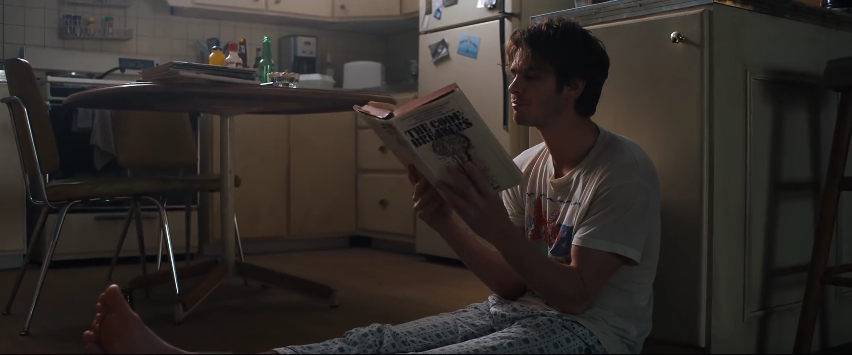
Garfield) is a slacker who becomes fixated on his new female neighbour Sarah
(Riley Keough), only for her to
immediately vanish. His search for her across --- Los Angeles will include the
King of the Homeless, conspiracies, a serial killer of dogs, and codes in
Nintendo games.
 Well, at least David Robert Mitchell was ambitious,
which is not something you say a lot when, frankly, most American directors
(and some beyond the States) when they have just made something interesting now
get sucked into blockbusters with no creative control in the slightest. It's a
view easily bias to how Under the Silver
Lake is absolutely indulgent and not without faults, but God only knows how
many filmmakers, when they've done well even in art house cinema, tend to now
go for the blandest and predictable of routes with their newest films too. The
comparisons to Richard Kelly have
been apt - Kelly gained a reputation
for Donnie Darko (2001), less when
it actually debuted theatrically but from word of mouth, the follow up the
notorious Southland Tales (2006). Tales was even more ambitious, comic
book prologues and all tied in, and was also debuted at the Cannes Film
Festival as Under the Silver Lake was,
getting a good thrashing between them. Time is looking to potential give Southland Tales a chance, but Under
the Silver Lake's too young to start asking about this.
Well, at least David Robert Mitchell was ambitious,
which is not something you say a lot when, frankly, most American directors
(and some beyond the States) when they have just made something interesting now
get sucked into blockbusters with no creative control in the slightest. It's a
view easily bias to how Under the Silver
Lake is absolutely indulgent and not without faults, but God only knows how
many filmmakers, when they've done well even in art house cinema, tend to now
go for the blandest and predictable of routes with their newest films too. The
comparisons to Richard Kelly have
been apt - Kelly gained a reputation
for Donnie Darko (2001), less when
it actually debuted theatrically but from word of mouth, the follow up the
notorious Southland Tales (2006). Tales was even more ambitious, comic
book prologues and all tied in, and was also debuted at the Cannes Film
Festival as Under the Silver Lake was,
getting a good thrashing between them. Time is looking to potential give Southland Tales a chance, but Under
the Silver Lake's too young to start asking about this.
Mitchell's journey is curious as, three films in when Kelly's was just a debut before he got
to Southland Tales, he started with
an indie The Myth of the American
Sleepover (2010), then suddenly got a surprise hit by entering the horror
genre, It Follows (2014) getting a
lot of traction. So he decides to take his chips accumulated and gamble them all
on this two and a half hour neo-noir pastiche which gets through so many weird
tangents I don't know when to begin. Definitely, absolutely, the legacy of Thomas Pynchon is growing even outside
of literature into cinema - amazingly, there's only been one official Pynchon adaptation in Inherent Vice (2014), but filmmakers
like Mitchell have instead appropriated his style of numerous tangents and
conspiracies interweaving into each other, loose ends, eccentrics and a lot of
pop culture. Under the Silver Lake,
whether you like it or not, is surprisingly faithful to his style even if by
accident, even the length befitting some of his monolithic tomes like Gravity's Rainbow.
Mitchell's film is strange, a farce to be honest whose central
figure, an obsessive compulsive conspiracy nut and slacker, is inherently a
dick, who indulges in his old Playboys and Nintendo Power magazines, and is a
peeping tom who gets distracted by eyeing up women. Andrew Garfield imbues him with some charisma, but he's having sex with
an on-and-off-again girlfriend whilst having women's tennis on the television
at the same time, beating up children for vandalising his car the next. The
voyeurism has put people off with the film, and I'll admit that whilst we get
to see Garfield's bared arse a lot
for balance, the amount of female nudity is not helped by how the female
characters really blur into each other; its far more problematic than the
nudity itself, or that our protagonist thinks with his smallest head too much,
or that it's roping in noir tropes of mysterious femme fatales. And Mitchell does make it clear he's flawed,
a little pathetic, even sprayed by a skunk for a lasting plot effect, even
having a voyeuristic scene involving a drone deliberately being a challenge to
the viewer when the woman being spied on in a screen on screen is in tears.
Sympathy is to be had for him as
much as failure, the film a long journey for him to potentially grow. A weird
journey, crammed to the point it's wrong to follow the story as a concise one
but, like Pynchon, a tangent factory.
LA here is a place of odd events and mysteries, just from the outset with a
squirrel dropping to its death off a tree in front of our lead and (visibly a
puppet) gasping in a way that's sickly humorous, an immediate warning Under the Silver Lake is going to get
silly on purpose. Independent comics talk of a spate of dog serial killers and
killer owl women, that the secrets of the city can be found in an old fifties
cereal's game on the box, or how the elite and rich are naturally getting up to
hysterical hodgepodges out of boredom. The only sane ones, or in a way in
control, are naturally the homeless or coyotes. The fact I first though the
film was set in the nineties, because of the strange logic gap where our lead was
able to see Kurt Cobain but is still
young, does also suggest that, eventually, the nostalgia for the eighties is
finally going to be punted off the throne in favour of a much more interesting
and weirder nostalgia that is the nineties, where Cornershop is on the soundtrack side-by-side with R.E.M.
It's also, dangerously, riffing
on the past whilst constantly undercutting it as being merely a distraction. It's
an odd paradox that it gets a lot of humour from even a help guide for a video
game being actually of importance, but that we also encounter a master
songwriter who undercuts any sense even the most rebellious of pop culture is
of actual subversion if it's mainstream. It comes off as bleaker, as a film,
than anything I've yet read of Thomas
Pynchon, and does show the real issue I have about Under the Silver Lake for all my enjoyment of it, a second viewing
allowing any clouding of judgement to take place, that Mitchell's visibly crammed numerous obsessions together but the
underlying idea that should tie it all together isn't cognitive enough. Even a
much weirder, scattershot experimental film would at least lean on atmosphere
and dream logic more, whilst Under the
Silver Lake still plays out as a quirky mystery.
This also includes some of the
mysteries and conspiracies as well, playing off coincidence or just an insane
amount of planning for a New World Order to make reality - it does make an
argument that such a conspiracy doesn't make sense in real life, due to how
chaotic on a large scale it would be, unless one takes the idea that it's as
shambolic of everything on the surface or that some really coordinated calculations
make us all sheep. Either way, going for the obvious like the sexual
suggestions of advertisement and such parts are the weakest moments in Under the Silver Lake, "duh"
moments no way near as simple and crisp as when They Live (1988) just had signs everywhere, black text on white,
just telling us all to marry and procreate.
This is more so as a lot is
brought in - silent cinema, Hollywood itself, hobo sign language, fifties
culture, and poignantly sixties and seventies cults alongside the type of
modern art performances you'd get now. The centre of this film is, arguably,
that nothing is resolved, which is a huge risk to take - details, without
spoiling anything, allow for interpretation, such as Sam carrying dog biscuits
and having dreams of women literally barking at him, or how the owl woman's
identity is resolved. (Then there's the caged bird whose one word he says everyone
including the viewer is trying to figure out). It's as much this why I liked Under the Silver Lake immensely, but I
will be the first to throw out (if it hasn't already) that even Southland Tales, the notorious film
it's compared to from a decade earlier, was at least circling the idea of how
mad, chaotic and strange America had gotten and exaggerated it in terms of a
plot. Whilst it took multiple viewings to get and love the film, which it at
least went a direction with progression. Here, aware of its clear leanings to
the idea of lack of resolution, or that the final scene at least has Sam
finding a serenity seeing the apartment he's about to be evicted from through a
new light, it was a gamble that a few people didn't like to be a lot more
vaguer in terms of plot expectations.
A lot of this is as well why the
languid pace and sense of nonsense is a good thing for Under the Silver Lake, less a mystery in the conventional sense but
an Alex in Wonderland tale of Andrew
Garfield encountering strange figures. A literal layabout, a semblance of (legitimate)
skill to be a good detective when he's actually focused, but he's lead on a
wild goose chase that we follow as confused as he is. This is the best way to
view the film, and thankfully, it's a well made accomplishment technically to
work in this direction, right down to the funny end credits animation. Bright,
colourful and vivid in a way that's drastically different from It Follows. Disasterpiece, who made his name known to the public conscious
through his score for that earlier work, comes with Mitchell here too and also takes a new direction, an orchestral
score which does riff on Bernard Herrmann's
work with Alfred Hitchcock but has
its own playful richness to it.
Abstract Spectrum: Playful/Weird
Abstract Rating (High/Medium/Low/None): None
Personal Opinion:
The resulting film's a divisive one
even for a defender like myself, just for the fact that it's decision to be a
maximalist work in detail, but ensue a primary theme, is going to cause a lot
of misreading or confused ones over multiple viewings. There's also just the
fact it's a director going into his foibles despite the mystery/noir genre
suggesting there'll be a conclusion at the end of everything.
What is there though, beyond
this, is still a playful, very funny and sometimes poignant work. A brave risk
which was worth taking, but what David
Robert Mitchell is going to do next after this one is up in the air now.
 |
| From https://ilarge.lisimg.com/image/16416730 /852full-under-the-silver-lake-screenshot.jpg |


