Showing posts with label Sexploitation. Show all posts

Saturday, 8 January 2022

Teenage Tupelo (1995)


Director: John Michael McCarthy

Screenplay: John Michael McCarthy

Cast: D'Lana Tunnell as D'Lana Fargo / Topsy Turvy; Hugh Brooks as Johnny Tu-Note; Wanda Wilson as Wanda Fargo; Kristen Hobbs as Franky; Dawn Ashcraft as Joey; Sophie Couch as Ruthy; Phillip Tubb as Pookie Fargo; Nancy Taylor as Mildred McCarthy; Edd Hurt as John McCarthy

An Abstract Candidate


We have a curious title here - produced by David F. Friedman, the exploitation producer behind many sixties softcore films and Herschell Gordon Lewis movies. Teenage Tupelo does however look like a mid-nineties independent production shot in Memphis, Tennessee, only rather than grunge and flannel, everyone has early sixties hair and our lead is D'Lana Fargo (D'Lana Tunnell), a pregnant teen seduced by a sleazy rockabilly musician Johnny Tu-Note (Hugh Brooks), and then tries to find herself. John Michael McCarthy is an obscure filmmaker, but having seen Superstarlet A.D. (2000), a post-apocalypse film released by Troma Entertainment, John Michael McCarthy is a really idiosyncratic artist. There will be unique voices from the 2000s and the 2010s I will stumble upon as I see more films, but from the eighties and the nineties alone, just from the North American (and Canadian) independent movement, I have tripped over unique figures who are not quite genre directors, cult in the truest terms. Someone like Trent Harris (Plan 10 from Outer Space (1994)) releases his work on his own website, and makes films into the 2010s, but someone like John Michael McCarthy feels more elusive to find to work of.

Teenage Tupelo is definitely a square peg in the round hole of distribution, coming to be during the VHS era of cinema in the mid-nineties, a square peg even for genre cinema as this, among others, is neither a film you can completely sell on a gimmick nor a film of then-current trends. You can, in mind to its producer Friedman, sell it on the erotic element as, slowly on after the initial set-up, there is a considerable bit of nudity based on the older era of sexploitation films, nudie-cutie toplessness and fettered in soft-softcore BDSM edge. Even that in itself is a throwback in mind to pornography existing at the time, despite being less readily accessible, making Teenage Tupelo a curious quirky drama in comparison of a pregnant teen, played by an adult, who looks likes a notorious star of sexploitation films from the same obscure Americana town. Crossing paths with a group of men hating women, some gay, who worship that actor/stripper she looks like called Topsy Turvy, D'Lana's story is less erotica for the sense of titillation, but a pastiche of the old era sexploitation film with its own curious melodrama being parodied. Her mother wishes to give away her baby when she has it, and life is in the doldrums in D'Lana's town of Tupelo anyway, one where the one figure she liked, the musician, is a slime ball who jilts her, even beats her up, and most people occupy themselves in conservative protests against sexploitation films being screened at their cinema.

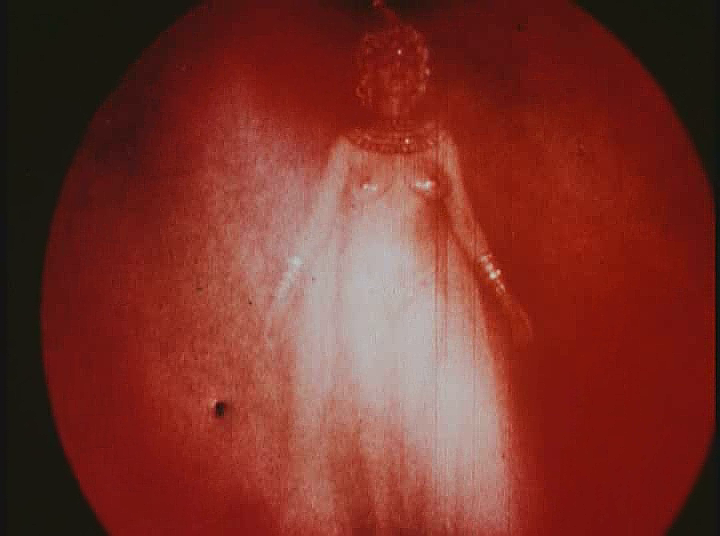
Teenage Tupelo's aesthetic, realism shot in celluloid but fixated on the past, is a really curious one. This is a director replicating pop culture but completely forming it into his own vision. Shot in black-and-white, the starkness is contrasted by the fantasy sequences. Openly meant to be titillating, with the cast topless and in quasi S&M moments, these heated Sapphic fantasies (and a film of Topsy Turvy's where Castro in Cuba, represented by a woodland, accidentally gets edible panties than the nuke he wanted from signed delivery) have their heated coloured tone too which stand out. Less exploitation, these scenes look more like saturated old time celluloid of avant-garde cinema in mood which adds a curious effect.

As a result, even if Teenage Tupelo has a male gaze whit large, especially in those colour sequences and the matter-of-fact nature of the production it has a distinct aesthetic, contrasted by the costumes and tone, one which can have the hallucinogenic quality of a heterosexual Jack Smith film. It is, regardless of sexual orientation, a narrative equivalent of Flaming Creatures (1963), Jack Smith's simulacra of old cinema (there forties and thirties b-pictures) turned here into a film focusing on early to mid sixties exploitation movies, as interpreted in both cases by having to one's normal environments and what prop clothes could be accessed. Some of Teenage Tupelo is entirely John Michael McCarthy and reminds one this was made in the nineties, such as the homeless tattoo artist, living in a bus, who dresses like an occult monk and takes the art of apply spider tattoos that cover the entire back severely.

And one time, as D'Lana contemplates her future motherhood, John Michael McCarthy splices in monochrome footage of a real birth, drastically shifting the tone from the erotic male gaze to a gynaecological reality whilst evoking older sexual hygiene films, which David F. Friedman would have been aware of too, which contrasted the titillation of getting away with sexual content, under the pretence of education, with some films showing such footage. Teenage Tupelo as a result is an acquired taste which however also has these touches which keep you on your toes, a fascinating film you could only mark as a "cult" film as genre because it has a sense of personality, weird humour and moments which are deliberately strange. By this point, I am fully aware what interests me is usually an acquired taste, the reviews less a recommendation but a sketchpad of figuring out what a work covered feels like to experience. Here what stands out is that, trying to recreate a sixties subgenre, entirely connected to that era, in the grunge era of the nineties becomes a weird cocktail of a low-fi, sexploitation pastiche from John Michael McCarthy. Know the resurgence of interest in old pop culture from years before, including the revival in fifties and sixties cocktail and lounge music, the rockabilly and classic rock n roll created for the film in the soundtrack, alongside the sense of the director-writer's Mississippi upbringing evoking the likes of Elvis in his career really adds a nice spice to the material too.

It is certainly curious, divisive not even for the clear male gaze but that like sexploitation films, it has a plot yet like certain niches of cult movies, they are less about an escalation of plotting in a lot of cases but their mood. This is something I actually prefer, which was one of the huge issues later on in decades many neo-grindhouse films did not work for me in the late 2000s into the 2010s. Melodrama is apt here as, even if a comedy at heart, you have a young woman wanting to find herself. Conformity is square and horrifying, but she is not a gay woman nor a man hater either, finding in the end her solace in Topsy Turvy, her doppelganger played by D'Lana Tunnell too. It is ironic, for a film you could say is full of an irony in its tone, it has a sincerity for all its nudity and kink. That it is about a woman finding a power in cinema as, D'Lana finds her onscreen character (and Topsy Turvy herself, helping her in real life) empowering as people wanting to claim their sexualities and individuality even if you have to put together your belongings in a knapsack and wander the country. Here, between this and Superstar A.D., John Michael McCarthy certainly suits me as a unique director who has interesting characters, worlds and personality.

Abstract Spectrum: Eccentric

Abstract Rating (High/Medium/Low/None): None

Saturday, 29 August 2020

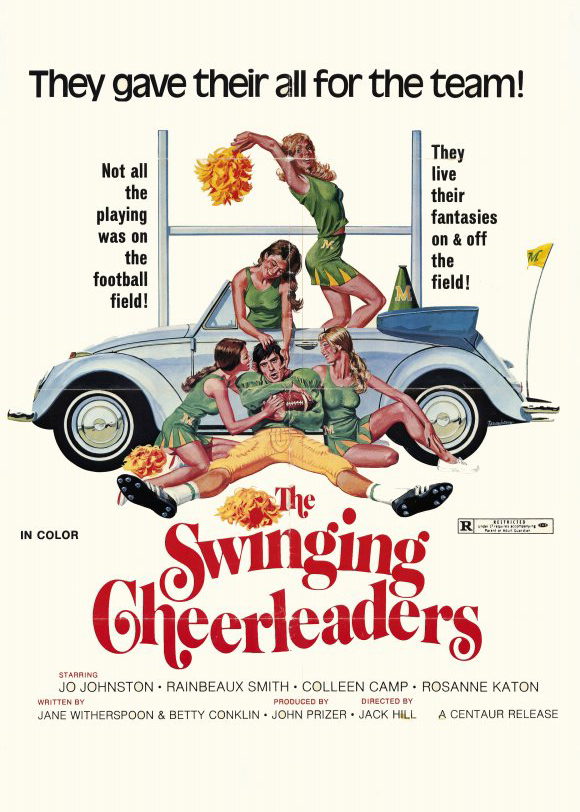
The Swinging Cheerleaders (1974)


Director: Jack Hill

Screenplay: Jack Hill (as Jane Witherspoon) and David Kidd (as Betty Conklin)

Cast: Jo Johnston as Kate; Cheryl Smith as Andrea; Colleen Camp as Mary Ann; Rosanne Katon as Lisa; Ron Hajak as Buck; Ric Carrott as Ross; Jason Sommers as Prof. Thorpe; Ian Sander as Ron; George Wallace as Mr. Putnam; Jack Denton as Coach Turner

Ephemeral Waves


Oh my cod, my cod!

The Swinging Cheerleaders is not a good film. Actually, it is an insanely dated and dull production, not quite a sexploitation production, not quite action either. Not really much of a high school football narrative either, though that makes up a huge part of the production and initially promises a bit with the zoom in on a sports stadium and a montage at the beginning of the movie. I say all this as a fan of Spider Baby (1968), another early production by cult filmmaker Jack Hill, a really interesting pulpy horror film which threw back to the past by casting Lou Chaney Jr. in one of his last films alongside looking to the future. He is held in high regard for his blaxploitation films, iconic because of his casting of Pam Grier, but he is a journeyman director who worked in multiple genres, which means he has worked in many areas throughout his career that would be of interest. Sadly The Swinging Cheerleaders did not succeed.

It is a fascinating artefact in principal, as cheerleaders (whilst they exist outside the United States) are an inherently American pop culture concept which I grew up with in various forms since childhood but as an inherently alien concept. Note that, whilst male cheerleaders exists, it is usually always female cheerleaders that are depicted, where they can exist in multiple forms - as parodies, as tropes, as archetypes, as figures of the popular students in American high school, and as figures of sexual desire, the latter significant in this case. Naturally, as a sexploitation film, the interest is in a female cast of sexy cheerleaders, even if by logic they are meant to be high school students and underage, thus adding a creepy edge.

The premise is that a liberal feminist plans to sneak into the team to write an expose, which will inevitably lead to her changing her mind about becoming part of the team. It actually feels like a plot from a 2000s Hollywood film, like when Miss Congeniality (2000) with Sandra Bullock was about the Miss America competition. Whilst there are attempts at giving the female cast some gumption and independence, it is noticeable that the female writers are actually pseudonyms for male one, and that they do not succeed entirely from creating fully formed female figures. There are definitely moments where they did not think through ideas or are absolutely of the time, such as when the feminist will suddenly want to have sex and romantically linked to the lead player, despite their first interaction with him asking her for sex on the introduction and coming off as a pig.

The men in general are pigs here. It is a plot-based one at times - as there is illegal fixing of games for gambling among the teachers - but there is also a lot of scuzziness played for humour. The coach is a horn dog perving on young woman, making up a lot of this, whilst the lead player comes off first as utterly unlikable in the modern day despite the later attempts to write him off as much more sympathetic. The lead female character's initial boyfriend, a liberal left winger, adds an odd reactionary slant as he comes off as a spineless deviant the more you learn of him, beaten up by the police in protests but here, when his girlfriend leaves him, showing himself to be a rat. Even the one likable character of the main cast, an African American maths teacher ("I want you to take your mind off permutations") is sleeping with one of the students, regardless of the fact that he has a change of heart of helping with the gambling when a moral pass is approaching that he refuses to break. Married, there is a really lurid sequence, one of the only few explicit ones in the film, where his wife, a really striking and deep voiced older woman, threatens his young girlfriend with a flick knife in a school corridor.

Much of the film, beyond this, drags on. The set decorator was having fun - peacock feathers, skeleton in a cheerleader outfit and seventies posters, all in one scene - but this is as conventionally put together as you can get with an exceptionally glacial pace. It realty is not that explicit in the sex either, as whilst it has some topless nudity, making it quite a quaint film. Even when it starts to get ahead, the tone is so cheerful that the one scene of note, a tumble between corrupt campus cops and the football players, should have shown that the film should have moved closer to the football and more pacey hijinks, completely ditching the sex appeal and becoming a more family friendly farce. Instead, the film is so quaint that, not only does it feel dull, but also skips over a lot of problematic content blithely. The film casually skips over what is effectively a gang rape in the plot line for one of the biggest examples of this, where a female cheerleader wishes to lose her virginity and accidentally encounters the male liberal rat, the content implied and never shown, but The Swinging Cheerleaders just casually dropping the event with the characters merely seeing that she now has a hangover and her love interest just beating the other male character up.

Even without this scene, that light tone is still dull. This fully embraces one of my biggest grievances when films stick adamantly to their plot without extra flair even if said plot is generic. So much that, honestly, this last paragraph is going to be this short and end here as there is not a lot I personally found of interest in this film.

Saturday, 4 January 2020

Bubbles Galore (1996)


Director: Cynthia Roberts
Screenplay: Cynthia Roberts and Greg Klymkiw
Cast: Nina Hartley as Bubbles Galore; Tracy Wright as Vivian Klitorsky; Daniel MacIvor as Godfrey Montana; Shawna Sexton as Dory Drawers; Annie Sprinkle as God; Andrew Scorer as Buck Lister; Sky Gilbert as Rip; Peter Lynch as Dick; Ed Fielding as Jimmy Remington

In terms of oddities forgotten in time, a Canadian comedy crime sexploitation film, set at Christmas, with real life adult film star and pro-sex activist/educator Nina Hartley as a former star turned porn director, with porn star/ sexologist Annie Sprinkle as God, is as idiosyncratic as you can get. It's a very low budget film with some quirks to say the least; those who can appreciate this however would get a lot out of a really low budget and resourceful pulp film that's difficult to categorise. Notably this is a film by a female director, who co-wrote the script, that's proudly sexy but hates its chauvinistic male porn producers and goons with a passion, which means the entire notion of the cinematic gaze in terms of gender is upended whilst being proudly feminist in its own erotic way.

I had no knowledge of Cynthia Roberts. I didn't even know the film was Canadian, set in a wintery environment around Christmas, until you see the red and white maple leaf flag proudly waving in one scene. Bubbles Galore is also very much an improvised production, stealing shots in a real hotel and outside environments, mostly set in rooms whose distinct bright lighting have a pronounced affect on the mood. It looks like a George Kuchar film shot if it met the mid-nineties - plastic colours, a fuck ton of pink lighting, and low budget digital layering effects are to be expected.

Premise wise, Hartley is Bubbles Galore, who is in the midst of trying to shoot a film with Dory Drawers (Shawna Sexton), who despite being a visibly voluptuous and attractive woman is a virgin, leading Galore to want to teach her to play the perfect innocent protagonist of her new film. Her assistant Vivian Klitorsky (Canadian mainstream actress Tracy Wright) is openly gay, a cynical person who is however in love with Bubbles, making her uncomfortable when Galore is more interested in Dory romantically during the production. A scuzzy porn filmmaker, who once had Bubbles as his star, is jealous and wants to sabotage her film to force her back as his property, even if it means targeting a veteran male star, now a drunk with erectile dysfunction, to plant a mole on her set.

Casting Nina Hartley was the film's wisest choice from the get-go. Alongside her work in pro sex education later in her life, Hartley is fascinating as someone who started in the eighties but is utterly different from the outsider's stereotype of what a female porn star. Looking closer to a school teacher, helped by a calm but subtly authoritative voice, Hartley in interviews has sounded as an incredibly strong voice, in the early nineties onwards making it a mission to teach sexual education to adults, and bucking trends in ageism as she still works in the adult medium. She could have also starred in mainstream cinema as she's good in the film. Really, really good, commanding a film where a lot of the cast can be broad, only Wright contrasting as the sarcastic assistant who shares a charismatic chemistry with her. Hartley is great, and with Wright, the large part of the film being a romantic tale between them makes the eventual honesty they show in their love for each other sweet.

In completely honesty, whilst I really enjoyed the film, Bubbles Galore is a mess at times, one which like a few micro budget films I've seen is obsessed with long scenes of nothingness. It's a playful indulgence you have to come to enjoying subjectively in the end to be fully able to appreciate this type of cinema, moments repeated and sprawling in a pleasure of insignificant things to the tip of experimentation. The best example, the closest thing (if done more) Bubbles Galore would've become abstract, is a never ending montage (with individual shots repeated over and over again) between Bubbles doing a sexy photo shot for a feminist magazine, the lead villain having an incestuous side revealed with a fantasy of his mother playing out, and what can only be described as two of his thugs roughing up the old drunken stud, to make him complicit to their goals, by pinning him to a hotel bed as one twists around his elephantine (and rubber) knob whilst the other wanks into his face.

The biggest surprise many would have seeing Bubbles Galore is, from a female creator, that it's a film openly embracing titillation and transgression, which will come as a shock as the 2010s onwards have seen this type of material as problematic, not even considering a women actually directing and co-writing it. The film is softcore, everyone barring Wright naked at times, with the exception of oral sex which I am going to presume, considering they are used at least for one character, is done with the male cast having fake stunt cocks. The transgression is much more shocking nowadays, especially as Bubbles Galore is meant to be a pro-sex comedy. The male characters barring the old stud, an old flame of Bubbles, are scumbags using some exceptionally sexist and crass language, objectifying women. There is, which is never explicit, a rape scene which might put people off, notably in mind however in a film where every female character is entirely sympathetic, always on the side of the underdog we route for, and literally under the eye of a female God with female dancing angels. So the film does come from a mind that the sex when positive is very positive,  fun on the porn shot with Hartley in a devil costume by a Christmas tree at one point and a hunky skinny guy in a bear costume, and Bubbles romances with two other characters played as romantic and sensual.

The result is a curious mix, coming from an era of indie transgressive filmmakers like Greg Araki etc. where bad taste and genre pulp were blended together, here with the notable difference however that it's a feminist film of sincerity and camp. The kind for an acquired taste certainly, but encountering a pro-sex film made by woman on and off-screen is certainly a distinction still, one full of vibrant colour and energy that wears its low budget with pride.

Abstract Spectrum: Camp
Abstract Rating (High/Medium/Low/None): None


Sunday, 27 May 2018

Psyched by the 4D Witch (A Tale of Demonology) (1973)

From https://4.bp.blogspot.com/-m2LVnt8J0CI/WPo4vDcnzuI/
AAAAAAAAMeE/mOSJxQVZJ18HWlIDQR-1U0mXpMiUo68zACLcB/s1600/Psyched%
2Bby%2B4D%2BWitch%2BAd.jpg


Director: Victor Luminera (a.k.a. Lawrence Milton Boren)
Screenplay: Victor Luminera
Cast: Margo as Cindy; Esoterica as Abigail; Tom Yerian as Mark; Kelly Guthrie as Mr. Jones; Tracy Handfuss as Jan Kleinmetz; Keith Erickson (as Dr. Ambrose Kleinmetz)
[USA]

Synopsis: Dabbling in the sinister world of the occult, naive college student Cindy (Margo) is contacted by a 17th century ancestor from the 4D realm, a witch named Abigail (Esoterica) who promises the virginal girl orgasmic joys without any consequences of physical sex. Secretly however she wants to pervert her out of revenge. Even if it means turning her older brother Mark (Tom Yerian) into a sexual vampire.

Since seeing a clip from Something Weird Video's back catalogue, I have been curious about Psyched by the 4D Witch. That and the fake legend of a print of the film being found where the Manson Family camped, all despite this film existing long after their infamy. Well, that's depending on if it actually was released in 1973, or if it was shot in the late sixties and sputtered out in the early seventies. If any film was late the psychedelic boom Psyched by the 4D Witch was one such example, and this is definitely one of the extreme examples of American cinema's exploitation production. It comes from the melting pot of independent American genre films, sandwiched between the two decades and feels like it. A sexploitation film which has more puritanical stains of the sixties, but released in the early seventies (if the case) and needing more bite. All shot in "Transetheric Vision", which feels like a fifties marketing gimmick.

From https://78.media.tumblr.com/944989de6fe3d52ebab668ee9e718d0b/
tumblr_mwn2r4Q9HT1saghvlo5_500.png

It is with a fair warning that this review will become crass just having to explain the film in depth, because sexploitation even when it was chaste was entirely about selling sex, even if how and what the stories were about are tasteless or just weird. What actual story to some is as much their DNA and also to be warned about, as you don't try to enter some of these films unless you have the tolerance for very different strain of filmmaking, be it technically inadequate or just on the fringe of culture. The warning, due to this, this is only for a select audience to try to get through. And this is bearing in mind you barely see a lot in Psyched by the 4D Witch. That's the irony with this film, the most sexless of sexploitation films which yet still has a lot that'd embarrass some people to be caught seeing. Inexplicably appearing on Amazon Prime, obscure even for a 4K Blu-Ray restoration, the version matching its haphazard tone cultivates various colonies of grain and age just on the print used for the digitalization, adding to the experience the television was spiked with bad hallucinogens.

The film's split personality is perplexing. On one hand its sixties tinged psychedelic, which was popular in exploitation cinema, reeking of the cautionary films from the same time. Stay for the titillation, but condemn the "perversions" onscreen. Yet this is also a seventies movie and tries to be more scuzzy in connection to its occult plot line. Cindy's friend Jan (Tracy Handfuss), when brainwashed into the occult rituals, writhes with a rubber snake as if in a burlesque nudie loop. Until its claimed in the voiceover she inserted the snake into herself before the ritual in one of the many  bizarre lines. The snake used inappropriately is just hinted at in dialogue, alongside mention of necrophilia and such. Attempts to clearly go further which the structure of the movie is compromised in being caught between both sides.

From http://www.thespinningimage.co.uk/cultfilms/images/8569.jpg

Scenes which seem to cut away from the sex as if they were actual porn sequences, purely softcore of the sixties cut to ribbons until its barely comprehensible at times. These perverse lines merely hinted at in the voiceover when what is onscreen, if viewed mute, wouldn't be perceived in that context. Plenty of nudity, but with sexual words bleeped inexplicably from the soundtrack nonetheless. A sense of the quainter sixties films but reeking of filth just in the plot and the atmosphere of the production. It makes it a confused film in terms of its existence, as its meant to be softcore yet if stuck between the sixties caution and seventies sleaze, all whilst not showing a lot actually onscreen. Especially as actual hardcore pornography briefly became chic in the mainstream, with the likes of Deep Throat (1972), a film like this missed the boat for its audience completely and flounders.

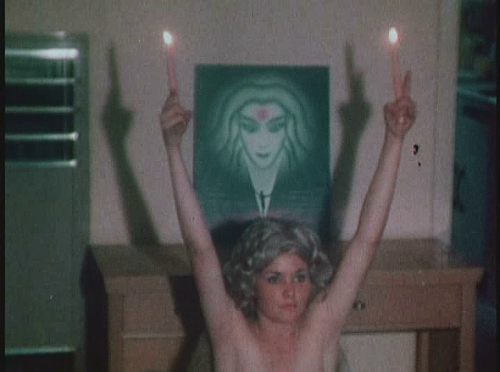
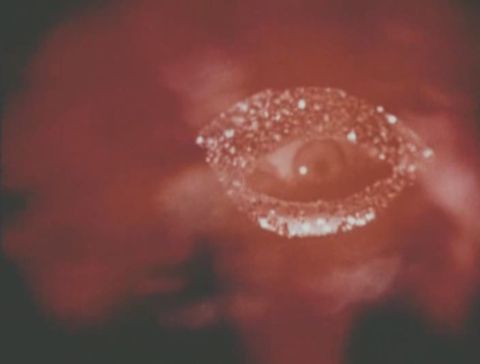
The experience is instead like Kenneth Anger, the legendary occult practitioner and avant-garde filmmaker, if Inauguration of the Pleasure Dome (1954) with its coloured gels covering the screen and actresses in quasi-ancient garb was instead made by people on a bad day using horse tranquilisers. A sense this was put together with various pieces of footage, even home movie material, as Psyched by the 4D Witch is all post-dubbed with narration and various scenes. Whilst there is a lot of nudity of both genders, you have a patchwork so extreme it becomes confusing. A scene between Cindy and her aunt - which demonises lesbianism by making it incestuous, but still lusts over an "exhausting three-way lesbian climax" with them and the ancestor Abigail - is so chopped up in structure I had no idea what was going on. A lot of shots are reminiscent of being inside a lava lamp. Superimposition. Quasi-Eastern costuming, which again evokes Kenneth Anger but also Jack Smith. So much pink and purple, due to the print seen as well as the aesthetic, to the point the scenes of the ordinary 3D world are heavily tinted in these colours. Eventually until pink is soaked into your eyes. Events from later in the film are even cut into the structure early on as if premonitions, such as the older brother mid-sex vampire role devouring a victim, all without context until you get to that plot point properly.

From https://78.media.tumblr.com/50cdb8cfe9d849e549c279ad31f75d58/
tumblr_mwn2r4Q9HT1saghvlo1_1280.png

There's little sense of the occultism being anything than just an excuse for the weird titillation. It neither helps how slapdash the film is in being put together. The strangest moment is not the sex. Or when it abruptly switches from Cindy as our narrator to her older brother, unaware despite being reflective of these events having past that he's about to be turned into a cannibalistic sex vampire. Nor the perversity attempted at. No, it's the unexplained and lengthy scenes that feel like home movie footage. In particular the one of a beach, just panning over the local environment and its tourists, which goes one for at least five minutes or so, that is incongruous to the extreme.

Now considering how many times I've said the film is bad, is Psyched by the 4D Witch to just be avoided? For those with an intolerance of the barrel of American exploitation, you stay away as far as possible. For someone like myself, with a tolerance for this type of film, it was something I'm glad to witness. Slithers of very memorable things that made it compelling, and all that was an aghast failure still idiosyncratic. Its luridness coupled yet with a chaste innocence. The gay neighbour who someone is convinced by Cindy to participate in her sexual exploration. That, technically, what she experiences is mystical rather than physical, extended fantasies Abigail is absorbing the energy from for her nefarious ways. That Mark's experience becoming a vampire is slowly built up with using travelogue footage of a seventies games arcade only to never be fully resolved, left to wander in his new life as an inexplicable plot point. Or that the solution to the drama, provided by Dr. Ambrose Kleinmetz (Keith Erickson), which also involves sex but at a significant cost. That even a film this misbegotten has a hummable psych rock title song.

From http://4.bp.blogspot.com/-62CQzOhIzzY/UDmYSAZOOZI/
AAAAAAAAPhE/f1jYnQ_Gghg/s1600/psyched14.JPG

And if anything, looking at any screenshots of the film makes you aware how utterly perplexing the film must be as moving images. Many will find this painful, but the mix of extreme colour saturation, avant-garde experimentation, and exceptionally low budget sexploitation is a peculiar aesthetic cocktail.  Trying to make sense of Psyched by the 4D Witch is arbitrary. It's simple on paper - an innocence young woman corrupted by an evil ancestor from beyond the grave - but the structure and tone is what causes one to feel in a stupor. Of course since this is sexploitation, one has to ask whether it is actually erotic, which it isn't. It isn't titillating in the slightest. And that in itself, because it's too rambling and unconventional to be, adds to the strangeness as, even without the sexual perversions angle, the film is so fragmented it would undermine any of its original purpose.

Abstract Spectrum: Grotesque/Psychedelic/Psychotronic/Weird
Abstract Rating (High/Medium/Low/None): Medium

Personal Opinion:
One of the strangest things I've seen in a while. One of the queerest at least. The film will be unbearable for many to suffer through, but for myself witnessing its hot pink tinted mass spew onscreen both made me feel dirty but was also oddly compelling.

Friday, 7 October 2016

Halloween 31 For 31: The Strange Hostel of Naked Pleasures (1976)

From https://horrorpediadotcom.files.wordpress.com/
2014/06/oophv7fhlgrq4jefrccbsomkypv.jpg
Directors: Marcelo Motta and José Mojica Marins
Screenplay: Rubens Francisco Luchetti and José Mojica Marins
Cast: José Mojica Marins (as Zé do Caixão)
A Night of a Thousand Horror (Movies) #32

Coffin Joe, aka. José Mojica Marins, is very much a "psychotronic" film figure. The term defines a certain type of cinema that can be found in the mainstream but is much more a term of for the outskirts of movie making. Admittedly the term comes from an English speaking origin, which could easily label a legendary Brazilian film maker and cult figure as inherently psychotronic, the bogeyman that went to become a pop culture figure with his elongated fingernails, top hat and cape, and Marins' tremendous fire-and-brimstone voice, if the term was used as an anthropological one meant to explore and celebrate other cultures. However if you define the term as its meant to regardless of the country of origin of the films, usually low budget genre films which have a distinct uniqueness to them, Marins work is a perfect example of it because of how he became a legendary figure in his home country only to find himself a transgressive figure against a dictatorship in the later sixties and seventies, how he'd made the films on very low budgets with inventive methods to create them, and how frankly bizarre and lurid quite a few of them are.

Also once you leave the key Coffin Joe trilogy - At Midnight I'll Take Your Soul (1963), This Night I'll Possess Your Corpse (1967) and Embodiment of Evil (2008) - which are already distinct and likely to surprise and awe new viewers to them, the other films that can be found from his filmography easily manage to raise the bar higher in terms of their strangeness but with acquired taste a necessity. A combination of even more lower budgets, the effects of censorship of his work by the dictatorship that took over Brazil at the time, and his potpourri of sexploitation and horror into the late seventies leads to some very peculiar work that won't appeal to everyone. Admittedly part of this includes a willingness to repeat footage and combine shots into collages that takes on an extreme in some of his films, exemplified by a film like The Strange Hostel of Naked Pleasure's near ten minute prologue, before the narrative proper starts, of Coffin Joe appearing out of a coffin to introduce the story. Back in the day I hated the film for this type of elongation of scenes, but there's a delirium clearly Marins' own, despite the fact this is technically directed by Marcelo Motta too, with the prolonged and repeated shots of a mass ritualistic dance by scantily clad women to summon him from the coffin, what can only be called troglodytes (actors in black clocks, fake plastic masks and breasts, one with a literal plastic front bottom) squeal on in horror at the dancing taking place.

The film proper is more of a prolonged mood piece, an obvious plot signposting its twist at the beginning and far more concerned with being a strange cacophony of sex and chills with religious undertones. Marins is a mysterious owner of an inn, sinister with cryptic monologues which he tells to guests as he selectively chooses who gets what room - a giant clan of hippies, a gigolo and his older female lover, four gamblers planning to play cards, a homeless man who gets brought in as Marins snubs a rich man and is given bikini wearing women to fed him fruit and wine amongst those introduced. The inn is immediately in another realm at night, a faceless clock on the wall in the entrance area with oppressive colour lighting everywhere. Clear warning is to be found when one of the employees, an older woman, sees a wallet on the floor only for it to turn, by jump cut, into a spider as she stares at it crawling with bafflement. It's blatantly clear what the twist is but you'll be more concerned with the concoction of images that take place onscreen instead.

The result is a barrage of raggedly edited moments of characters in various activates that last for most of the film, including a lot of the same shots of the hippies dancing in a room and getting naked that'll bring out an entirely new perspective of the female form for viewers, juxtaposed with Marins' eyes glaring in extreme close-up. He constantly repeats moments until a new piece is added each time, either depending on your mood padding at its most ridiculous to be feature length or a hypnotic loop. By the end the religious and ominous undertones become more intense as the music blares at unsuspecting viewers, the supernatural nature of the inn already known and getting more macabre as it goes. Barring one sequence which is problematic depending on  how it was actually done - when animals like mice and crabs suddenly flinch and spasm on their backs whenever Marins passes them through the corridors - it becomes a slow, absurdly soporific experience which can be utterly frustrating at points but madly compelling, more so as the extremely damaged print the UK DVD release used adds to this with its scratches and pops, an eclectic blend of choir chorus, psychedelic and exotica in the score exceptionally diverse and keeping you on your toes.

The really interesting aspect of the film beyond this, alongside the rest of Marins' career, is how he was a purveyor of lurid horror and sex films yet he has an obsession with morality and religion that borders on incomprehensible at times with some of the monologues in The Strange Hostel... but sound utterly sincere and are fascinating to hear and read in the subtitles. Before the story of the inn even starts, you get a diorama of the cosmos, with asteroids on strings, as Marins narrates about the infinite nature of the universe, a bizarre tangent in a film that'd get even more bizarre later on in its short eighty or less minutes length, its existence still compelling in the oddly mystical weight it adds despite how vague his proclamations can be. The Coffin Joe trilogy is the best example of Marins' philosophising as he has a fascinating character he plays in Joe - a nihilistic atheist influenced by the creator's issues with the hypocritical nature of religion but also an extreme parody of masculinity in Joe's obsession with continuing his bloodline by having a child in any way he can - but the scraggier films in his career like The Strange Hostel... are just as curious in their attempts at profoundness. Especially as the ending of this film manages to be incredibly macabre and eerie, from the scene of a naked woman wandering out the inn through the gates to salvation to its final shot, his obsession is still as compelling to see here as with the more successful attempts.

From https://horrorpediadotcom.files.wordpress.com/
2014/06/a-estranha-hospedaria-dos-prazeres-1.jpg
Abstract Spectrum: Mindbender; Psychotronic; Weird
Abstract Rating (High/Medium/Low/None): Medium
This will not be the last time Marins will be on this site - ever since he created the mind-blowing hell sequence in colour in his black and white sequel This Night I'll Possess Your Corpse he decided to try to top that sequence and did so many times after. His tendency later on to almost stitch his films together from what materials were available, as far as create a film (Hallucinations of a Deranged Mind (1978)) from censored scenes with a new narrative around them the most extreme example, added to this habit of creating mad moments of cinema alongside the repetition and juxtapositions. His fingerprints and vision are smothered on this particular film even if others created and wrote it with him in the centre. To paraphrase Carlo Carrà's The Painting of Sounds, Noises, and Smells (1913), you won't find " the rrrrrreddest rrrrrrreds that shouuuuuuut" like you find here in Marins' films, from a woman's lips let alone the coloured lighting in his films, anywhere else barring animation or Kenneth Anger. The music is as unpredictable as the visuals as Marins' personal mythology is vague and yet compelling at the same time, able to get away with the same shot of actors rolling around naked on a bed because on how it feels like you've just taken a narcotic and are feeling the effects as the scenes play out. It's an extremity of genre cinema that's absolutely not for everyone, scratched to shit in the version available to me with burnt on subtitles and muffled sound, but is unique in how it whittles down sex and horror to its basics, a wallet left on the floor suddenly turning into a spider turning out to be the sanest moment in the entire film.

Abstract Tropes: Repeated Footage; Monologues about the Cosmos and Fate; Sexploitation; Wanton Nudity; Excessive Coloured Lighting; Supernatural; Eclectic Music Cues

Personal Opinion:
An acquired taste of the most extreme but utterly compelling.

From https://horrorpediadotcom.files.wordpress.com/
2014/06/a-estranha-hospedaria-dos-prazeres-56.jpg

Wednesday, 10 August 2016

Teenage Caveman (2001) [Mini Review]

From https://images-na.ssl-images-amazon.com
/images/I/5137K9CGFCL.jpg
Director: Larry Clark
Screenplay: Christos N. Gage
Cast: Andrew Keegan (as David); Tara Subkoff (as Sarah); Richard Hillman (as Neil); Tiffany Limos (as Judith); Stephen Jasso (as Vincent)
A Night of a Thousand Horror (Movies) #15

In the early 2000, a series called Creature Features was created between US cable and satellite station Cinemax and American International Pictures (AIP), an independent film production company known for b-movies from the fifties and sixties which Roger Corman would grow into a legendary director and producer from. Creature Features remade five of AIP's older films for the new Millennium, the one which stood out the most for me for all these years the least expected one to ever exist and standing out of the set as the potential oddity. The idea that the producers took Teenage Caveman, based on a 1958 prehistoric teensploitation work directed by Corman, and let it be directed by the legendary and notorious photographer and film director sounds like a bizarre masterstroke I'd be compelled to see. Clark made Kids (!995), a controversial cult drama where youths have sex, take drugs and get into grim situations, and continued down this path with as much controversy. With all this in mind, I had for years since I was a young naive cineaste wondered what the hell a film about (preferably) teenage cavemen would be like from Larry Clark. Lots of sex? Likely. Nubile youths waxing lyrically on their lives naively? Possibly, thought stranger if its teenage cave people musing about their lives living in caves eating brontosaurus. Violence? Definitely and since Clark has tackled violence in films before, such as someone being battered nearly to death with a skateboard in Kids, he's able to tackle to visceral in affecting ways that would make it a pretty nasty genre flick.

A post apocalypse tale, mankind is reduced back into a new prehistoric age living in caves again. David (Keegan), the protagonist, has to live with a father who uses his position as the tribe's priest to restrict others and try to sleep with as many of his son's friends as possible. After David commits patricide, he and his friends wander in exile only to find a ruined metropolis and encounter two survivors. One a drug and drink fuelled guy named Neil (Hillman) who missed the chance to have become a rock star in the old world, the other his caring girlfriend Judith (the beautiful Limos), they welcome the youths into their home, openly admitting they are immortal due to being guinea pigs in an experiment to save humanity but not revealing how they intend to pass it onto the youths even if the side effects of the failed mutation is death by internal explosion in gore and guts if the transition isn't successful. It was interesting to see whether Clark would be censored slightly for a TV movie even if it's for cable and could get away with a lot more; while there's still a lot of nudity, drug taking and sex, as Neil and Judith encourage their guests to partake in drunken orgies, there's something innocent to the material in a schlocky T'n'A filled horror movie sort of way appropriate for an updated b-movie. Unfortunately while this sounds good in a silly way the result is an abominable disaster. The first issue is that it's not a film about teenage cavemen. Once it gets to the metropolis and Neil and Judith's home, the rest of the film is in corridors and is another cheap sci-fi horror movie. The film looks bland and like the TV movie it is to a severe detriment, claustrophobic corridors that are lacking in style and even the outdoor moments not offering a change of look.

The other, even bigger issue is that the screenplay by Christos N. Gage is garbage. Clark can have young characters who sound real in his films but it's clearly a case of who is working on the screenplay, such as having the than-teenage Harmony Korine write Kids with the realism of being around the age of the characters he wrote about. Gage's script is a botched attempt at broad, exaggerated youth dialogue, the kind that one wishes Greg Araki made this film instead to get this done properly, spliced with the bland exposition dialogue of terrible modern sci-fi horror movies. Where the hero is bland and uninteresting, his girlfriend Sarah (Subkoff) is whiny and emotionally stunted rather than likable, and the teenagers are merely fodder for a body count. Neil and Judith are more interesting characters, especially as villains who actually want to help humanity by way of sexually transmitted immortality, the least expected and memorable intention for any villain to have, but the finale has Neil becomes embarrassing in terms of how actor Richard Hillman has to chew the scenery from then to the conclusion. At first, like a man whose drug and drink intact would even make Keith Richards blush and balanced on a knife edge between charisma and being scummy, the character alongside the more likable Judith are the only real virtue of the film especially as they are technically the villains; when terrible CGI effects and prosthetics that look dire on Hillman's head, even by the late Stan Winston, are involved Neil becomes the worst example of a villain who won't shut up thus making the viewing experience even more painful.

As a result, Teenage Caveman is not even a fascinating failure, which fans of a director would still like because the director's personality is there, but a film so compromised and bad that one would prefer if it was buried never to be watched by said fan again. Like Tusk (1980) for Alejandro Jodorowsky or The Mother of Tears (2007) for Dario Argento for examples, it's an incredibly embarrassing work from a director I admire that I really and significantly doubt I would want to witness again, preferring amnesia and watching other Larry Clark films instead to revisiting Teenage Caveman again. 

From https://image.tmdb.org/t/p/original/
6Z0p92sXNAblWs0QT6XS4HYGWnT.jpg

Saturday, 28 June 2014

Smoke and Flesh (1968)

From http://media-cache-ec0.pinimg.com/736x/b3/cb/fd/b3cbfdeef9fc1281e49fc28ad742b668.jpg

Dir. Joseph Mangine

Ah, to dig further into an area of cinema that you truly know little of. Full of surprises, films that you don't know the basics of fully let alone the true obscurities like Smoke and Flesh. This film nicely connects itself between counter culture, sexploitation and softcore, drug films and American underground cinema of the time. What I wasn't expecting was how good this film is technically and altogether knowing that these films are usually scrappier, the reason many are loved. Usually these films are campy fun, but this knocked my socks off in what I got and for what it is. The first few images included freeze frames of urban city bustle, a female voiceover describing how life stops in the day in work hours, a clock heard ticking away, already setting up a veneer of gloss and boldness unexpected for the film as I started viewing it. Night comes, and you are hit by sumptuous black-and-white photography as a masked motorbiker travels on the inner city streets of New York City. It intercuts with an old, balding man and his younger, sexy wife planning about a party. Then the film is set-up - a night at said party held by the youth of the day, with liberal pot smoking and lots of intermingling between the genders. The motorbiker is the friend of the house owner/party planner whose brought the weed with him. The old man is actually a professor who with his wife go to these sorts of parties frequently to bask in the lifestyle. From here, this is less of a plot driven film but almost a slice of life drama that is as sexploitation as you can get.

From http://www.dvddrive-in.com/images/a-d/aliceacid8.jpg

Plot strands do take place. The professor, sexually impotent, allows his wife to sleep with any man she wants as long as he can watch and take photos, spotting an appropriate hunk at the party. People hook up and mingle. The closest to a dramatic plot twist happens in the last quarter when the party thrower Turk's girlfriend is followed home by a group of hoodlums, one who feels she cock-blocked him from her and leads to the potential for a fight taking place at the party. Aside from this, the film just follows various characters partying. Almost plotless, but for seventy minutes, it's enjoyable to merely follow the characters get high and become intimate. It's certainly softcore for the large amount of sex and female nudity, which won't disappoint most, but its casual, realistic, aimless tone adding a greater amount of entertainment in how it nearly veers into the experimental "talky" dramas of the time. A matter-of-fact breeziness, far more legitimately respectable in content because of it while being much more erotic and fun at the same time. For one of the first, and maybe only times, someone can write that they've seen a game of strip Scalextric, and I can add that it never comes off as one of the embarrassing examples of these modified versions that exists in films - I've been reminded of Strip Ouija board of Terror Toons (2002) the same day I was writing this review for example. The romance between a white guy and a black girl, the later probably the most beautiful of the female cast and charismatic, starts with them having the munchies for a giant, and I mean giant, tub of ice cream, and ends with kinky shenanigans with whipped cream, probably one of the most sexually arousing scenes I've seen to be completely honest, something to applaud when usually you piss yourself in laughter at the stereotypical  tackiness of softcore cinema and its abuse of saxophones. While made to titillate, the film is easy going from every perspective seen, adding a great deal.

From http://pics.imcdb.org/290/smokeflesh53.jpg

Also despite being a counter culture film of its time, it never comes off as dated, naive hippy/hipster preaching of a better life. Little is made of anyone having fun like this, and even the plot with the old professor, while getting a little weird with the extreme close-ups of his teeth, is seen as bringing him and his wife closer, the third person getting as much out of it too. The marijuana smoking is not languished over, never celebrated or criticised, only the waste of an entire roll of  kitchen paper, as its thrown in the bin for the cardboard tub to be used as the inhaler, being offensive. There is an LSD freakout, done with visual manipulation and extreme close-ups of eyes, that's closer to typical drug films, with the actor shouting maniacally as it fully kicks in, spiked into their drink in case the worse happens as a semblance of a plot takes place, but aside from it this is far from Reefer Madness (1936) as you can get.  That plot transition, where the hoodlums introduced separately very early on end up in the house, takes on more of the vibe of an exploitation film, threat to the girlfriend of Turk and to anyone else involved. Aside from it though, the film is so laid back it never mattered that it hadn't the narrative of most sexploitation films, the right length to avoid dragging and too interesting to dwindle. And the content in it, minor details are inherently memorable. Perspectives from inside a fish tank. Shots on a motorbike in a tunnel. The strip Scalextric scene where the loser of each race has to take off a piece of clothing.

From http://www.dvddrive-in.com/images/a-d/aliceacid11.jpg

The film's great visual quality, such a jaw dropping surprise to see in an exploitation film like it with a limited budget, furthers the virtues of it, alongside the late sixties psychedelic rock score that gets you in the mood. It never takes itself seriously, nor makes excuses for itself existing. The result is just cool in tone. Unfortunately its director only made one other film. Surprisingly its Neon Maniacs (1986), one of the odder creations from the eighties horror boom, far from the best but still a hell of a lot of entertainment. Together with this, its shows someone in Joseph Mangine who would've contributed some very entertaining and different films to cult cinema if he had done more work as a director. The end of Smoke and Flesh finishes with returning back to daytime, back to work and the clock back up and running, ticking away. A snapshot of an interesting night that just happened to be part of an exploitation film. A memorable viewing experience.

Abstract Rating (High/Medium/Low/None) - None
Very little in the film gets close to being unconventional in tone. Even the LSD freakout, while great, stays in the conventions of freaky strobing effects.

Personal Opinion
Again, another dip into American grindhouse cinema for this month that has been rewarding. For any flaws this might have, it nonetheless makes up for them, providing a snapshot of a very alternative slice of American cinema waiting to be scrutinised. It was a joy just to have my expectations surpassed from a b-movie like this.

From http://www.imcdb.org/i529509.jpg

Wednesday, 25 June 2014

Bad Girls Go To Hell (1965)

From http://images.moviepostershop.com/bad-girls-go-to-hell-movie-poster-1965-1020199011.jpg

Dir. Doris Wishman

I've seen a few grindhouse films, but this one enforces the fact that concepts of political correctness, good taste and conventional strands of filmmaking are jettisoned in their desire to exploit. The fact that these original films have not really been made available over here in the UK - not the irony or throwback of Grindhouse (2007) which plays within modern day attitudes and aesthetics, or those easy to market to this mindset - made viewing this one, despite being very chaste, very shocking in its content. Once I explain the plot, it's up to you whether you'll see the film. A young wife goes out of her flat to dispose of the garbage, only to be raped by the predatory janitor in the corridor stairway and blackmailed by him for more sexual favours. This doesn't last long as she kills him with an ashtray to the head, fleeing to New York to avoid murder charges under a false name, going door to door for places to live. Unfortunately every male she encounters is a sexual predator. Belts hit flesh, and in a film meant to titillate as well as be nasty, the result lingers on these tribulations like a voyeur. This is my first encounter with a "roughie", softcore American b-films with an added domination theme over women, literally, being roughed up. Immediately, this is not something you get around our British waters on DVD, and is something that, unless you've already dived into the muddy waters of exploitation cinema, is still surprising to see even if you've seen some of the most violent and nasty films of now. And what adds to this surprise is how such a film is: a) very chaste baring this lurid content, with no actual nudity baring tease and occasionally female buttocks, and b) is one of the most well know, by title at least, films of a female director.

From http://366weirdmovies.com/wp-content/uploads/2012/07/bad_girls_go_to_hell.jpg

A cheapie production, nice looking, from the mid-sixties, but the name Doris Wishman holds a lot of significance in the area of American exploitation cinema. The Queen of American Sexploitation in fact, worshipped by John Waters, one of the few women in this morally dubious field to have a large, prolific career, and someone, despite the expectations of the content, was adding her own idiosyncrasies to films like this because she was self taught, produced many of her own films, and likely had the personality to get these films made. (I have only seen this and the infamous A Night to Dismember (1983), but the later showed how determined she was as a person, making a film regardless when most of the original footage shot was destroyed by a disgruntled lab technician even if it meant creating a strange, collaged and post-synched oddity). Bad Girls Go To Hell is the sort of film that would make feminists uncomfortable, and for a male like me who likes exploitation cinema but is concerned with progressive attitudes to feel a moral quandary, regardless of what one thinks of the technical quality of the film. Yet the fact that Wishman, a woman, made this film inherently complicates the issue of what gender is,  what "Political correctness" in films is to actual, real life attitudes one may have. It puts a spanner in the arguments, and surprisingly, causes one to ask more serious questions about gender and sexual politics than a morose, serious drama on the subject. Not bad considering, were it not for my concerns in these areas, the film is in the end complete and utter camp, juggling an unbelievably nihilistic view of life, even if it's meant to titillate, with a naive kitsch.

From http://31.media.tumblr.com/tumblr_lgw2toQABV1qc42blo1_500.jpg

Only over sixty minutes long, shot in stark black and white, its set around cramped rooms and brief glimpses of the streets of New York, against shop windows, taxis, from the ground looking at peoples' feet. Scored to soft jazz, rooms decorated in chique objects and furniture, the layering of a silly, fun film. Were it not for the fact I've only seen my first of the "roughies" in this, that silliness would've been more pronounced from the beginning. As an exploitation film, its narratively simple, fragments tentatively put together actually, the morals against scuzzy thrills, cutting to the chase with its content rather than tease it out. For its low budget, its well made and has a tone to it more realistic than other films in that it feels lived it, and shot in real buildings and exteriors. Editing occasionally becomes very jagged for moments of chaos and nastiness. The dialogue is also post-synched, an eeriness matched by the charmingly wooden acting of some of the cast. The cast itself is far removed for the Barbie dolls and Ken dolls of softcore, women who look like women, real figure, people who'd meet on the street, even compared to now, and men who look grizzled and drink whiskey all night.

From https://blogger.googleusercontent.com/img/b/R29vZ2xl/AVvXsEif8W-1sR3Q76w2xepK2Dlm0rDYmStUMzRFLyXvrfjgfuSZm1BstiEk-k6c0FOM-VT4q4vqTqw2Pf1I_crGyOWbEyuPhmhlelRO8a3ObZpHIoNVMXA3KdC3-ha7AaPzJ9F7aDVwGoe5PwES/s1600/Bad+girls+5.png

If there is a defence for the morality of the film, it's the fact that the men, including married ones, are not seen in a good light for the most part at all, lust filled potential rapists with no redeeming value to them whatsoever. There is a stereotypical predatory lesbian character, but the resolution of that segment has the problem being the protagonist not being able to want to continue the relationship and leaving despite the comfortable living in the room, where love and doing handstands in her underwear claiming she's an acrobat would be how she'd spend her time with the older, body stocking wearing haired woman. If it wasn't for the scenes of undressing that are tantalising, the scuzzy thrills aren't actually sexual, the roughie aspects just sordid.  Everything surrounding this content, while not of good taste, is pretty inexplicit and tame compared to the films of now. It's just the roughie content is probably a greater taboo now because of how the complicate history of gender politics have developed over the many decades. The film eventually takes on an (intentional/unintentional?) meaning in that our protagonist, completely innocent, murdering the janitor by accident in self defence, is stuck in a continuing nightmare where no one is on her side. A cyclical one where it continues with no escape. It's an odd mix, this nihilistic tone with very lurid, jarring content that would've been innocuous and naive to anyone else but me who've viewed more of these films and been desensitized. As a film being viewed from a view of abstract cinema, it certainly qualifies. The contrasting tonal differences between it all, mixing the camp with material that would be scorned over, although the contrast is as much the result of me, as a person, being wrapped up in cotton wool from these sleazy genre movies. Distant acting, drifting along the scenes aimlessly as hot jazz plays over the images. A goofiness that is met with a very negative view of humanity that somehow exists in a low budget film like this. It perfectly sums up what an American grindhouse film is as I watch more of them from this era.

From http://cinenthusiast.files.wordpress.com/2014/01/bad-girls-go-to-hell.png

Abstract Rating (High/Medium/Low/Non): Low
The shock of seeing a film with material that is more controversial now adds a personal effect on it, an oddity, in complete honesty, from a very different time because of how it's made and acts. It's shocking in ideas, but there's not a single bared breast in the film, adding a peculiar paradoxical air to it. The obvious kitsch, the suave furniture choices particularly, adds to this. It's from an era a company, Something Weird, entirely devoted themselves to, the transition between the fifties b-movies to the trangressions of the seventies, trashy cinema on scratched celluloid that yet feels innocent at the same time.

Personal Rating
Is there virtue in the film or something to defend? Possibly if one avoids lapsing into hypocrisy. To know the difference between a lurid film and misogyny taking place in real life. Baring in mind the campiness of the whole work.  And that a woman who controlled most of her career, in an area few women were involved with, made this film. The result makes it much more complicated morally, fascinating as a cult film. The film as entertainment? Rough, no clear direction in the way it's going, utterly compelling as scrappy exploitation. The Queen of American Sexploitation making an enticing offer to view her other films after this one, and somehow managing to bring out real questions about my social politics rather than an apparently serious work. That's a great way to get further interest in Doris Wishman if any.