Showing posts with label Meta-Film. Show all posts

Wednesday, 22 February 2023

Detention (2011)


Director: Joseph Kahn

Screenplay: Joseph Kahn and Mark Palermo

Cast: Josh Hutcherson as Clapton Davis; Shanley Caswell as Riley Jones; Spencer Locke as Ione Foster; Aaron David Johnson as Sander Sanderson; Walter Perez as Elliot Fink; Dane Cook as Principal Karl Verge; Erica Shaffer as Sloan Foster

A Night of a Thousand Horror (Movies)


You have the arms of an anaemic spider monkey.

The follow up to Joseph Kahn's debut Torque (2004) as a feature filmmaker, a post Fast and the Furious motorbike action film from a director originally prolific in music videos, drops a gauntlet down immediately in terms of whether you can appreciate its tone or hate it. From the first scene of a high school girl talking to the viewer in a very reference heavy, but bluntly vapid, dialogue with masses of text and on-screen graphics morphing on the foreground, the film immediately stands out as something very different from the post-nineties slasher films which were already being meta-textual. Detention now is a film from an entire different era of culture too, but by 2011 when it was first released, it existed in context to how Scream (1996) and its self awareness for the slasher genre had already become nineties chic alongside the boy bands and the fashion of the era. Knowing this later film, despite being about a slasher killer, is going to involve a time travelling taxidermied bear and going to 1992, Detention manages to be both irrelevant and bouncing off the rubber walls.

Greg Araki with his nineties films could frustrate people, from The Doom Generation (1995) and Nowhere (1997), with their irrelevant mashing of sci-fi, teen sex and abrupt gore, and if anything, Araki's naive nihilism of his characters was at least sincere. Aptly, he released Kaboom (2010) which contrasts Detention. Kaboom was an older director reflecting on his obsessions in the then-modern day in a wacky apocalyptic cult scenario, whilst Detention is a film made by Kahn, who started his career in music videos in 1995, reflecting on two decades worth of pop culture, the nineties and the 2000s, he was a part of building himself, all in a mass of post-ironic prodding in the template of slasher films and teen films in general. From a man who worked with the likes of Korn, Destiny's Child, Wu-Tang Clan, Mariah Carey, literally figures who were popular in these two decades among others, his sadly sparse filmography is contrasted by all the music videos he worked on in-between them. Kahn (born in South Korea and moving to the United States as a child1) is someone who is clearly proud of his work in glossy movies but also deliberately prods and mocks the pop culture too2. With this, he is taking an entire generation of young adult culture, and the one before it, and transforming it into an abrupt, multi-text mirror back towards this past.

At Grizzly Lake High, a killer dressing up as a fictional prom queen slasher villain, a mix of Prom Night parodying the Saw films known as Cinderhella, is picking off high school students. What this is from this springboard is less a full slasher film in the usual plot tropes, but drawing from the pop culture of the 2000s and 1990s through this context, the film centred around the lone, alienated female student Riley Jones (Shanly Caswell) who has nothing to live for to the point her fellow high school students gladly walk over her prone body on the hallway floor without realising her presence. Around her is every stereotype of high school culture, including herself, from the jock to the nerd, melded with vast areas of filmic culture, from high school dramas to, of all things, Cronenberg body horror, pulled together by Riley’s relationship with failing outsider Clapton Jones (Josh Hutcherson) and a serial killer who has literally jumped out from a slasher film series in the story’s world. From there, stereotypes are bent plastically into shapes unexpected, and referencing multiple pop items at the same time, going through the countless sub-chapters on even minor characters which disrupt the film with stories-within-stories which do not even have direct connections to the Cinderhella killer. It becomes apparent that, while there is a clear plot line with an ending, Detention is as much a purposely abstract movie, and gleefully so, whose tangents are meaningful in how out-of-place and silly they can get.

The film will put people off. Immediately it is clear this is a film with heavy levels of referencing that have become of the time it was made, the dialogue intentionally arch to the point it could cause the film to feel pretentious and obnoxious to others in conjunction with its tone and visual barrages. However unlike another work, say the animated television series Family Guy which made its bread and butter a lot of references to old pop culture with thin bare stories wrapped around them, Detention still has a core that is both cute with its referential jokes but have a clear, razor tongue in them, the erratic bombardment of music references, film homage and quips reflective of the age we live in. Even the stereotypes themselves, both meant to reflect the ordinary lives of real teenagers and abstract archetypes, is part of this, whether it is parodying (in a film-within-a-film) when they are cast with thirty year olds, or that there is even a reference to a seminal eighties film about teenagers, The Breakfast Club (1985), in having the titular detention also happen on a Saturday in the school library. The film has many visual gags, but especially with the many passages of text onscreen, this was an early film figuring out how to depict an age of Wikipedia, Facebook, Twitter, iPhones, and many decades worth of the internet from the nineties onwards to take into considering in culture and cinema. With the countless forms of media on many tiny or large screens, the rapid fire nature of Detention visually is a picture of what all this would look like if it was fully part of our lives as breathing is.

The overriding nature of pop and geek culture both good and bad – hipsters, retro fads, cult films etc. – has reached almost everywhere in Western society, and this ironically was already riding on jokes about the nineties making a comeback in fads, something that prominently would start to be mined into the next decades in mainstream culture themselves. The film avoids making itself merely a parade of references by showing how pop culture can fade and become old quickly, even for the next people a few years later, and is also regurgitated, coming in with the subplot of Ione Foster (Spencer Locke), who fixation on the early nineties in trends is explicitly part of a curious Freaky Friday scenario in one of the many strange tangents in a world where anything can happen. Even the tangent about half fly-boys, the Cronenberg parody, would have gotten David Cronenberg's approval as it leads to them growing up with a literal television on their hand, which is not really a reference to pop culture saturation, more of a strange joke, but really feels apt for a film about culture itself. This stays to the late 2000s and the early to mid nineties in terms of the jokes, but looking at my own upbringing even in Britain, I think of all those nu-metal and pop punk bands I heard on Kerrang TV over here. I think of how they have flooded the second hand stores now with their albums between the likes of Dido and Coldplay, representatives in terms of popular radio hits, let alone NME magazine and the crest of indie rock they promoted which has moved along into the mid 2000s. An inspired highlight is a reverse timeline from the film’s main setting to 1992, depicting the music and fads from 50 Cent to Hole along the way, a 360 degree repeating camera spin, helped by simple optical effects, that depicts the changing trends of culture.

It helps that the film is so amused in its oddness, that despite being conventionally made when stripped of its flourishes, in terms of structure and still having to resolve itself in some form, it is still immensely weird. The time travel, the cultural references from both decades the film is set in, and the collage created plot threads, lead to some bizarre and absurd ideas made more prominent by how they can be casually done. This feels less intentionally strange in a hollow way, something you could have accused other films from this era of parodies and pastiches, but something when this has plot details which could have made whole movie narratives. A sequence involving a film-within-a-film-within-a-film-within-the-film-I-watched, work prints-within-work prints downloaded off the internet, even a porn parody, was the scene back when I first watched the film which won me over to Detention, even if the use of Ron Jeremy, a porn star who became famous for cameos in the mainstream between the nineties to this point, has not aged well due to real life (and horrifying) criminal convictions.  This sequence, the bravado it has, is inspired for how absurd it is, adding to the complete disregard for solid dimensional reality to the film. It made me realise the film should be embraced as a non-narrative blitz on its material references as well, following what Airplane! (1980) was after with its amount and frequency of jokes on-screen, pushed to the stage of anti-narrative cinema with its silly walks and bloody pie shots to the viewer’s face.

It still is a genre film which needs to end with a resolution, and any flaws the film has is that it has to lead to a conventional conclusion rather than what Greg Araki could pull off, let alone the fact that, despite actual nudity here and some surprising gory sequences, Araki's films were far more transgressive. Proudly anarchic, proudly bisexual (and horny in general), and proudly subversive, Araki's films for all their pretensions really struck the tone right for how weird the strangeness of the nineties were. Kahn's film here is more openly a parody of these characters, with a distance kept, and it still has to be ironic even if mocking "post-irony", something Araki's films did not do at all even to the point of alienating an audience more than Detention could do in how sincere its characters' angst was meant to be. Credit to Kahn though, despite this, he still makes something good here, and that Kahn’s director credit, looking like alphabet spaghetti, is puked out into a urinal bowl by a character shows a self mocking from the get-go that emphasises people made this production with a sense of fun and with a reason to its parodies. That opening credit sequence along, before you get to anything else, also presents so much more creativity on screen than many parodies I remember from this time.

By this point, in mind one dialogue sequence is a digression into the legacy of Scream in Detention, the famous slasher franchise had came back this year with Scream 4 (2011), after a long period of that series not being continued and as an old franchise being rebooted. Even the slasher films in its wake of divisive receptions were nostalgic by this point. The meta text here could not be a mere parody of straight faced slashers unless it had managed to reinvent the wheel again, as the original Scream had both done this.  Here we have Detention fully breaking down the films of the past, even making jokes about the idea of post-irony with a mocking glance, and then having Patrick Swayze and Steven Seagal have a metaphorical fist fight. This eventually becomes a film that has broken so many rules of logic it clearly does not care as long as it entertains and still pokes itself savagely in recognition of the silliness of it all. It is telling, when it comes to its film-within-a-film, Cinderhella, Kahn is parodying the Saw franchise, and the "torture porn" genre films, Saw from 2004 to 2010, before a huge gap in time, releasing films each October each year for a time as horror trends themselves had changed.

Detention sadly has become an obscure film, one of many that came to DVD and are ready to find a cult audience - call it the cult era of just before Netflix became the streaming service and still rented out discs - and sadly in Detention's case for Britain, it came out in a generic looking DVD and, unless you were aware of what it was or stumbled across it by accident, it became the kind of film you may thankfully get for a couple of British quid still but gets lost among all the many copies of big blockbusters also found on the charity shop shelves. Jokes about how long it took Avatar (2009), which gets name checked here, to actually get a sequel aside, even that film by now on DVD fills the same shelves too, and both feel like time capsules of their eras, both becoming the type of films Detention if it had been made in the 2020s would have parodied in terms of a characters obsessed with the early 2010s in music and fashion.  As someone who grew up in the early 2000s as a teenager, the days of rap metal on Kerrang, the seeds of hipsterism and the shiny little monoliths known as the iPods about to invade music culture, all jostling in my mind as I write this and in said mind as countless other memories from the period, this is a film that speaks to my generation as well as the young audience of 2011 it was intended for. Nowadays, with some of the references likely to go over a new audience's head, even some of the jokes in this back then feel deliberately obscure or obfuscating references people would have gotten on purpose, such as the guy in a Sigur Rós t-shirt trying to steal peoples' iPods whilst listening to Aerosmith. As a film along tackling the 1990s, which I grew up in as a child, with its pre-Millennial panic and post-modernism Ouroboros eating its own tail, Detention could have only been this much of a mess on purpose to tackle it. Far from perfect, as a horror film which is secretly a parody of pop culture, it does so much to admire.

=======

1) The Bio on Joseph Kahn's own site.

2) Joseph Kahn, the infamous director of Taylor Swift’s music videos, tells the ugly truth, written by Wesley Yin for the Washington Post, published on August 5th 2016.

Friday, 6 November 2020

Cinemarxisme (1979)

Director: Béla Tarr

Canon Fodder


Bathing is refreshing. Fabulon is beautifying.

Not surprisingly, a student film from Hungarian director Béla Tarr will not reach the scale of Satantango (1994), his near eight hour epic adaptation of a László Krasznahorkai novel, or his other theatrical films. It is however a fascinating piece of his world to see. A couple is in a bathroom, the film beginning with the wife being berated by her husband for selling her body in her work. A hybrid between meta film, a fictional interview and a sociological critique, the best way to describe Cinemarxisme is a document on hardship and the struggle of life, something the Hungarian director will become accustomed to. The wife is a model who advertises the likes of Fabulon shampoo, the film cutting repeatedly to her, in the same bathtub she is soaking in throughout the whole film, promoting the product to us the viewer. Her husband, in the shower throughout the film, is more in general labour work, talking of having Fabulon in a barrel and pouring the contents into small plastic bottles. They stay bathing/showering throughout, the film discrete without any explicit nudity, a lot of water likely used in the short film as a result too.

I can see the interest in people the director developed. Tarr may be a bleak director, but he studied people in his career. Long way off his legendary long takes, instead what we have here are long takes of these two figures talking to the camera, listening to them as they list the many concerns they have. Reference to a tuberculosis sanatorium. That for the husband, there is no love, instead the belief that thicker the envelope of pay, the larger the love quotient is. The banal life of marriage with children, which is said to have no life especially for the wife. It becomes as much a non-fiction essay critique, starting with a Karl Marx quotation, ending with another from Jean-Luc Godard which even questions the point of filmmaking.

You can argue it is as bleak as Tarr usually is, not someone with an apparently optimistic view of humanity. To his credit, his work does have its moments of human individuality, their interests or quirks to bask in, colouring his (usually) monochrome worlds as here, also filmed in black-and-white and showing within this. Mainly the husband in this case, recounting his enjoyment of frequent cinema visits, watching a film like the Russian picture The Claws of the Black Crab1, or the positives of a sexual experience with a forty year old woman, without an opinion of whether he is a good person or not, merely a snapshot of a man's life.

This makes up most of this thirty or so minute short. The last piece breaks the fourth wall by showing the crew tidy up their equipment out of the bathroom. Then the female cleaner, an old woman, appears who complains about the mess. Then she is interviewed, and her segment adds a huge moment of humanity to Tarr's career. Her life has been miserable - an unhappy marriage, having to be on sedatives and drudgery - but there is also joy in recounting giving birth to twins, her hobby of reading and talking about herself. She even adds a bit more cineaste content when she talks of watching Ben-Hur (1959) and Gone with the Wind (1939) in West Germany, even remembering seeing the silent Ben-Hur (1925) in the 1930s. This in itself becomes something to treasure in the director's career, a levity to how (for many) miserable his career can be in terms of the depiction of humanity. A combination of different pieces, some of this he would jettison entirely when not long after he would start making theatrical films, but it still feels of importance to include for this emotional surprise to his work. That this student film was considered lost, only to be found again, adds contextually a delight to this film even existing.


========

1) Possibly In the Claws of the Black Crab (1975), by Aleksandrs Leimanis, a medieval film set in Latvia, in which brave peasants fight against German lords in a combination of romance, adventure, comedy and possibly even a musical.

Monday, 12 October 2020

A Cat in the Brain (1990)


Director:  Lucio Fulci

Screenplay: Lucio Fulci, Giovanni Simonelli and Antonio Tentori

Cast: Lucio Fulci as Dr. Lucio Fulci; Brett Halsey as The Monster; Ria De Simone as The Soprano; David L. Thompson as Professor Egon Schwarz; Jeoffrey Kennedy as Inspector Gabrielli; Robert Egon as the Second Monster / Self; Malisa Longo as Katya Schwarz; Shilett Angel as Filippo the Producer

A Night of a Thousand Horror (Movies) #179 / An Abstract List Candidate


You say that the first manifestations of your illness have been the fear of hamburger and gardeners...

One wonders if all male, Italian filmmakers, or at least prominent ones, have a piece of DNA in their being that draws them to making autobiographical films or ones dissecting their own histories and place as directors. Never would the thought come to mind, at first, that Lucio Fulci, considering his emphasis on horror and genre cinema, would make his own 8½ (1963) like Federico Fellini. Would Dario Argento take a chance at a meta-film if he had the chance? He already did with Tenebrae (1982), a self reflecting giallo about a creator and his work but played as a straight forward film, and there are a surprising amount of self referential films in Italian genre cinema into the eighties like Demons (1985) as well. The difference here is that Fulci explicitly includes himself as Fellini did, breaking the fourth wall. When one considers Lucio Fulci’s work however a little deeper, even if one has only seen a slice of his filmography, his use of dream logic - not a cop-out phrase to describe his less narrative driven films like The Beyond (1981), but the only phrase suitable for films like his which purposely abandon logic and narrative from the beginning of them - is abstract enough for a meta-film to make sense for him and this break to happen.

When it comes to Fulci himself however there is also the factor that this particular film comes from his final films in the late eighties and nineties, a period where there has been a slow and very hesitant series of prods at, due to the lower budgets to his work, the sense of the Italian film industry winding down, and his own health issues increasing. Infamy brings Zombi 3 (Zombie Flesh Eaters 2) (1988) attention, the follow-up to the legendary Zombi (1979), attention especially given when, due to his increasing issue of declining health, Fulci despite finishing most of the film had to bow out as the infamous Bruno Mattei took over. The Devil's Honey (1986), an erotic thriller, gained attention as companies (namely Severin Films) have made it their mission to create Blu-Ray quality releases of even the era of the declining Italian industry1. Beyond this, this is not a well held time for Fulci, A Cat in the Brain the one film from this era people have glommed onto from later Fulci.

Having seen some of the sources from this film, which re-uses films of his and those he produced they had difficulty selling, the result is peculiar to say the least. Fellini, for all his strange scenes in his career, did not start his with a clearly obvious cat puppet eating pieces of brain meat scattered around on a floor. The moment immediately starts with a statement of intent, where you throw your arms up in the air and give up any structures to film opposite to Fulci’s style regardless of your final opinion of him. It is a meaningful film for him to have made. Whether he qualifies as an auteur or not who gained immortality, he won it after his 1996 death, and was able to appreciate it somewhat in his lifetime, due to his horror films like Zombi 2.

He certainly has the personal voice, a nihilistic one which, regardless if he was pushed into making some films of lesser quality, and to add long and extended gore scenes to others, could be heard in all the films I’ve seen. (Arguably The Beyond, even with its quirks, manages to transcend into an honest-to-God horror masterpiece.) Even in A Cat in the Brain, you cannot argue against it being a Fulci film. The thing to bear in mind however is that he once made westerns, made comedies and giallos, not just films with splatter, something which comes into play here. We admire The Beyond and it's like, but he made just horror films continually after a while, even if he did do one or two hyper violent exceptions. (Conquest (1983), his sword and sandals film, has to be seen to be believed). That would be something that stuck in the back of his mind, even if he would enjoy his reputation.

Now here, his version of himself, he cannot even order a steak without thinking of a gore scene he directed. Replicating the frustrations with his career he may have actually had, Fulci plays himself, the director Lucio Fulci, as he find the gory horror films he is making and his ordinary life are blurring together. Unfortunately the psychiatrist he goes to, Egon Swharz, to heal his condition is a psychopath with plans to use Fulci’s illness to cover his serial murders. In context it is absurd, as it leads to footage from the likes of Touch of Death (1988), a sequence of an older man cooking a piece of a death woman's thigh, eating it, and then disposing the body by feeding it to the pigs. My thoughts of the film comes now with a greater knowledge of the films of Fulci's, particularly as Touch of Death is a bizarre film you barely scratch the surface of in this form, which makes this creative choice even more strange on paper to have done. The premise however, whilst it paints broad brushes on the issue of whether horror films innately corrupt people, and could be seen as problematic, is also something to take seriously.

We argue, to protect art, that the myth of horror and violence innately corrupting people is problematic. It is on both sides a subject that can be too broadly argued, without considering the complexity of human behaviour, how a person's psychology, their mental state and upbringing, are factors as much as any object being an accidental trigger. Even the real villain here, Swharz, explicitly says he wants to use that myth to use Fulci as a scapegoat, triggering gore hallucinations in him. I take the stance that an object cannot really be evil unless the supernatural was real, but I am aware of the complexity and case-by-case you have to tackle this in that mind. My thoughts went to Mortal Kombat returning to the film, not the original scandals of the first games, when they were two dimensional and cheesy in their gore, but the story behind the production of Mortal Kombat 11 (2019).

In that case, seeing the fully retendered "Fatalities" of the 2010s, where matches can end in killing you opponents, even a staunch defender of horror and transgressive are like myself felt they were too realistic and gross for my own being in terms of being healthy horrific content. The thought that came to mind was not that a player might be corrupted by this violence, but an article that came out which exposed how a developer on this sequel developed PTSD (post traumatic stress disorder)2 creating the game; in that case, the issue is not the corrupting influence of playing a violent, realistic looking video game, but the creators spending so much time researching real images of violence, and trying to replicate it, that it took a psychological toll. A Cat in the Brain is so ridiculous, and with gore that is unrealistic and exaggerated, that it could not a serious comparison to a sad, real life case which causes one to think carefully about this subject, even as a staunch defender of all art, but Fulci did touch on a subject here that, ironically, would be an issue to consider even if in an entirely different artistic medium, in regards to the creators themselves.  


This in itself could easily be accused by horror fans, wishing to defend the genre, as a cheap thought to consider as they are different cases, but it is worth having. The other difference is that A Cat in the Brain, whether the humour actually works or not, is with a wink and a very weird sense of dark humour too, initially with Fulci being put off some meat dishes as an unfortunate result of having worked on such gore scenes earlier in the day, or being woken up from a nap by a chainsaw, unfortunate too when you have filmed a scene involving a chainsaw. The latter is something that must at least be a moment horror creators could have sympathise for, at least whenever trying to come up with something new many have wandered through a DIY store looking for something that has not been used yet onscreen.

When I first watched A Cat In The Brain, it was a surprise, a cascading reel of gruesome murder sets pieces, filmed for the film or taken from other sources, that goes from the sickly humorous, the disgusting and at least one that rifts on one of the most famous murder sequences in cinema in a more excessive interpretation. At first, it riffs on Fulci’s cinema, the frustrations of his filmmaking, and parodying it too as with one scene, knowingly referencing his obsession with eyeball trauma, where he has to deal with false eye prosthetics not up to his standards.  Then things start to become more erratic; with a penchant for wearing raincoat macks in his kill sprees, Swharz is a merely tangential catalyst to push Fulci, and ourselves, into hallucinatory scenes of debauchery and violence as Fulci the character slowly starts to become more and more unrevealed mentally. Decapitations, cannibalism, chainsaws, rotting corpses, and in terms of the non-gory hallucinations, even a sinful Nazi orgy amongst other things make up the running time, all nasty in tone and, even if some of the effects are clearly fake, the watery ickiness of many of them by their own would be enough to make some viewers turn green in the face.

Large portions of the film, when this transpires, are new scenes of Swharz on his killing sprees, or Fulci in continuous hallucinations which cut to pre-existing footage. As a result, the film really becomes repetitive, a string of set pieces, without a sense of connection, with decreasing impact until I became numbed by it all completely. On one hand, this could be argued to have a deliberate effect, to be so intense it becomes desensitising, but also it is numbing to a detriment. The constant gore does become too much but not in distaste, instead without meaning to it. It neither is really retrospective either; there is a profoundness of Fulci in his own fog for one scene, profound as heavy fog machine use is a trademark of his, but beyond this it is a film with a structure you have to struggle with.

The production values of the film will put off some viewers used to his earlier work if they are not prepared for this later era, the odd sense that this looks like a TV movie undercut when you wonder whether something this violent would be broadcast on Italian television in the 1990s, flatly put together, aside from some of the gore scenes and moments where Fulci’s trademark fog effects is included3. I have softened to this considerably in knowledge of the budgets he had, and my taste in cinema sympathises with no budget productions, but it will not help people used to the atmosphere of his famous work how stark this movie is. In another context, like Touch of Death, it could have overcome this if the tone's weirdness matched the production for example. Say what you think about the wavering quality of some of his films, but even his obtuse entry Conquest, which I have already mentioned, has an atmosphere even if it may have been filmed in a rock quarry, something far more memorable than most genre films. A Cat in the Brain's look is so matter-of-fact it really jars against the repetitious tone using footage from other films with other production values.

The film also does unfortunately cause me to think of the accusations of misogyny at Fulci, entirely by accident due to most of the pre-existing footage, and the new footage of Swharz's murders, always being female victims, baring a child on a tricycle getting his head carved off with a chainsaw. I will say this is accidental as, more of a misanthropist, Fulci's male characters got it as bad with drills to the head and fake looking spiders eating faces off in his filmography. It is a film like The New York Ripper (1982), a divisive film in his career, which raises the concerns, or a scene of sexual violence in his one poliziotteschi film Contraband (1980) which does a disservice. I see in this film, alongside the nudity, more the unfortunate habit, even if unintentional, of always falling back of female victims in horror which rightly gets questioned by feminists, even if completely without thought of any maliciousness from male creators. An accidental bias which presumes horror looks and plays this way, the same way Argento put his foot in his mouth, quoting Edgar Allen Poe, of the most poetic thing being a beautiful woman dying.  

And yet, I will return to A Cat in the Brain, and will find something in it, beyond even being a diehard fan of Lucio Fulci over and over, and that will be the thing to bar in mind. I can be so negative about this film, and will argue there are films in his last years - Touch of Evil, Zombi 3 and Aenigma (1987) - that are much more rewarding as lurid and weird horror flicks. But, I will have even a perverse fondness for this fascinating, batshit creation of his. Things like a strangely engaging (and jaunty) version of Edvard Grieg’s In The Hall Of The Mountain King on pan flute repeated as Swharz's stalking scenes, or Fulci running a man over in his car despite the fact man could have just stepped off the dirt road, have a funniness to them which is not ironic and cruel. Fulci completely severs the tightrope between being a serious look at his psyche and in revelling in the violent set pieces, like the case is for some of his great films, but rather than what I once thought of this, that it was a lightly lame and egotistic dissection of himself that is eventually pushed away in favour of the set pieces, it is a film made when you have little resources to make a Beyond with a sense of whimsy to it I find charming.

A weird thing to say, yes, but even in a film where a pool ball is shot into someone's body like a pocket, I found the film whimsical. Fulci himself, in his warm hunter's jacket, looks like a beloved uncle needing a hug, and even if the structure is such a huge negative creative decision, there is a meaning to him throwing himself through a barrage of this material, finally leaving it unscathed. The anticlimax, where the villain is punished off-screen, is actually inspired even by accident when you have sat through all the gore of before. It also at least, whilst I am glad this was not his final film, has an ending which redeems the whole project and, if it had been his last, would have been a wonderful one. Starting with a piece of gore and a twist, Fulci himself sails peacefully of into the horizon, content and on a vacation, on a boat called Perversity. That, even if most people would not find it sane to say unless you were a horror fan or an admirer of Fulci, is a beautiful little moment, even in its awkwardness, to have left his career on.


Abstract Spectrum: Chaotic/Grotesque/Quirky/Ramshackle

Abstract Rating (High/Medium/Low/None): None


======

1) Even Cruel Jaws (1995), Bruno Mattei's television film which "borrowed" footage from the Jaws franchise and even another Italian Jaws cash-in The Last Shark (1981).

2) A link to the article HERE from Kotaku

3) Fulci did make television movies in the late eighties, including The Sweet House of Horrors (1989), which were too violent for Italian television.

Wednesday, 9 September 2020

A Moment of Innocence (1996)


Director: Mohsen Makhmalbaf

Screenplay: Mohsen Makhmalbaf

Cast: Mirhadi Tayebi as The Policeman; Mohsen Makhmalbaf as The Director; Ammar Tafti as The Young Director; Ali Bakhsi as The Young Policeman; Maryam Mohamadamini as The Young Woman

An Abstract List Candidate


Everyone knows best how to direct one's young self.

One anecdote I have heard of Iranian cinema, which had always stuck with me though I can no longer remember the source, held that it had entirely skipped Modernism and went straight to post-modernism. Humility however is also a factor I would include, as Iranian cinema in spite of the many factors to consider, how since the 1979 Iranian Revolution the country lived under a government of sever fundamentalism and cinema being continually censored, it is empathetic. Even if A Moment of Innocence itself was banned, and he himself eventually had to make films outside his own country, Mohsen Makhmalbaf does not show any anger here. Even when dealing with a semi-autobiographical work here, about a moment in his youth during the Revolution, stabbing a young police officer as a seventeen year old fundamentalist guerrilla, he goes about it with his most well regarded film in a self reflective way that is a mending of his past.

This film origins from when, during the direction of Salaam Cinema (1995), the now former-policeman approached a drastically changed Makhmalbaf again, that meeting leading to the creation of this work. The opening belies the sense of what I had originally thought of the film, a fictional narrative around the recreation of the real incident, from the first images of a clapperboard with a female voice speaking the credits written on them, by showing that this is actually going to be a fictional tale of the production in recreating this tale, beginning with the policeman as a man in his forties trying to find the house with a green door where Makhmalbaf lives. A daughter of his answers it, saying he is not there, and I immediately wonder whether if it is Samira or Hana Makhmalbaf; tragically, whilst they never made as many films as the father has, everyone in the Makhmalbaf family has directed a film, his wife Marzieh Meshkini a couple of times, Samira sadly a rewarding director who abruptly stopped after Two-Legged Horse (2008), and Hana with three, the first a behind the scenes documentary of her older sister's film she made when she was only fourteen.

The premise is to recreate the incident, where Makhmalbaf's cousin distracted the officer for Makhmalbaf to stab him. The meta-textual game, in lieu to greater emotion empathy, is already established with a light sense of humour in the casting of the young officer and the young Makhmalbaf. Whether merely acted out, there is a charming humour, when wishing to cast a really "photogenic" version of himself who looked like a heartthrob, the officer is paired with a more realistic and awkward figure Young Officer instead, someone who he will eventually bond with as the film progresses. Helping considerably with the film is that Iranian cinema too is assisted by how unique Iran is as a country visually, here with the surprise of seeing a Middle Eastern environment snow covered, including a mosque covered in white, an evocative if subtle look for the film to have for a large portion of its small length.

And said film is charming. There will be a serious side as the narrative progresses, but you even have a digression into cinema itself, a trip to an elder male tailor, initially hostile when he is asked for a police officer uniform from the pre-Revolution era, softened immediately when the youngest Officer says it is for a film. Love for The Vikings (1958), Spartacus (1960) and Kirk Douglas in general is involved, rumours that Anthony Quinn got a face lift to marry Sophie Loren is evoked, and even love for John Wayne playing Genghis Khan in The Conqueror (1956) transpires. If there was ever any incentive for me now to see that notorious film, Mohsen Makhmalbaf is as esteemed (alongside the tailor) as you can get to recommend it.

The structure makes sense in the idea that, wishing to depict a moment in his past he regrets with a moment of innocence (i.e. recreating the moment here), Makhmalbaf may have realised the double edged sword of interpreting the past with all the issues of bias and forged memory that can be involved, with too much danger too of indulgence and/or tricking the viewer with a version of events which are even subtly distorted by the cinematic gaze even if this film has such a low key and admirable sense of honesty to it. Deconstructing the act of recreating this event, just to film what is merely one sequence in the end, leads to more reconsideration and greater depth being put on what transpired from multiple sides.

With one of the most sympathetic characters, in a film where everyone is shown kindness, being cameraman Mr. Zeinal, who has to deal with wanting to cast a more realistic young policeman at first and also having to continually get the original officer back after he keeps walking off the production, you are getting more than just a role play to exorcise the events, but a contemplation which forces the raw emotion out with said role-play and to a greater truth. This is, in truth, abstract cinematic techniques used in the most gentlest of form for the most moral reason, as nothing in the film requires reading or endurance to decode. The deconstruction is instead abstraction of a generic and complacent form of cinema. You could imagine a much less sincere form of this film is Makhmalbaf tried to recreate his past and (God forbid) he failed to capture any of the empathy I have seen in the works of his I have seen. Instead, this is clever and even playful forms of structural manipulation for a greater good.  

Some of this is time being chromatically out of order, such as an event of the young office being passed by a young woman, the young student chosen to play the cousin, being a repeated scene now from her perspective. The casting of the cousin herself is a distortion, in the dramatised form that is already a layer, of reality and fiction as Makhmalbaf cannot convince his cousin, who was involved and is never onscreen fully, to cast her own daughter as her younger self. Whilst of a friend of the actor playing the young Makhmalbaf plays the cousin, the daughter does briefly play her mother, suddenly during the visit to her mother's house, role-playing with the young Makhmalbaf some time before their plan came into action it is startling. It is abstract.

Makhmalbaf's goal in reality is not to recreate the event, as he deliberately undercuts it, such as (in this narrative where the fictional crew are filming) an actress playing a beggar with a child speaks in French rather than the language requested for the realism, part of the film's fabricated layers to show how difficult it is to even create the film. He clearly wants to reinterpret the event for a greater goal. He has the attempt breakdown on purpose twice. The young Makhmalbaf abruptly bursts into tears in the midst of the recreation, unclear on purpose if as himself the young actor or as Makhmalbaf, wishing not to have to stab an officer as if being forced to by strings, wishing now to help people with bread, used to hide his knife originally. Both Makhmalbafs have taken the route the route between them of idealism of a better world. The original police officer angry at the fact, attracted to the cousin only to be tricked and betrayed, tries to train his younger self to recreate the scene with shooting the young woman, the direction taken wishing to violently destroy the past.

The final shot grew in a new meaning for me when I considered it is not cutting the moment that is meant to be the stabbing. [Major Spoiler] The final shot is the young woman, the young officer off the left of the screen offering her a potted white flower, the young Makhmalbaf on off the right side of the screen offering out bread. [Major Spoiler Ends]. In hindsight, this is meant, at least from my perception, Makhmalbaf ending this scene from his past by turning it into one of peace, even if just cutting and pausing the film, with the end credits appearing on the image, before any violence can transpire.   

 Abstract Spectrum: Calm/Deconstructive/Empathetic/Thoughtful

Abstract Rating (High/Medium/Low/None): Low

Thursday, 26 December 2019

Epidemic (1987)


Director: Lars von Trier
Screenplay: Lars von Trier and Niels Vørsel
Cast: Lars von Trier, Niels Vørsel, Allan De Waal, Ole Ernst, Michael Gelting, Colin Gilder, Svend Ali Hamann, Claes Kastholm Hansen, Udo Kier

After his debut The Element of Crime (1984), Lars von Trier made a film in Epidemic that's a drastic shift in production. Far from a glib result, Epidemic is an important work even though it's held as a minor creation - it didn't even get a UK premiere on home media until Tartan Video released the whole E Trilogy (alongside Europa (1991)) in the 2000s. It is a moment where Lars von Trier first embraced his obsession with self set restrictions, upon himself and even filmmaker Jorgen Leth in The Five Obstructions (2003). The restriction is in budget, rawer in appearance and as a meta film starring Lars von Trier and co-writer Niels Vørsel as themselves, and proved he could leap into new genres and ballparks very quickly into his career.

Interestingly, if The Element of Crime was subconsciously a post-apocalypse film, in a future Europe where everything's collapsed and struggling along in the aftermath in the midst of a detective story, than Epidemic is a prologue to one. Von Trier and Vørsel, when their original script is lost due to the issues one always has with new technology and need to still provide a story to sell to a producer, hastily begin researching a tale about a disease epidemic which leaves humankind obliterated, with recreations of their script staring von Trier himself as a noble doctor who however is an unwitting Typhoid Mary, taking the disease with him when he leaves the quarantined remaining city into the wasteland. A narrator also explicitly states that, far from a comedic and mainly improvised drama, this is all a prelude before an actual epidemic wipes everything in civilised society away.

The film drastically changes in aesthetic away from The Element of Crime, von Trier's debut indebted to his love of Andrei Tarkovsky. The production is far less precise - abrupt editing cuts, a heavier grain to the images, monochrome and with a bit of stolen footage of environments, especially when there's a brief jaunt to Germany. Whether it's largely improvised or not I cannot fully tell, but Epidemic does feel well thought out baring the Germany segment which feels like a separate section in itself. Much of the film becomes a documentary on the life of filmmakers if fictionalised, going about trying to organise and research their subject in such a short space of time. One segment I cannot help but wonder about mind, and whether he was okay to have it in, is the small cameo of actor Udo Kier as himself in the Germany segment. His segment, where he describes a memory passed on by his dying mother about his birth and his subsequent break into tears, is uncomfortable in whether it should be in Epidemic, as it stands out considerably in tone, but is nonetheless a moment that startles.


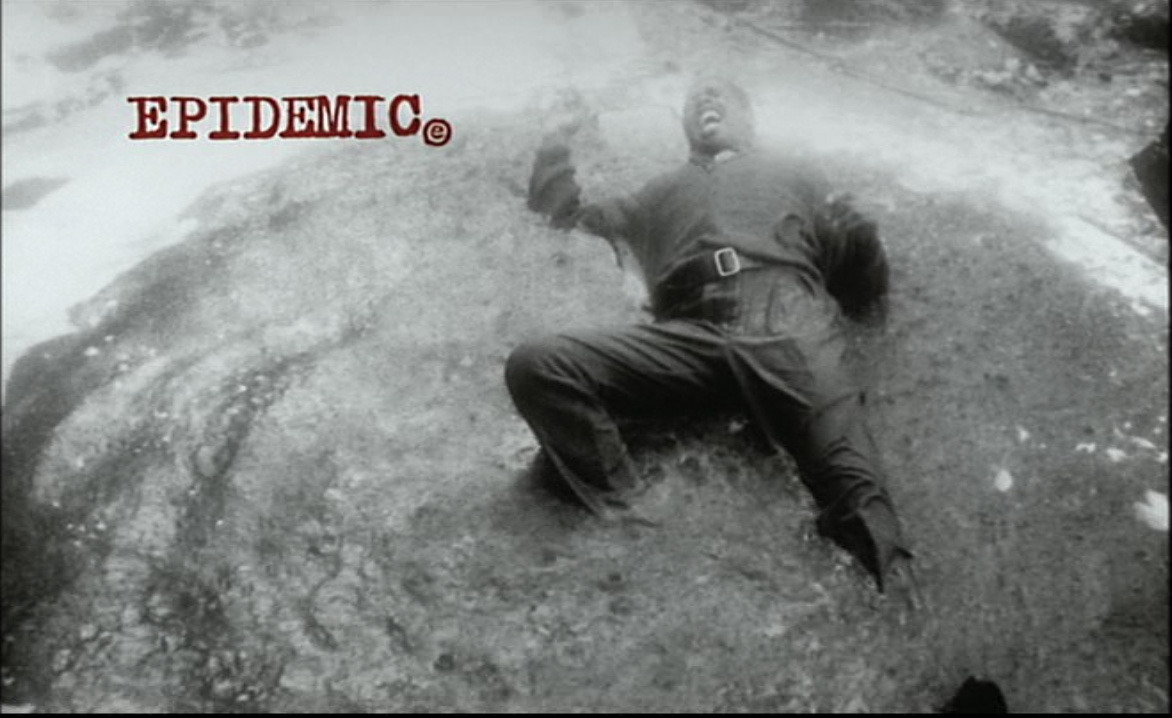
The fictional scenes in vast contrast are significantly more stylised, a sense even on this lower budget the director can compose very eye catching scenes, taking locations as they are and using them to his advantage. He doesn't hide the artificial either and uses it to affect, a scene of a person in a coffin from the side, underground probably one of the most striking and evocative of the whole film. These scenes do however have the one sour point of Epidemic - a really crass piece of dialogue for a black character, an interesting figure who (with the actor initially introduced as a taxi driver in one scene in the real world) is in the apocalyptic world foisted into becoming a Catholic priest with only a few days training and unable to read Latin, in his death throes due to the epidemic speaking the really cringe worthy piece in question. It's sadly the sign of one of Lars von Trier's greatest vices appearing this early in his career, really misguided attempts at provocative which can lead sometimes to convoluted defences of free speech, where his least rewarding work appears from, and how he kept sticking his foot in his mouth especially at Q&As decades from this film.

You could also argue the eighties pop song at the end credits with heavy handed lyrics co written by von Trier is also a sour note, but it comes off as strangely endearing in a curious film. Epidemic is, despite its few flaws, actually a really unique gem which defies genres in its structure. Part of it is a lo-fi drama; some of it is a post-apocalyptic film in a minimalist style. Aspects like Udo Kier's scenes blur fiction and reality, and I haven't even mentioned the film's title is permanently etched on the top left corner of shots like a watermark, a curious creative choice some might find distracting but has a personality to it as a creative decision. The film, if it has a theme, is the power of creativity as ultimately the fake epidemic becomes real. Whilst over-the-top, the finale involves a woman brought into a hypnotic state to see the world of Epidemic with her own eyes, turning the film into a horror film as a result which gets hysterical in tone and certainly ends the story in a memorable way at a dinner party.

In terms of idiosyncratic filmmaking, it is an achievement in how unconventional it is. Lars von Trier, for his flaws, has thankfully never had a film which he made just for money or is truly dreadful, even a lesser known work like The Boss of It All (2006), a comedy, being a lo-fi production where the camera was programmed to hot how it liked in a form of controlled visual indeterminacy. Epidemic, from the challenge of its own low budget, became a story of two creators (played by the actual figures) trying to hastily create a work. A question to how accurate it is to themselves is to debate - I hope so for Niels Vørsel its exaggerated for this version as, whilst it has a sick humour to it, the tangent where he posed as a teen pen writer to American teen girls, whilst never played for sexual connotations but Vørsel having to play a teen in his thirties, has aged in a way where such scenes might not be funny to many anymore.

But, hey, if there ever was a director who was a critic of himself before there was a line for his detractors, it's Lars von Trier. There's a sense, credible, when Epidemic does become a horror film that its narrative is how these two men, von Trier and Vørsel, are complacent to the horrifying power of their craft. Its telling, probably in the most poignant scene in the film that even though he eventually accepts the offer, when von Trier has the chance to see an autopsy at a hospital for "research", he looks on at a male human body without excitement. Not distressed, but distant. Blurring genres, the film's narrator warned us the world here would end in an epidemic. Befittingly von Trier made his self referential film about film making one where that means little when a super disease takes central stage, growing boils and all, naturally becoming a greater concern that a movie deal with a Danish film producer.

Abstract Spectrum: Lo-Fi/Meta
Abstract Spectrum (High/Medium/Low/None): None


Tuesday, 29 October 2019

In the Mouth of Madness (1994)

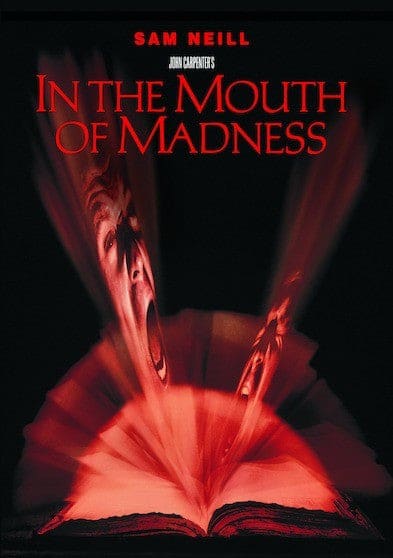
From https://pisces.bbystatic.com/image2/BestBuy_US/images/
products/3231/32317207_sa.jpg;maxHeight=640;maxWidth=550


Director: John Carpenter
Screenplay: Michael De Luca
Cast: Sam Neill as John Trent; Julie Carmen as Linda Styles; Jürgen Prochnow as Sutter Cane; David Warner as Dr. Wrenn; John Glover as Saperstein; Bernie Casey as Robinson


[Major Spoiler Warnings]

Surprisingly difficult to see in the United Kingdom, especially as Carpenter is as popular here as anywhere else, but between this and his collaboration with Tobe Hooper for television called Body Bags (1993), it's one of the few blind spots in a career where even the 1979 Elvis TV movie was released on physical media in the UK. This is a shame as, lore tells us, that In the Mouth of Madness was the last great Carpenter film, which isn't as accurate as that claims but is a tag that was given to one of his most underappreciated works. The nineties was held as where his career wavered, ironically my first films of his Vampires (1998) and Ghosts of Mars (2001) as they were early Sony Pictures DVD released when I grew up with that format becoming a big thing. Before then, Memoirs of an Invisible Man (1992) was seen as a big slip as his first film of the nineties - not as bad as its reputation suggests, but definitely a film lacking his personality. Village of the Damned (1995) has actually grown on me, but it was not seen a powerhouse, and we'll see if the special effects and surfing in Escape from L.A. (1996) are as bad as it sounds.

The first positive credit to In the Mouth of Madness is actually to the screenwriter Michael De Luca, whether his work was adapted exactly from the page or modified out of his hands, as that is a huge factor to this film. His CV as a screenwriter only has three films alongside this, more of executive producer in his career, which include the divisive 1995 Judge Dread film with Sylvester Stallone and Freddy's Dead: The Final Nightmare (1991), the most derided of that series barring the 2010 remake; in comparison he managed here however to hit the ball out of the park. This film does suggest it's going to be pure cheese, a big metal guitar riff on the John Carpenter and Jim Lang soundtrack just when Sam Neill's name is on the opening credits, but this alongside Wes Craven's New Nightmare (1994), rectifying that previous Nightmare on Elm Street film, are two incredibly fascinating meta horror films that came out the same year, certainly a superior pair to Craven's own Scream (1996), which felt pointing out the clichés but not subverting them beyond plot was enough. De Luca with this script found a take on the meta-texture, significantly, which is truly weird and, without nasal gazing, is still idiosyncratic today.

That, in lieu to the King of Yellow, in which author Robert W. Chambers envisioned a text that drove people insane, this film envisions a text, the work of a prolific horror writer Shutter Cane, which will induce nervousness, anxieties and fear upon reading. That's his usual work, and Cane has done so well he's ended up breaking reality itself, as insurance detective John Trent (as played by Sam Neill) is sent on his trail; believing its all a con, Trent instead wanders into the plot of a pulp horror film and eventually an actual pulp horror nightmare land. Its pulp in the truest sense, but it chills the bones a little when Cane, revealed as Jürgen Prochnow with a giant spread of white hair, talks about his work being more wildly read than the Christian Bible. Star Wars has a religion, Jedi, and more people are more likely to know the innings and outings of Harry Potter lore than actually read the Book of Revelations all the way through.

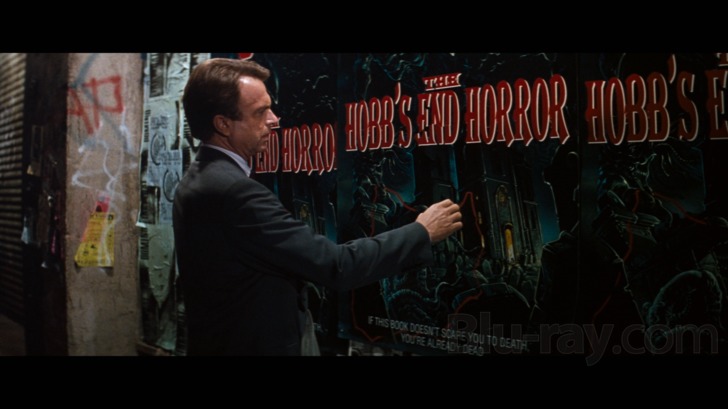
Now imagine if this new book was even more infectious and could poison people further, to madness and violence, even the apocalypse, and In the Mouth of Madness is the closest John Carpenter touched upon the cosmic horror of H.P. Lovecraft, in which beyond the perception of fragile mortal humankind, a novelist can distort reality and be a vessel for horrifying Old Ones to appear through. That they might've been created by him, as it's entirely subjective what exactly his work is or not in what we see, is even more terrifying. It's far more terrifying, as reality eventually splits, the tear reveals that a) the protagonist is a created character, and b) reality has no rules and for a man who believed in logic that term losing meaning is more frightening than monsters. This review has a major spoiler warning, but you couldn't get the true effect of any plot point without the images themselves.

From https://images3.static-bluray.com/reviews/8897_1.jpg

Carpenter
as always is a classist who shots the film with elegance, famously a man who grew up admiring film makers like Howard Hawks, wanted to make films like his in genres like Westerns, but came about in a time where he proved a daub hand in horror and sci-fi. Any moments of broadness - a bicyclist turning husk-like or the guitar riffs in the score, don't undercut the tone in the slightest or his precise filmmaking. In fact the film itself eventually gets around to mocking plot points in pulp horror, like Neil's counterpart, Julie Carmen, suddenly trying to seduce him in the nightmare town "because the author wrote it that way". (Which is hilarious as, whilst he didn't write the film but collaborated on it greatly, Halloween III: Season of the Witch (1982) despite being one of my favourite horror sequels has this absurd cliché depicted completely seriously).

The distinction here to Carpenter's other films is how over-the-top and phantasmagoric this gets. We've had The Thing (1982) in terms of body horror, but In the Mouth of Madness is lurid and intense with this from the beginning. All when a publicist goes axe happy, the film gets increasingly weirder and more grotesque in body mutations and freakishness as the film draws from horror as a genre in general, the Lovecraftian horrors against a pastiche of Stephen King's popularity, apt as by this point even TV let alone film gorged on adapting King's books.

The film finds the right balance of credibility by having seriousness against this, because it plucks symbolism from the entire genre - terrifying possessed children; monstrous entities; religious horror; plenty that is slowly drip feeding and helped by Sam Neill being the cynical sceptic who plays the anchor. We realise his fate already - the film starts with him in a mental health hospital as he tells his story to David Warner - but Neill finds the right tone for a man who is stoic even to the most horrifying things until it gets too much, not surprising as whilst the New Zealand born actor as always come off as meek and affable, he was in Andrzej Żuławski's Possession (1981) going batshit insane, so this film would've been a cakewalk.

The build for the film, when it's already gone off the deep end, is still slow burn because Carpenter finds idiosyncratic ways to move the film's nightmares. A reoccurring image of a police officer randomly beating a man up in a dark alley or how the author's favourite colour drives a man to screaming are among such examples; all never heavy handed because the film is so over-the-top its gone to that tone the moment you encounter Hobb's End, the nightmare town whose own name is even a reference to Quatermass and the Pit, giving you an idea how in depth some of the references are.

The other aspect, in honesty, that whilst H.P. Lovecraft is an author whose work is still innovative and powerful for me, I am also aware that a reader can find his elaborately descriptive vocabulary and exaggerated tone utterly ridiculous, befitting this film's many moments of absurdity, like strange fish-like Old Ones they wisely left as shadows only, and possibly another reason why it's been a huge issue to adapt his work straight rather than evoke for cinema. Befittingly like those stories, insanity is the end, though few would watch themselves in the film they have seen when they finally snap; between this and Wes Craven's New Nightmare we had two of the best of these meta films as far back in the nineties, where more well known films like Scream and The Cabin in the Woods (2012) just come off as flaky in comparison. This, really needing to be more easily available, is definitely as well a gem in John Carpenter's crown.

Abstract Spectrum: Grotesque/Surreal/Meta
Abstract Rating (High/Medium/Low/None): None

From https://offscreen.com/images/made/images/articles/_resized/Review_167_Photo_6_-_In_the_Mouth_of_Madness_(John_Carpenter,_1994)_1000_420_90_c1.jpg

Monday, 30 October 2017

Two Dollops of Killer Tomatoes

I grew up with knowledge of the Killer Tomatoes since a young age, created after co-screenwriter Costa Dillon saw Ishirō Honda's Matango (1963), and continued over multiple sequels by the same director, and Dillon's high school friend, John De Bello into the early nineties. An intentionally absurd, self reflective farce taking old sci-fi b-movies tropes, it takes the fruit most often mistaken as a vegetable and images if it developed sentience and decided to rebel against mankind. I remember seeing a piece of the 1990-1991 animated series, where my fixation on these rebellious tomatoes first came from. Alongside that series, there were four films, the first two the most well known. With a proto-primordial Zucker brothers structure of absurd comedy, the tone the first Killer Tomatoes film has is rough around the edges. As intentionally goofy sci-fi, ironically these films have to be watched in terms of the rise of genetically modified crops and the fear of them, inexplicably bringing so seriousness to films that were meant to be a joke1.

From https://i.imgur.com/HPxoG9U.jpg

Attack of the Killer Tomatoes (1978)
Director: John De Bello
Screenplay: John De Bello, Costa Dillon and Stephen Peace
Cast: David Miller as Mason Dixon; George Wilson as Jim Richardson; Sharon Taylor as Lois Fairchild; Stephen Peace as Wilbur Finletter; Ernie Meyers as The President; Eric Christmas as Senator Polk; Al Sklar as Ted Swan; Jerry Anderson as Major Mills; Jack Riley as Von Schauer; Gary Smith as Sam Smith
A Night of a Thousand Horror (Movies) #146

The fascinating thing about the first film - created between De Bello, Dillon and fellow high school friend Stephen Peace - is that whilst ultimately a mess, it perfectly slides into that era's rich history of American independent genre cinema. Shot in San Diego, California you have a film with the same rough edge of the other independent films, only with the desire to elicit laughter at itself deliberately. The opening credits make you aware of this farcical nature from the beginning as the text is full of jokes, none too lame to not be included. The humour's scattershot, some jokes funny, others not which is ultimately the issue that surrounds Attack.... Also be aware, sadly, that some of the humour is also un-PC. To those who will perceive me as being "soft" for including this warning, what qualifies as politically incorrect is usually not funny anyway, jokes that merely present race or sexuality (for example) as they are in exaggeration, usually for the sake of laughing at them rather than anything remotely further. Sadly this does crop up in Attack... a couple of times, alongside a lot of sex humour, which makes a film that would be suitable for families actually difficult to shown to children.

There was a great energy at the start. The first scene brings up a lot of hope, a tomato appearing out a kitchen sink plughole to terrorise a stereotypical housewife. It doesn't have a prologue and immediately gets to the red invasion, which helps the film a lot, where the police are already fighting them and things are getting worse. It's the perfect set up both for this absurd humour and even a cheap, but funny political joke or two as the president (Ernie Meyers) is in damage control by contacting an ad company to suggest the tomato menace is not as bad as it sounds, in his office permanently signing documents for their own sake and having bartered the Statue of Liberty to the Middle East for a loan. A sense of mayhem is found alongside the ridiculous humour where actors have to pretend to shot tomatoes and scream that they're not being pushed back. This also includes a helicopter crash captured on film that was not meant to happen. This is the one moment that stands out in the film because its sudden on screen and was an actual accident, no one thankfully hurt or killed, the actors hesitating but improvising that a rouge tomato jump at it in the sky, an ad lib on screen that for any major flaws with the film around the sequence is stuck in my mind still.

When the film is directly about the tomatoes it succeeds. There is something ridiculous, despite the existence of John Wyndham's The Day of the Triffids (1951), in tomatoes devouring people. The rudimentary effects behind them, whilst not being bad for the sake of it, emphasises this. Actual tomatoes. Prop tomatoes. Giant red inflatables larger than cars waddling across the camera. Many speaking gibberish growling noises. There's even a tribute to the aforementioned Toho films with a battle in an urban city using extensive model shots, all explosions and prop buildings and tomato juice on everything. Considering tomatoes are remotely the least sinister of all fruit and vegetables - consider the pineapple with its hard shell and spikes, or the pumpkin which has become part of horror symbolism culture - these red fruit are funny to imagine in this role. To be lobbed at people in stocks. A good base sauce for paste. For Red Nose Day charity. Not for a monster stand in. The joke works when the film accepts the absurdity of this situation, but important, plays the attack of the tomatoes as matter of fact, finding humour elsewhere in the scenario.

The film's problems are in this elsewhere. The human characters themselves is where you realise this film has a shaky structure, one which is merely built to suppose any strange jokes the creators could come up with but with the danger that the humour is hit-and-miss to an extreme. You have a crack team of specialists to fight the tomatoes, the only one of importance being Wilbur Finletter (Stephen Peace), a former Vietnam War veteran who wanders around in full parachute and uniform even if the parachute itself is constantly in the way of his movement. Peace is not bad as a comedy figure especially paired to David Miller as the government agent Mason Dixon meant to coordinate this task. This team of specialists however is pretty useless in terms of humour and story. A female athlete who eats steroids literally for breakfast but little else. A scuba diver in full wet suit, back in the era where that was inherently surreal. A master of disguise Sam Smith (Gary Smith), who could've been more useful as a funny character, especially when he attempts with some succeed to disguise himself as a tomato and infiltrate the enemy, but also has risible humour attached to him such as, as an African American actor, dressing up as Hitler just because. The female reporter Lois Fairchild (Sharon Taylor) who also plays a large role in the film is also not that interesting, contributing not a lot and really there for dated sex humour that's somewhat demeaning.

This humour, despite being the main point of Attack..., is inconsistent to an extreme. Attempts to be wacky are as liable to fail as they are to succeed, with reoccurring jokes taking huge chunks of the running time that could either be awful to sit through as much as be a pleasure to follow on with. When it works, it's the jokes about the ad company being hired to disguise the tomato invasion in propaganda, the presidential press secretary Jim Richardson (George Wilson) meeting an ad company manager obsessed with pure commercialism. Ads appearing on screen to the viewer, as well as his latest projects (never seen onscreen but heard) which allows us to witness Wilson's horrified reactions to material like Jesus Christ shilling a tech company. Or the unexpected fact this turns into a musical at multiple points, such as with the ad executive bursting into song about his work or soldiers performing a choreographed dance before they fight the enemy. Its heavy handed but, outside the homicidal tomatoes themselves, its where the film gets the most interesting. However there is so much undeveloped slapstick, crass sex jokes, and jokes in general that fall short that I have to concede that Attack of the Killer Tomatoes is the sum of its individual parts judged separate rather than a success. Aspects I am happy to have seen, and laughed at, but it's also a failure.

From https://i.pinimg.com/736x/5e/2d/f3/5e2df3555c8412991
ec9f8470e46e84b--tomato-movie-sci-fi-horror-movies.jpg

================

From http://www.scifi-movies.com/images/
contenu/data/0002003/affiche.jpg

Return of the Killer Tomatoes (1988)
Director: John De Bello
Screenplay: John De Bello, Costa Dillon and Stephen Peace
Cast: Anthony Starke as Chad Finletter; George Clooney as Matt Stevens; Karen Mistal as Tara Boumdeay; Steve Lundquist as Igor; John Astin as Professor Mortimer Gangreen; J. Stephen Peace as Wilbur Finletter; Michael Villani as Bob Downs; Frank Davis as Sam Smith
A Night of a Thousand Horror (Movies) #147

Return of the Killer Tomatoes is in many ways the superior film even if the original, despite being a failure, had the more intentional risks to praise. It also has to be kept in mind this isn't really a film about giant killer tomatoes, but where a mad scientist Professor Mortimer Gangreen (John Astin) can turn tomatoes into human beings with toxic waste and certain choices of music. As bizarre as you could get as a premise still, slap bang in the late eighties after teen sex comedies populated the era. Surprisingly it does continue on from the last film, ten years later in a world where tomatoes are outlawed, a subplot never really tackled fully but amusing that they've become prized contraband and the owner of any grocery store could be the equivalent of a moonshine dealer in Prohibition America hiding the goods in the back. Wilbur Finletter (Steve Peace returning back to the film) is now running a pizza parlour after his military service, where weird (and likely disgusting) pizza toppings have to be used like candy to replace tomato sauce2, and our two leads, nephew Chad Finletter (Anthony Starke) and Matt Stevens (George Clooney) work behind the counter.

Clooney, and young and bouffanted here, is part of the reason the sequel is known, his early pre ER television days a curiosity where, before his television success let alone when people called his the Clark Gable of his era, he feels here like he's merely in primordial form here. His comic timing especially isn't as defined here as when you get to his work for the Coen Brothers, the only really interesting joke (that just happens to also be crass) being how he's conning beautiful women with a fake competition in hope of getting laid himself. Starke as his friend, the straight man to his joker and the main lead, is also just adequate. The plot's absurd fluff where Chad meets Tara (Karen Mistal), the perfect woman who just happens to have once been a tomato, Gangreen's ideal woman he wants back. It's a cocktail of meta humour, sex jokes and farce which is as erratic as the first film even if the look and style of the film is considerably slicker than before.

The more overt meta humour works, the film actually stopping half way through as the cast and crew deal with the fact they're run out of money, the film afterwards suddenly full of product placement in the background and blatantly in dialogue. It's moments like this where Return..., even as a fun romp first, gets the funniest and more rewarding. Going for the strangeness of its material is as successful. Where the scuba diver returns from the first film for a cameo, living in a water submerged lounge where even the pet dog has a scuba mask on. How it runs with Gangreen's machine being able to create an army of Rambo knockoffs, big beefy musclemen, or even the Pope just from tomatoes and certain music. And Igor (Steve Lundquist), one such creation who despite being the henchman really wants to be a news reporter more, a joke the actor does pull off with real fun. Even the fluffy tomato creature named FT turns out to be funny as a creature which makes noises, waddles around unconvincingly, and is willing even to sacrifice itself by jumping on a live hand grenade.

It's a shame, considering these virtues, that the ending does lean more of the scattershot tone of the first movie, a mess of jokes and plot which vary in whether they work. It's this which does undermine Return..., arguable that if the creators focused more on giving a more serious plot to these two films, they would have been more well structured and actually funnier as a result. Also strange with Return... is that, whilst its more overt about the sex comedy, its surprisingly chaste, not a criticism or a compliment, just a very strange detail with the sequel that stands out.

From http://theslaughteredbird.com/wp-content/uploads/
2016/07/Killer-Tomatoes-Product-Placement.jpg

====
1) And Matango, despite its absurd premise of mushroom men, is actually a bizarre and compelling psychodrama, one in which shipwrecked people forced to survive on an island may be hallucinating their own turning into mushroom people from eating the local fungus, or that the mushroom people are real but the desperation and madness being formed in the survivors is as dangerous as the local population. It's a film in dire need of availability as its underrated from the director of Godzilla (1954) and very alien from the traditional "fun" sci-fi Toho studios were also doing.  

2) Though considering you can have caramelised onions, hummus, cheese, even pumpkin as options instead of tomato sauce for pizza or otherwise, we're clearly dealing with the deliberately absurd. Only a mad person would consider eating any of the pizzas made during this film.