Showing posts with label Director: Alfred Hitchcock. Show all posts

Saturday, 26 October 2024

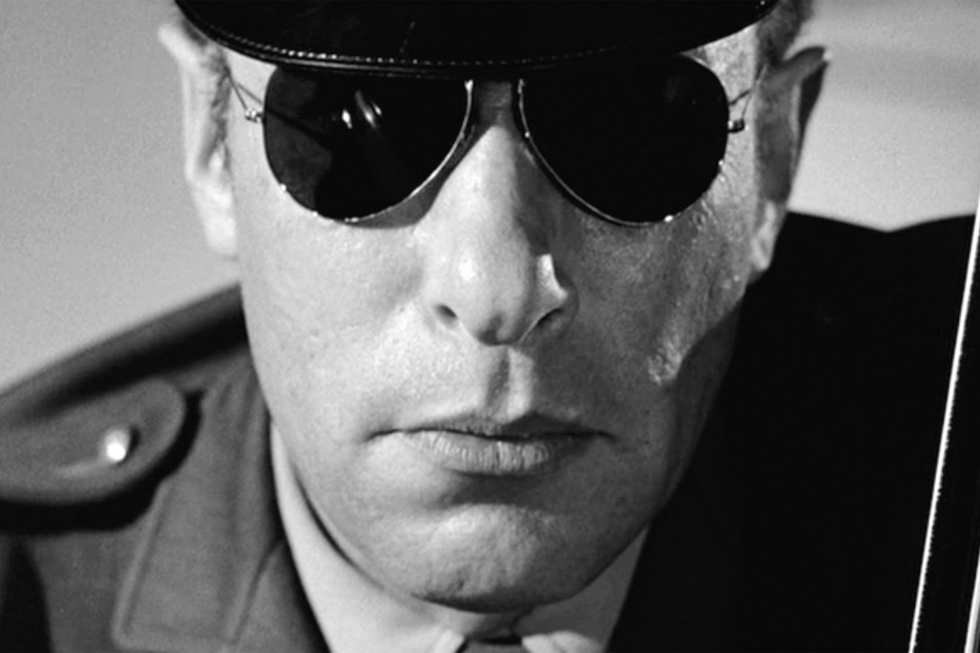
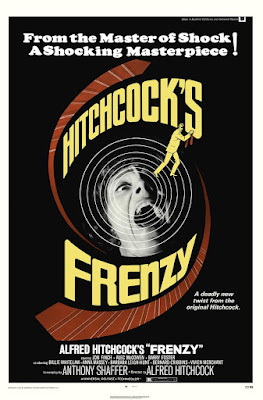
Frenzy (1972)


Director: Alfred Hitchcock

Screenplay: Anthony Shaffer

Based on Goodbye Piccadilly, Farewell Leicester Square by Arthur La Bern

Cast: Jon Finch as Richard Blaney, Alec McCowen as Chief Inspector Timothy Oxford, Barry Foster as Bob Rusk, Billie Whitelaw as Hetty Porter, Anna Massey as Babs Milligan, Barbara Leigh-Hunt as Brenda Blaney, Bernard Cribbins as Felix Forsythe, Vivien Merchant as Mrs. Oxford, Michael Bates as Sergeant Spearman, Jean Marsh as Monica Barling, Clive Swift as Johnny Porter, Madge Ryan as Mrs Davison, Elsie Randolph as Gladys, John Boxer as Sir George

Canon Fodder


One of the last Alfred Hitchcock films, Frenzy stood out in his career with its impact making sense in context. By the seventies, Hitchcock had not made that many films since 1964 next to his prolific golden period from 1950 onwards, having struggled with his attempt to be an independent producer of his own work in the late forties and failing. His golden era, which gave us films like The Trouble with Harry (1955) to Psycho (1960), and did not have producer David O. Selznick involved as his forties career, for good and for bad, ended in the mid-sixties with him considered a huge unreliability. Hitchcock is a controversial figure for how he depicts women, his obsession with the "Hitchcock Blonde", and for me, it is everything with actress Tippi Hedren where I agree is the uncomfortable moment where he crossed a line. I cannot defend what happened with how he treated her on both films they worked on, but it also clearly crossed a line to even alienate those close to him and studio executives at Universal. The first film, The Birds (1963), was a box office success, if one which would have got him cancelled for the story of what happened with Hedren on set, but Marnie (1964) was not, and was the straw which broke the camel's back.

Frenzy's genesis likely comes from a project Universal confiscated from him, Kaleidoscope, a proto-Frenzy which was meant to be very explicit, sexually and in terms of violence, influenced by the like of Blow Out (1966) by Michelangelo Antonioni, to be shot with handheld cameras, natural light and location shooting. Personally the films which we did get after Marnie have their virtues if their problems are felt in their sluggish paces and having his creative power pulled from - Torn Curtain (1966), as Hitchcock has to put up with Paul Newman, as someone who hated the method acting style, has this issue as does Topaz (1969) - but Frenzy feels alive and still disturbing decades later. As a lower budget film shot in his homeland, as someone who was an old man by that point, he nonetheless got carte blanche to make a film which does not feel antiquated and with a sick humoured tone. Frenzy is the most explicit and adult film in his career, but this tale of a serial "neck tie murderer" killing women in London, despite it being lurid subject matter explicitly invoking rape and strangulation of these victims, is more startling because of its sense of humour contrasting this premise. When members of the police trying to deal with the case in a pub talk of the psychology of said killer, only to say having a sex murderer is good for English tourism, it emphasises the gleeful misanthropy felt fully throughout this film.


This will make some very uncomfortable for Frenzy, but in context, what has aged is ye old seventies London, and that feels like a time capsule to what locations we still have, starting with the opening by London Bridge and the Thames, only to undercut them with from the get-go with a public gathering interrupted by a female corpse floating in the river. The set up is the traditional Hitchcock wrong man scenario, in which the obvious red herring is Richard Blaney (Jon Finch), a former lieutenant of the air force reduced to a bar man fired for drinking on the job and forced to sleep at a Salvation Army hall when he has no money. It is very obvious and not hidden who the killer is, his friend and market fruit & vegetables seller Bob Rusk (Barry Foster), with the reveal a disturbing one which places Richard as a suspect, as it involves the murder of his ex-wife. To the film's credit, and why it's more salacious and sick humoured aspects work rather than feel inappropriate, is that when it is about the awfulness of these murders of women, they are meant to lead to revulsion, whilst the humour is felt in terms of how, as throughout Hitchcock's career, he has an obsession with this twisted side of the human consciousness, its obsession with crime and murder, where the humour is the relieving puncture of the tension.

The parallel plot is Chief Inspector Timothy Oxford (Alec McCowen) who is investigating the murders, and this is where the humour especially comes in, that his wife is also into cuisine cooking. It is surprising in context to how explicit and grim the film is, the sole one to be fully able to in Alfred Hitchcock's career than imply such themes, and yet this is one of the most distinct parts of this entire film, funnier when you are aware of his and wife (and important collaborator) Alma Hitchcock's love for cooking and cuisine, thus presenting us with dishes of a solitary quail on a plate with a few measly grapes, or a soup full of fishes heads, when all Oxford wants is an English breakfast. There is still the style of older Hitchcock films here too, which was only briefly seen in both Torn Curtain and Topaz, the flashes of his deft hands when a tragic death of a main character is perfectly depicted with the camera in one take leaving the environment back out onto the street, without needing to show us what we know is going to happen. There is also the set piece with a truck full of Lincolnshire tates (potatoes) which mines tension against the sick humour from the act of disposing a corpse, including rigor mortis and a neck tie pin that needs to be retrieved, all despite the figure involved being a complete monster now in peril. You should not be laughing either yet the farcical nature of such a gristly scenario is felt to ease the tensions.

What is also felt particularly that here too, despite the character of Oxford who happens to be the one person, including the wisdom of his wife, to think, is Hitchcock's long standing paranoia and distrust of the police and the law, especially when people are quick to put the kicks in Richard as witnesses, like the male bar manager who fired him. Throughout Hitchcock's career, including adapting a real life case of a man put to trial as an innocent The Wrong Man (1956), ever since he was put in a jail cell as a child which created his long standing fear of authority, Hitchcock has always shown the frailty of the system. Even the murderers in his career do their acts for petty grievances, or here have compulsive sexual dominance obsessions but look like nice blokes who sincerely love their mothers, and that is probably the most misanthropic aspect of Frenzy as well as Hitchcock's career. Barring his forties work where he decided to fight real fascists by pitting his characters against reel ones, his work as always had this, and whilst the adult content here is strong, the more potent aspects are the gullibility of law and the matter-of-factness of such disturbing crimes taking place in a world where you could still smoke in pubs. The air of downbeat grungy London, like a lot of more lurid genre films from this era, makes its way here too, adding to the macabre nature, emphasising all these traits and adding to the atmosphere, and whilst I would argue his final film Family Plot (1976) is deeply underrated, I see why Frenzy is a late era Alfred Hitchcock film that is held in high regard for good reason.


Saturday, 16 September 2023

Number Seventeen (1932)


Director: Alfred Hitchcock

Screenplay: Alfred Hitchcock, Alma Reville and Rodney Ackland

Based on the play by Joseph Jefferson Farjeon

Cast: Leon M. Lion as Ben, Anne Grey as Nora, John Stuart as Barton, Donald Calthrop as Brant, Barry Jones as Henry Doyle, Ann Casson as Rose Ackroyd, Henry Caine as Mr. Ackroyd, Garry Marsh as Sheldrake

Canon Fodder


Sausage. Hit him over the head with.

Number Seventeen promises a lot as an early Alfred Hitchcock film immediately, of expressionist shadows as a homeless sailor enters a house for sale, only to find another man and also a corpse there. Already you have awesome compositions, almost like a supernatural drama, of looming shadow hands alongside jump cut editing to a train to show shock. It is however, just in its title too, a weird film for Hitchcock, the kind of “weird” in terms of not a positively delirious title but something that is absolutely curious in his career. It is an oddity with virtues but a lot of issues behind its creation.

Hitchcock had to make this film, part of his career with British International Pictures1. Despite the fact he had already made The Lodger: A Story of the London Fog (1927) and Blackmail (1929), and was becoming an acclaimed filmmaker, his career up to sailing to Hollywood and the United States for Rebecca (1940) includes films which stand out in premise (his personal project, the drama Rich and Strange (1931)), only to not become films which stand out the highest in his career, and titles which he made as a studio director whether he wanted to make them or not, such as the operetta film with Jessie Matthews, Waltzes from Vienna (1934). Number Seventeen, based on a thriller play by Joseph Jefferson Farjeon, has a suspense plot including one of the earliest McGuffins, if not for the first, for Hitchcock’s career in that it is a piece about jewel thieves swarming around this house alongside a detective, his daughter, a cop in disguise and the homeless man Ben (Leon M. Lion). Hitchcock however, in adapting this, decided to turn it into a farce on purpose tonally, which affects the final result.


The final film because of this is a really broad farce which does not really work. Hitchcock films can be legitimately funny, without becoming comedies but being suspense films which have incredibly dour winks at the banal mixing with the morbid – the cop in Frenzy (1972), one of his grimmest tales, whose wife is trying experimental cooking to his horror, or a key scene of Strangers on a Train (1951), whilst not played for laughs, being based on whether the lead can complete a game of tennis as quickly as he can – or incredible one-liners, such as the many Cary Grant has in North by Northwest (1959). This does eventually have charm, with Leon M. Lion as Ben, once you get past his initial gurning klutz performance, becoming lovable as a genial homeless man caught in the middle of this against his will, but a lot of the humour, being the slapstick to speed up fight scenes, goes over the head in actually landing. A lot of it being a pastiche of the suspense drama completely falls flat when it eventually gives up and becomes a more heightened crime film by the finale. Instead a lot of this feels like a stage play with Hitchcock managing to make it visually vibrant and soaked in shadows, entirely set at night, of a group of people ending up in this house all at once. The sense of this comes when one of its parodies, the female lead on the villains’ side who is so mysterious she is a deaf-mute, being jettisoned. When this character Nora (Anne Grey) just starts speaking, completely kneecapping one of its more idiosyncratic touches as quickly as it is introduced in a film only an hour long, you get the feeling Hitchcock made a legitimate mistake with his collaborators which effects the final quality.

Seventeen, by way of its finale with model trains, gets a really thrilling ending of escaping by train and the commandeering of a public bus to catch up with it, which shows how the film could have been cultivated into an ambitious and grander work by its director. The film had the potential to be a great production, full of McGuffins and plot points for the sake of getting to the next scene – corpses not quite dead, cops posing as lackeys, heroines secretly hiding in the villains’ side – as people fight over an expensive necklace. Even a scene of falling over a broken wooden railing does show how the comedic tone of the film could have mixed with suspense. What this feels like is a germ of a bigger work, and instead it is Hitchcock the master craftsman who sticks out than a successful result, still early in his career showing the mind which planned out his films carefully before they were filmed, compositions even here of the images which stand out incredibly. If it is a failure in Hitchcock’s career, but that does not mean you cannot appreciate the skills he shows here that would grow in his filmography.


====

1) Alfred Hitchcock Collectors’ Guide: Number Seventeen (1932), written by Brent Reid for Brenton on Film and published on August 16th 2019.

Monday, 7 August 2023

Vertigo (1958)


Director: Alfred Hitchcock

Screenplay: Alec Coppel and Samuel Taylor

Based on the novel D'entre les morts by Pierre Boileau and Thomas Narcejac

Cast: James Stewart as John "Scottie" Ferguson; Kim Novak as Madeleine Elster; Tom Helmore as Gavin Elster; Barbara Bel Geddes as Marjorie "Midge" Wood


Vertigo was once a critically maligned film from Alfred Hitchcock only to grow into one of his most critically lauded, so much so it knocked off Orson Welles' Citizen Kane (1941) from the top spot of the Sight & Sound magazine poll for greatest film ever made in 2012. That was not exactly an easy achievement to have completed when Citizen Kane was number one before it for five plus decade, and the fact Vertigo has gained this stature is both an achievement but also strange for me when viewing the film. Vertigo is a true one-off deserving to have done this, but it is a difficult film to digest, one which is possible to criticise for being too languid, too obvious and at times too stripped of Hitchcock's precise, expert filmmaking, even having something the director himself considered a plot flaw in how reliant the protagonist’s acrophobia would be for the plot the succeed1. It is also justifiable to champion, even if it involves digging into his own psyche at the same time as a filmmaker, for how alien, disquieting and hypnotic as a film it is. The premise is one perfect for a Hitchcock thriller: when he develops acrophobia and vertigo at heights, San Francisco detective John "Scottie" Ferguson (James Stewart) is forced to retire from his career, but is asked by an old friend to follow his wife Madeleine Elster (Kim Novak) under the belief she has been possessed by one of her late ancestors. The results of taking this job lead to Scotty becoming detached from reality chasing after a woman he falls in love with, one who might not be all she seems. This however leads to a very different result, an unnerving melodrama with vaguely Gothic tinges.

You have to accept a lot of poetic license. That Scotty's vertigo is a MacGuffin. That a major plot twist is shown earlier than it would in any other film, and very obvious if you are attuned to these types of plots, turning the rest of the movie into a type of psycho-dramatic character piece that roots itself into a direction detached from the rational. If you "get" Vertigo's tone and appreciate its crafted elegance, however, it is an unnerving film about psychological breakdown and neurosis, the plot crux more to do with the emotions of two characters, Scottie and Madeleine, who become more emotionally disconnected from reality and pull the rest of the film with them into their heightened worlds. For the moments of lightness that take place, screwball comedy with Scottie's friend and ex-fiancée Midge Wood (Barbara Bel Geddes), who still loves him, most of the film is connected to Scottie almost entirely, onscreen for most of the film in the centre during his descent into dark obsession.  When the film shifts to its second half, the already mentioned plot twist which would usually happen at the end of another thriller is suddenly revealed halfway through with half the film left, leaving Vertigo in uncharted waters where one is disturbed by Scottie's increasingly erratic behaviour after he is briefly hospitalised.

Passages of Hitchcock's career have this film's tone, an odd supernatural or psychological murkiness. Rebecca (1940) is an obvious cornerstone of supernatural melodrama, even Under Capricorn (1949) expressing his interest into slow burn dramas based on hidden neurosis. However even the dream sequence in Spellbound (1945) is safeguarded by the fact, despite being designed by Salvador Dali, that it is a dream whilst Vertigo, despite also having a dream sequence, is entirely in the vague and mysterious. In Vertigo the characters are drawn along narratively by emotions and unseen forces, not elaborate plots of other Hitchcock films, locations such as flower shops, woodlands and a mission called Mission San Juan Bautista all becoming imbued with ghosts of many forms, literally in an image at the ending in the bell tower of the mission. The use of striking colour especially adds to this. Made in the height of Hollywood's Technicolor era, the film is striking in its aesthetic and use of San Francisco locations, but it is especially when you get to the interiors this stands out. Those scenes emphasises the ghostly air from the red walls of a restaurant that is repeatedly entered by the characters and the reoccurrence of the colour green in the second half which purges the world into a sickly obsessive form. It is a deeply perverse film in its themes, carefully dictated by Stewart and Novak, between them managing to keep the film's tone in the right groove, despite the visible age difference, Stewart able to switch himself from the stereotypically jovial and charming man he is seen as in cinema to someone almost shell shocked or a walking comatose, while Novak also has to juggle a complicated role when the film pans out in the end.

Shot in said lush Technicolor by director of photography Robert Burks, a regular collaborator with Hitchcock into the early sixties, Vertigo is as much able to work because the aesthetic of classic Hollywood that the story is depicted through, especially when this takes the studio system style of Hollywood, always evoking for me the sense of the elaborate and stylish, literally the "Dream Factory" creating dreamy films even when shot on location, and undercut it with this tale of obsession. The rear-screen projection for actors driving cars to the colour palettes now become unintentional tools for creating heightened dreams, here becoming more and more unsettling as this narrative of a love for a construct continues. The San Francisco locations, especially the gorgeous panoramas of the sprawling metropolis, add a sense of scale, keeping a Gothic tone for the plot but setting it in a modernist urban environment. Another big contribution to the film is Bernard Hermann's orchestral score, the drama contained in it solidifying the characters' emotions as a lush but far-from-generic score, adding further to the mysterious air surrounding all Scottie encounters and does. That it can switch from the legitimately romantic to the disturbed, and you can pick up the difference in the orchestral instruments and the notes they play, is evidence of its success as a score.


The most openly unconventional aspects of Vertigo are specially created animated sequences. The first is the opening credits by Saul Bass, the title emerging from a woman's eye in extreme close-up, the very modern design of Bass' work for Hitchcock still to this day incredible for their craft but also unique compared to modern title designs still, the use of colour and shape. They become almost avant-garde especially as the credits do not portray anything that takes place in the movie but sets up an unnerving mood it has. The other is the mid-film dream sequence designed by abstract artist John Ferren that takes the same route, flower petals spiralling outward and a figure falling into the void, one of the most iconic images of Hitchcock's career being James Steward's disembodied head staring straight at the viewer which comes from this sequence. It is an iconic image as he is sucked into a mental abyss of his own psyche that he is chained to for the rest of the narrative. It aptly sets up the emotional shock, in the series of events that set up the second half, which will turn Scottie drastically.

Barring its style, including the innovative depiction of Scottie's vertigo, a distortion of our perception as well as his as it is always in first person, cinematic space growing in size without any seemingly actual movement, the rest of the film's unconventional tone is internal. Alfred Hitchcock was a Hollywood director who made commercial films, his auteurism coming from how clear and involved in their craft he was from the get-go of each production, but Vertigo does reach its tendrils into the expressionistic, with its languid pace, in that it is all induced and affected by its characters' minds. When it gets to the second half as Scottie meets another woman similar to Madeleine, the ghosts of the first half change from historical ones to psychological baggage of sexual and gender issues. About a man's memory and view of others becoming distorted and affected as he tries to control and groom this second woman to be Madeleine, Hitchcock was completely blunt about the sexual meaning of this in his interviews with Francois Truffaut, even going as far as say that Scottie was “indulging in a form of necrophilia2, but there is as well the notion of idealism and how it can become poisoned is noticeable. It also cannot be denied that, to an uncomfortable degree after this with his problematic history with Tippi Hedren, Hitchcock himself had blatantly obvious fixations on the idealised woman, and whether he can be defended as an artist for this or not, Vertigo becomes a text unintentionally, but with greater weight, in seeing obsession as a concept for the perfect woman be dissected by its plot.

[Spoiler warning. Skip italicized text if you do not want the film to be spoilt for you]

Adding to this is knowing the woman Scottie is obsessed with is a mere image, a fake stand-in for his friend's real wife in a twist Italian giallo filmmakers would have ran with. The woman he loves manages to die twice in fact, his love only existing for the form of Madeleine, wearing a certain flower, a certain way to their blonde hair style tied up in the back, a certain grey suit dress designed for the film by Edith Head, and an image created based on the real wife, the individual Kim Novak's character actually is and Carlotta Valdes, the ancestor Madeleine is said to be possessed by, amalgamated together. The image of femininity he adored is a mere picture, while the stand-in who promises to love him is rejected for admitting how she is not the Madeleine he wanted and that she was used to trick him into a murder scheme. The "abstract" I am obsessed with in cinema, how I use the word, is as much about the questioning of subjective reality, and the theme of Vertigo of an idealised image, a beautiful woman, being both impossible to be reach and not even existing is a good example of this type of questioning, when the symbols of femininity for Scottie not the woman herself is what he desires. As an entertainment film, this makes the film a cautious tale of this obsession, and that the film is as languid as it is befits this.

[Spoiler ends]

Whilst there would be a film later on which is stranger than this in tone - The Birds (1963) even as a monster film is more stranger and chilling in the baggage it evokes - Vertigo is haunting as an entertainment feature, and as art, because its conceit is about the image one has overtaking reality as Scotty is chasing after a phantom in many a sense. This comes with mind as I have had to gradually warm to Vertigo over the times I have seen it. It does meander significantly halfway through, noticeably slower in pace to other Hitchcock films, and that makes it a film whose acclaim is fascinating in that it shows visible flaws in plotting and pacing that cannot be denied. It possesses something which overcomes this, even if it is unnerving, even before the Sight & Sound polls, back when the film was not readily available to see, causing someone like Brian De Palma to openly riff on the same theme of perception in Obsession (1976), the title spelling out the themes openly. Film critics dug into this film when it was more readily available to see, and what virtues the film has - its performances, the music, the aesthetic style - make what would be a hammy melodrama at points in another's hands enticing as it is disconcerting.


Abstract Spectrum: Expressionist / Mind Bender/ Weird

Abstract Rating (High/Medium/Low/None): Low


====

1) Truffaut, François (1985). Hitchcock/Truffant, Revised Edition. First Touchstone Book Edition. Pg. 247.

2) Truffaut, François (1985). Hitchcock/Truffant, Revised Edition. First Touchstone Book Edition. Pg. 244.

Sunday, 23 July 2023

Under Capricorn (1949)


Director: Alfred Hitchcock

Screenplay: Hume Cronyn and James Bridie

Based on the stage play by John Colton and Margaret Linden, adapted from Helen Simpson’s novel Under Capricorn

Cast: Ingrid Bergman as Lady Henrietta Flusky; Joseph Cotten as Samson "Sam" Flusky; Michael Wilding as Hon. Charles Adare; Margaret Leighton as Milly; Cecil Parker as Sir Richard; Denis O'Dea as Mr. Corrigan; Jack Watling as Winter

Canon Fodder


Under Capricorn presents a bad moment for the career of Alfred Hitchcock, where after beginning his American part of his filmmaker career, working under producer David O. Selznick from 1940’s Rebecca to The Paradine Case (1947), he stepped out with Sidney Bernstein to start his own film making company Transatlantic Pictures. Under Capricorn was the film he was focused on making, with Swedish actress Ingrid Bergman, yet irony holds that the film quickly made beforehand, the experiment in long takes Rope (1948), became the film of the two more easy to fit in the image of its director, with its own idiosyncratic and compelling traits to dissect technically and in its content. Under Capricorn, as a melodrama adapted from a novel, had the unfortunate existence that, as an expensive colour production, Bergman became a pariah to the United States, a big source of potential revenue for the production’s release, as by when the film was released, her controversial adulterous affair with Italian director Roberto Rossellini had transpired causing scandal. Under Capricorn was taken by one of its investors, Bankers Trust Company, when a box office failure to coup the lost finances, not seen until the sixties when made available to see again, and the studio Transatlantic Pictures was to be no more into the fifties. Thankfully, Hitchcock’s fifties period onwards would produce some of his most iconic films, even contenders for some of the best ever made for people, but Under Capricorn itself is a curious film to think about. Simply to watch and actually digest this lesser known production is a lot to chew on, and this is factoring in the number of voices championing the film over the decades when you dig into its history.

Set in 19th century colonial era Australia, this follows an British ex-patriot Hon. Charles Adare (Michael Wilding) wishing to make his fortune there, only to come to Sydney and come under the wing of Joseph Cotten’s Samson "Sam" Flusky. He is for many a suspicious figure, and as the story continues, his pariah status despite his own fortune is learnt of by Charles. A place where convicts are said to be able to step back into respectability, this proves hypocritical as Sam was such a case, still shunned due to the circumstances around his case, murder, as a former tender of the horse stables where he met his wife, Lady Henrietta Flusky (Bergman), who loved each despite their class differences only for tragedy to strike. A luscious film, yet set in a place where shrunken heads are traded secretly in the streets, the film is stepped in melancholia despite its lush colour aesthetic shot by legendary cinematographer Jack Cardiff. Bergman’s lead is ill, explicitly an alcoholic whose addiction is caused by the anguish of the time having had to wait for Sams release from prison in the colony, neither helped by it being very clear the head maid Milly (Margaret Leighton), in love with Sam, has been gas lighting and feeding her mistress’ drinking for control of the house.

It is an odd folly for Hitchcock as much as I can see this be a legitimate grower in its riches, where in contrast to later films which were maligned, digging the virtues out of this one means tackling a film which is out of step from the director’s many trademarks. As much as Torn Curtain (1966) for an example was viewed as a lesser production, his Cold War spy thriller, that at least has stand out set pieces, and his cynical whit written everywhere in its tone, whilst this was one of a few tangents away from the thrillers and suspense dramas Hitchcock rebuilt and innovated in whilst providing more to them. Rope, made quickly before this film, was an experiment that fed into this one’s production, with that tale being told entirely in ten minute long takes, but that was still a taut thriller based on a stage play based on the moral corruption of the heart, the perfect murder. This in contrast is a depressed melodrama, compelling but one that with hindsight would have not been a success for his own studio, even if Bergman’s affair was not a factor, unless the mood of the audience was in his favour, moments in danger of pure dourness, even next to the melancholia soaking in Rebecca which this can be compared to. 

The biggest issue with Under Capricorn, truthfully, is that there are times this feels like it could be directed by anyone else but Hitchcock, and that is factoring in how much is clearly his craft, but with pockets where the film lacks some finesse to match when this triumphs in other moments.  That is an issue, as even Rebecca, notoriously a jostling competition between Hitchcock and his producer O. Selznick for influencing its content, feels fully a piece to the director’s career, whilst here it does feel its length with some padding. Thankfully you see a lot to Capricorn which clearly comes to this, a mature drama about accepting the demons of the past and jealously, even with humour, as fittingly for a known food connoisseur, Hitchcock has an extended joke about breakfast preparation with deadpan expressions at some horrifically cooked eggs. The qualities of the acting help what does feel its length without feeling methodical, and one of the biggest aspects of its production which can be missed, its long extended takes, does lead to moments where the viewer fully engaged with the emotion of the drama. Bergman’s introduction into the film, or her eight minute confession of her traumas, are some of the best moments, which are helped by Hitchcock deciding to force the film to extend takes for longer than usually done, forcing you into the space with these scenes. There are moments where this style clearly did not work, where honestly the film feels morose in its pacing, or where the drama is undercut by scenes of dialogue which have not got the snap of his work before and after, where the film as a technical level, and the tone of the film, needed to be rethought.

His sense of black humour may have also helped as someone, despite rarely writing his scripts, visibly influencing them, as it would have actually helped make the strongest emotional parts more meaningful. Considering how this nudges to some very adult content even in terms of cinema in the decades after, the film is trying at a deft hand at a really serious subject needing to not always lean on these extended long takes and slow pace – Henrietta’s confessions, alongside his alcoholism, seemingly evoke even prostitution or at least a life of squalor part of her life in the slums of Sydney whilst waiting for Sam’s release, either subjects still taboos a century on for some, are where the themes of the film really do become some of the darkest of Hitchcock’s career among many times he entered into this territory, in spite of not explicitly showing a lot. It would have not been inappropriate if the film had embraced its more macabre edges more, or used its languid technical style as a weapon by occasionally stepping into some editing once or twice, especially as where the film feels its weakest is in its lighter moments, too fluffy or insubstantial next to the best comedy in his films, sticking out in contrast to the richness of the emotional angst and pained love, including class bias, for Sam to Henrietta. Tellingly it is the character of Charles where most of this comes from, though he is an important part of the love triangle within the film itself, so there is a sense that the optimistic and lighter moments of the story, and effectively him as a character allowing the viewer into this world of Sam and Henrietta, needed to be rewritten even if in one or two touches as with these few drab moments.

This juxtaposition of where the film succeeds and does feel like it could have been better paced is found in how more vibrant the last quarter is, where its gothic and melodramatic storytelling becomes more prominent, with the machinations of Milly and playing to more lurid suspense in the attempts to psychologically ruin Henrietta come to the fore, including the shrunken heads referenced earlier in this review make their return. It is done without it seeming inappropriate for the rich characterization, and where this film fully succeeds including with the character depth, by writing and acting, of the tale of Sam and Henrietta. It is not a surprise how the film has managed to win more and more respect over the decades - Peter Bogdanovich was a huge admirer of the film1 – and honestly, this is the kind of production that could easily grow in respect from me, especially if it was readily available in the best restorations to allow its aesthetics to be emphasized, the contrast of rich late forties colour cinema against its bleak heart one of its more enticing favors. I am still going to say, even when the film may become flawless the more times seen, where I find its sluggish moments of pacing dissipate to full admiration, that this was a film that was going to be doomed back in the day as a box office film or be a risk to have even committed to. Some of this is simply Hitchcock’s name had already been cemented to thrillers, but a lot of this feeling comes simply from what this film is, a production even when it offers a happy ending that finds itself intentionally wallowing in its melancholia.

The shadow the film had thankfully subsided. Ingrid Bergman was welcomed back into American cinema with films like The Inn of the Sixth Happiness (1958), and whilst Transatlantic Pictures was the real casualty of this film’s failure, some of Hitchcock’s most legacy defining films in terms of pop culture and cinema, even really difficult ones which force one to challenge him as a human being within his own work, came after this to the end of his career. Under Capricorn is a production lost and in need of more assistance in being brought into attention, especially as what you can get is a slightly hazy DVD only release from a lost vanished distributor in the United Kingdom, in spite of the fact this was Hitchcock’s return to his homeland as a British production. It is not a film to immediately return to, next to the murder’s row of iconic and underrated films in Alfred Hitchcock’s career, but it fascinates and rewards as a serious, somber minded drama with ambitious in dealing with its themes.


=====

1) My favourite Hitchcock: Under Capricorn, written by Joe Walsh for The Guardian, published 14th August 2012.

Wednesday, 4 December 2019

Psycho Vs. Psycho (1960/1998)

From https://fffmovieposters.com/
wp-content/uploads/74343.jpg


Directors: Alfred Hitchcock (1960)/Gus Van Sant (1998)
Screenplay: Joseph Stefano
Based on the novel by Robert Bloch
Cast: Anthony Perkins/Vince Vaughn as Norman Bates, Janet Leigh/Anne Heche as Marion Crane, Vera Miles/Julianne Moore as Lila Crane, John Gavin/Viggo Mortensen as Sam Loomis, Martin Balsam/William H. Macy as Milton Arbogast, John McIntire/Philip Baker Hall as Sheriff Al Chambers, Simon Oakland as Dr. Fred Richman/Robert Forster as Dr. Simon Richmond
Obscurities, Oddities and One-Offs

[Spoilers throughout. Even if this is Psycho, one of cinema's most iconic films twice over, doesn't mean I still need to add this.

So Gus Van Sant tried remaking Alfred Hitchcock's most famous film shot-by-shot? Well, that's in itself a fallacy, something of an illusion as upon rewatching Psycho from 1960 in the morning, revisiting Psycho from 1998 in the evening the same day. There's a strange déjà-vu but so much between them which is different; to shoot an exact shot-by-shot film would have meant dialogue and concepts of the past were left in1, the film shot in the past fully transferred into the nineties (money not changed to a higher value, no Rob Zombie heard in the scene when Marion Crane changes her transport at a used car showroom). It would mean the dialogue was not changed (the "transvestite" line from the psychoanalysis's speech about Norman Bates' back-story not being removed), but also the pace and tone would be kept, which would be strange to experience as over thirty years of influences changed nineties Hollywood cinema considerably.

Its stranger to compare the two's origins. Psycho was a risk for Hitchcock and we forget that, ignored that he had to make the film with his TV crew from his television work, in monochrome rather than the rich Technicolor of his fifties masterpieces, because the sordidness of the material he was adapting was controversial. In an alternative world, he would've fell into the fate Michael Powell did when he made Peeping Tom, also released in 1960, a transgressive film that appalled people and kneecapped his career. Hitchcock, with his promotional ballyhoo, managed to have an incredible hit from a risk in his career. Psycho in 1998 is created by a director, Gus Van Sant, who after a beginning in American indie cinema of the eighties managed to have a huge Oscar winning hit Good Will Hunting the year before; when given the chance to, he decided to spent his metaphorical success coins on that infamous concept I yet love, of artistic follies. The kind where Steven Spielberg makes 1941 (1979), a WWII comedy epic, or Richard Kelly made Southland Tales (2006), the bugnuts zeitgeist of mid 2000s culture, the absolutely divisive production usually hated when first release that get their little cults as time passes.

From http://www.thedoublenegative.co.uk/blog/
wp-content/uploads/2015/03/Psycho-slider.jpg

Here, given the keys to make whatever he wants, Van Sant had a thought experiment knowing what films Universal owned the rights to, tried to remake Psycho but almost exactly. It's actually insulting to call his film "Psycho (but in colour)", as colour drastically alters the mood. This is nineties cinema colour, bright and layered, in a time when people wore chartreuse coloured clothing, shot by Christopher Doyle; Doyle, who made his name working with Wong Kar-Wai, is cinematography's Keith Richards, in lifestyle and look, as good with a camera as Richards is with a guitar. The colours are something to cherish in a film full of questions, quirks and misfires; a vibrant and almost plastic at times that, when the original Psycho credits are recreated in green, its an appropriate introduction to how colour itself changes so much of this world before you get to any other adaptation detail.

I'll be blasphemous and say aspects of the 1998 version are superior to the original even though it's ultimately an utter failure. Psycho, whilst a classic worth of praise and canonisation, is not remotely Hitchcock's best work for me, falling a little too in pace when the characters of Sam Loomis and Lila Crane search for her sister, dragging somewhat for a brief bit in the middle and just a series of exposition scenes. The opening skyline shot is awkwardly edited to transition to Marion Crane and Loomis in a motel, reflected that Hitchcock would have appreciated the panorama shot done in the 1998 version. (Whilst not better than the original, I like the 1998 version ending from the car being dragged out of the swamp to linger over the police and the countryside under the end credits, all done with a surf-like guitar piece). And knowing how the exposition dump of the psychoanalysis in the finale is infamous in how long it, to clarify material rarely covered in thrillers at that time, casting Robert Forrester in the role was perfect. In fact, both films can claim to having a pair of Milton Arbogast figures, the detective hired to find Marion, that no person should have to argue about in terms of the best; when one is Martin Balsam, famous for 12 Angry Men (1957), and the other William H. Macy, both are as good.

From https://thejar.hitchcock.zone/files/misc/Psycho1998/py98_005.jpg

Let's talk about the casting. This for me is where remaking Psycho is a poisoned ideal in that an actor who can be great is unfairly forced to compare to someone else, emphasis on why with a story that is repeated a lot (let's say Shakespeare for an example) an actor returning to King Lear or Lady Macbeth must be allowed to breathe in the role even if they say the exact lines as everyone else. Here, the attempt to remake the film of before almost exactly is a trap, where in fact you need an actor to bring their own personality even if the canon is the same as before. Viggo Mortensen I'd argue, honestly, is more interesting than John Gavin as Sam Loomis, an issue in Hollywood's past that they forced many actors into bland white bread figures2, whilst Mortensen comes from the period onwards where you could be both a pin up icon but also a serious character actor.

Julianne Moore's Lila Crane however raises a modern concern that, to make you for the marginalisation and sexism of the past, you still need to keep a balance between a credible character as well as a strong one. Even if she's allowed to even kick Norman Bates in the face at one point, the role comes off as patronising than what Vera Miles did in a more sedate version. Also, what was the deal with the headphones? That was an odd decision - she even says she has to go get them even though they are going to Bates Motel in an unintentionally hilarious line of dialogue - and feels like a merchandise tie-in gone wrong; her entire look and attitude, brash in casual clothing listening to her canary yellow Walkman everywhere, would make more sense if the character was a teenager, not Julianne Moore.

From http://cinemajam.com/mag/wp-content/uploads/2015/04/325140756.jpg

Then there is Marion Crane and Norman Bates. Amy Heche tried, though on revisiting the original I realise Janet Leigh's performance is incredible. There is a nuisance when Crane is on the run with the money which Leigh gets perfectly, balancing hesitance and suppressed panic, a stress to her voice when confronted with a police officer when found sleeping in her car that sadly flees out of Heche's hands in the same scene. Psycho is built on the gimmick that Marion is killed halfway through, to the point that Hitchcock had marquees in cinemas saying not to spoil the ending, to even bar people from the cinema if they missed the beginning; but Leigh is as vital as Anthony Perkins is, to the point its part of the reason the original Psycho flags for me, as whilst Perkins as I will get to is exceptionable, once Leigh is gone the film is following actors for the most part who aren't as compelling.

Then there is Norman. Vince Vaughn cannot play nervous - he is like a school jock, not just because of his height but his natural charisma, the nervous laughter more sarcastic. He is good when his Bates gets angry or sad talking about mental asylums or his mother's illness, an actor who was mainly known for comedy who could have untapped potential in this, something to bear in mind as he is clearly S. Craig Zahler's muse in films like Dragged Across Concrete (2018). He has unfortunately been forced to try to recreate Anthony Perkins' role, when his Norman Bates is arguably one of the best horror film performances in American cinema, arguably of all horror cinema. It is tragic he was typecast as a result of this film's iconic nature, unfortunately horror having a narrowness surrounding it when actors capable of potentially more great performances, like Perkins, really don't get a lot of choice after they create an iconic character in horror cinema. His Bates is nervous but charming, a gentleman at first only to slowly unravel so much neurosis and untreated psychological damage to cause a person to worry. The entire speech leading to "we all go a little mad sometimes", despite having seen this film many times before, scared me this time due to his performance. As a horror fan who would argue scaring a viewing is not the most important thing for the genre, when it does frighten me it's something of a mercurial success to experience, next to Brad Dourif's performance scaring me even in the theatrical cut of The Exorcist III (1990) in terms of both being about subdued, nuanced roles; also trust me, whilst the exposition scenes do drag, when Joseph Stefano's script, adapted for the 1998, is allowed to add flavour to itself, its full of many sparks of whit.

From https://www.townereastbourne.org.uk/wp-content/uploads/
Screenshot-Psycho-1960-Hitchcock.jpg

Neither helping Vince Vaughn are the really bad decisions Gus Van Sant made, the moments where Psycho 1998's reputation is understandable due to them. He flubs the shower stabbing, but considering how intricate and difficult the original was to put together, recreating it would be a challenge for anyone. Even intersecting odd details in subliminal images in the murder scenes - clouds, masked nude women, the strangest a sheep on the road - just come off as playful. Bates masturbating to Marion through the peephole and Lila Crane finding a porn mag in his childhood bedroom however are dreadful. They remind me that, controversially, I hated Bloch's original source novel when I read it, thinking Hitchcock's film is superior because he gutted out all the contrived clichés about Norman Bates, who was original balding and overweight, studying occult texts and every unnecessary detail that is an annoying aspect of horror storytelling, something evoked as the sexual undertones Van Sant adds fell like these same heavy handed mistakes.

So Gus Van Sant's Psycho failed but I prefer we would talk of it more even as a curiosity one. I am becoming more intrigued by Sant as, whilst he has made "conventional" dramas, this is a man who jumped genres and types of film regularly. Starting in LGBT low budget cinema with Mala Noche (1985), he has done black comedy in To Die For (1995), oddball premises like Restless (2011), the entire Bela Tarr inspired "Death Trilogy" which absorbed slow cinema aesthetic, or reteaming with Christopher Doyle again with Paranoia Park (2007), a hybrid of the Death Trilogy and his roots in a skate mystery drama. His Psycho is infamous, but its admirable in the way, whilst very different, very comparable to Luca Guadagnino's idiosyncratic remake of Suspiria (1977) from 2018, two art house directors taking a risk touching sacred cows in horror cinema but at least making something memorable between them. It is also ironic knowing Hitchcock took a huge risk with Psycho himself anyway; the remake itself neither forgets the fact where it came from, offering a sincere nod to the maestro in its end credits, and even if he might've found the challenge absurd, a part of me would consider Hitchcock himself, famous for his experiments over the years, to find this entire project of interest.


=====

1) According to an LA Weekly retrospective, the original screenwriter Joseph Stefano was hired to modify his original script, which is an admirable decision from Van Sant's part.

2) John Gavin to his credit worked with Douglas Sirk twice, such as in A Time to Love and a Time to Die (1958), so I won't dismiss his acting skill in the slightest.

Friday, 15 May 2015

Vertigo (1958)

From http://upload.wikimedia.org/wikipedia
/commons/7/75/Vertigomovie_restoration.jpg

Director: Alfred Hitchcock

Screenplay: Alec Coppel and Samuel Taylor 
(Based on the novel D'entre les morts by Pierre Boileau and Thomas Narcejac)

Cast: James Stewart; Kim Novak; Barbara Bel Geddes; Tom Helmore; Henry Jones

Length: 129 minutes

Synopsis: When he develops acrophobia and vertigo, San Francisco detective John "Scottie" Ferguson (James Stewart) is forced to retire from his career, but is asked by an old friend to follow his wife Madeleine Elster (Kim Novak) under the belief she has been possessed by one of her late ancestors. The results of taking this job leads to Scotty becoming detached from reality chasing after a woman he falls in love with who might not be all she seems.

Vertigo was once a critically maligned film from Alfred Hitchcock only to grow into one of his most critically lauded, so much so it knocked off Orson Welles' Citizen Kane (1941) off the top spot of the Sight & Sound magazine poll for greatest film ever made, not exactly an easy achievement to have completed when Citizen Kane was number one before it for five decades. The fact Vertigo has gained this stature is actually strange when viewing the film because it is such the opposite of the kind of films you'd imagine a stereotypical film critic, not necessarily a real one, would love, a ripe melodrama with vaguely Gothic tinges and where suspension of disbelief is very much required. You have to accept a lot of poetic licence. That Scotty's vertigo is a MacGuffin. That a major plot twist is shown earlier than it would in any other film, turning the rest of the movie into a type of psycho-dramatic character piece that roots itself into a direction detached from the rational. That it is a hammy film in tone but isn't undermined by this because if you "get" Vertigo's tone and appreciate its crafted elegance. Its place on that magazine poll would not help it as it would also lead people to seek it out, many of the films on the last poll in fact quite subversive but the potential mausoleum effect of the poll's nature in danger of undermining their power. Vertigo is at odds with the kind of film you'd picture on a great film poll, which are honestly for the most part very neutral and for the widest audiences for many such lists, because its full of troubling subtext easy to read into and has a very exaggerated tone that stands out.

Its elegance doesn't mean cover its intentional un-subtleness, close to being ridiculous. It dares to be a blatant supernatural film that does not follow rational conventions, and even when it becomes the Hichcockian tale of betrayal and deceit, this stays as the tone to the ending nonetheless. It's a slower paced film for Hitchcock, one where its plot cruxes are more to do with the emotions of two characters, Scottie and Madeleine, who become more emotionally disconnected from reality and pull the rest of the film with them into their heightened worlds. For the moments of lightness that take place, screwball comedy with Scottie's friend and ex-fiancée Midge Wood (Barbara Bel Geddes), who still loves him, most of the film is connected to Scottie almost entirely, onscreen for most of the film in the centre during his descent into dark obsession.  When the film shifts to its second half, the already mentioned plot twist which would usually happen at the end of another thriller is suddenly revealed halfway through with half the film left, leaving Vertigo in uncharted waters where one is disturbed by Scottie's increasingly erratic behaviour after he is briefly hospitalised but is still pulled into the break from reality that takes place too with him, where a character can enter a stranger's hotel room without warning and manage one hour later to go out with them for dinner as a sudden romantic couple, hidden emotions or not, pushing the movie into the illogical.

Vertigo hinges itself onto an area of disbelief that is drastically different from any other Hitchcock film I've seen except The Birds (1963). Even the dream sequence in Spellbound (1945) is safeguarded by the fact, despite being designed by Salvador Dali, that it's a dream whilst Vertigo, despite also having a dream sequence, is entirely in the vague and mysterious. In Vertigo the characters are drawn along narratively by emotions and unseen forces, not elaborate plots of other Hitchcock films, locations such as flower shops, woodlands and a mission called Mission San Juan Bautista, that plays a key narrative role, all becoming imbued with ghosts of many forms, literally in an image at the ending in the bell tower of the mission. The use of striking colour especially, usually in interiors, emphasises the ghostly air, from the red walls of a restaurant that is repeatedly entered by the characters and the reoccurrence of the colour green for a supernatural metaphor. The emotional centre of the film dictated by Stewart and Novak manages to keep the film's melodrama in the right groove, despite the apparently and significant age difference, Stewart able to switch himself from the stereotypically jovial and charming man he is seen as in cinema to someone almost shell shocked or a walking comatose, while Novak also has to juggle a complicated role when the film pans out in the end. One has to be patient with this film, jarring against one of the more quicker paced or elaborate Hitchcock films, and if it succeeds for the viewer the result sucks them into a peculiar headspace of deathly romance that's perverse.

From http://theredlist.com/media/database/settings/cinema/
1950-1960/vertigo-/033-vertigo-theredlist.jpg
Technical Details:
Shot in lush Technicolor by director of photography Robert Burks, Vertigo is as much able to work because the aesthetic of classic Hollywood that the story is depicted through, the studio system style of Hollywood always evoking for me the sense of the elaborate and stylish, literally the "Dream Factory" creating dreamy films, even when shot on location, because the passing time distance from this era to today means a drastic change in look, aesthetic and mood. The rear-screen projection for actors driving cars to the colour palettes now become unintentional tools for creating heightened dreams. The San Francisco locations, especially the gorgeous panoramas of the sprawling metropolis, add a sense of scale, keeping a Gothic tone for the plot but setting it in a modernist urban environment thus proving it could still work in such an environment as it would an ancient castle.

The biggest contribution to the film is Bernard Hermann's orchestral score, the drama contained in it solidifying the characters' emotions and the lions share, not to dismiss the hard work of everyone else who made the film, to why it's able to actual work as a movie, a lush but far-from-generic score that adds further to the mysterious air surrounding all Scottie encounters and does. That it can switch from the legitimately romantic to the unsettling, and you can pick up the difference in the orchestral instruments and the notes they play, is evidence of its success as a score.

From https://www.dkit.ie/sites/default/files/styles/full_screen/
public/vertigo6.png?itok=4jiwF16n
Abstract Spectrum: Expressionist; Mind Bender; Weird
Abstract Rating (High/Medium/Low/None): Low

The most openly unconventional aspects of Vertigo are specially created animated sequences. The first is the opening credits by Saul Bass, the title emerging from a woman's eye in extreme close-up, the very modern design of Bass' work for Hitchcock still to this day incredible for their craft but also unique compared to modern title designs still, the use of colour and shape almost avant-garde especially as the credits don't portray anything that takes place in the movie but sets up an unnerving mood it has. The other is the mid-film dream sequence designed by abstract artist John Ferren that takes the same route, flower petals spiralling outward and a figure falling into the void, one of the most iconic images of Hitchcock's career being James Steward's disembodied head staring straight at the viewer as he is sucked into a mental abyss of his own psyche that he is chained to for the rest of the narrative.

Baring this, Vertigo structurally is a very narrative driven melodrama. Barring its style, including the innovative depiction of Scottie's vertigo, a distortion of our perception as well as his as its always in first person, cinematic space growing in size without any seemingly actual movement, the rest of the film's unconventional tone is internal. Alfred Hitchcock was a Hollywood director who made commercial films but Vertigo does reach its tendrils into the expressionistic, with its languid pace, in that it's all induced and effected by its characters' minds not the other way around. When it gets to the second half as Scottie meets another woman similar to Madeleine, the ghosts of the first half change from historical ones to psychological baggage of sexual and gender issues. It would be crass and miss the point to say that it's a metaphor for cinema's dreams when it's about a man's memory and view of others becoming distorted and affected as he tries to control and groom this second woman to be Madeleine. Hitchcock was completely blunt about the sexual meaning of this in his interviews with Francois Truffaut but as well the notion of idealism and how it can become poisoned is noticeable.

From http://hitchcockzone.com/1000/Vertigo%20(1958)/0853.jpg
[Spoiler warning. Skip italicized text if you do not want the film to be spoilt for you]

Adding to this is knowing the woman Scottie is obsessed with is a mere image, a fake stand-in for his friend's real wife in a twist Italian giallo filmmakers would've ran with. The woman he loves manages to die twice in fact, his love only existing for the form of Madeleine, wearing a certain flower, a certain way to their blonde hair style tied up in the back, a certain grey suit dress designed for the film by Edith Head, and an image created based on the real wife, the individual Kim Novak's character actually is and Carlotta Valdes, the ancestor Madeleine is said to be possessed by, amalgamated together. The image of femininity he adored is a mere picture, while the stand-in who promises to love him is rejected for admitting how she is not the Madeleine he wanted and that she was used to trick him into a murder scheme. The "abstract" for this site, how I use the word, is as much about the questioning of subjective reality, and the theme of Vertigo of an idealised image, a beautiful woman, being both impossible to be reach and not even existing is a good example of this type of questioning, when the symbols of femininity for Scottie not the woman herself is what he desires. As an entertainment film, this makes the film a cautious tale of this obsession, and read further, this is a theme of mistaken perception that Hitchcock ran with continually and here concentrated on fully.

[Spoiler ends]

Whilst the film for me is not any more abstract than 'Low', The Birds more stranger and chilling in the baggage it evokes, Vertigo is haunting as an entertainment feature and art because its conceit is about the image one has overtaking reality as Scotty is chasing after a phantom in many a sense.

From https://eclecfreak.files.wordpress.com/
2011/11/vertigo-1958-720p-mp4_005093171.jpg
Personal Opinion:
I am gradually warming to Vertigo. It does meander significantly halfway through, noticeably slower in pace to other Hitchcock films and once very sluggish and dreary for me. If one is not engaged with the film it's not going to work at all. I am not surprised Vertigo was originally a very unpopular film, as it isn't easy to digest needing time to soak in. Why it's become beloved by filmmakers like Brian De Palma, who openly took the plot but also riffed on the same theme of perception in Obsession (1976), the title spelling out the themes openly, and film critics is likely because one can dig deeply into its subtext but still have a very unconventional and rich melodrama, not just a study piece around it, to watch. The themes couldn't have been as enticing if you didn't have great central performances, the skill of Hitchcock and the technicians behind him, and the Hermann score, and it wouldn't have worked if the plot, hammy as it is at points, wasn't as enticing as it was. I still prefer other Hitchcock films but I wouldn't be surprised if I find more and more virtues as I think about Vertigo and revisit it. 

From http://theredlist.com/media/database/settings/cinema/
1950-1960/vertigo-/026-vertigo-theredlist.jpg