Sunday, 6 February 2022

Labyrinth of Dreams (1997)


Director: Gakuryû "Sogo" Ishii

Screenplay: Gakuryû "Sogo" Ishii

Cast: Tadanobu Asano as Tatsuo Niitaka; Kotomi Kyôno as Chieko Yamashita; Tomoka Kurotani as Tsuyako Tukikawa; Kirina Mano as Aiko; Reiko Matsuo as Mineko Matsuura; Kyûsaku Shimada as Kuro-Tonbi no kyaku; Takeshi Ikeda as Tsuwaomote

An Abstract Candidate


The change Sogo Ishii made, the trajectory, to becoming Gakuryû Ishii means more and more when you start to see the films made during the decades from the transition. Slowly, but surely, his work is being made available, but even in little pieces, you can suddenly see an abrupt transition from Burst City (1982), his punk dystopian film with abrasive editing and a punk soundtrack, and how alien it is by the time you get to Labyrinth of Dreams, a sombre period based drama set in yet its own dream world. Yet the transformation is compelling for an auteur that clearly evolved, realising after his initial films he wanted to step in other directions and managed to succeed fully. Ishii found, here as with Angel Dust (1994), a drastic change in direction, building from the eighties, that lead to him finding his own distinct eeriness which he constructed for these films.

Labyrinth of Dreams is set in the past, a comparison apt to another Japanese film hard to see appropriate, that being Mikio Naruse's Hideko, the Bus Conductor (1941). A quiet drama, set in the era it was made into the forties, both films tackle the concept of the "bus girls” (basu gâru), of a tradition from between the early 1920s to the mid-1960s when buses would have only a driver, male in both films, and a female bus girl to assist him1. In Hideko..., it is a lighter drama where a duo attempt to salvage their bus service, in danger of being lost in a rural town with their boss more interested in money, by adding a tourist side of explaining the historical locations of their routes for the bus conductor Okoma, played by Hideko Takamine, so popular her name rather than her character's gets the film title billing. Labyrinth of Dreams, clearly set in the thirties to forties, is a much ominous narrative where a mysterious male bus driver has been seducing the bus girls he has worked with, only for him to, like an unmarried Bluebeard, dispose of them in faked bus accidents. For Tomiko (Rena Komine), working at one company and still dealing with the death of someone dear to her was a victim, she believes her company's new hire Tatsuo (Tadanobu Asano) is that man. Tatsuo immediately tries to get close to her, with Tomiko deliberately trying to stay her distance as much to catch him. His aura however proves a wear-and-tear which may seal her fate, drawn to him more with the danger itself part of the aura.

The premise is one, even in its historically specific context, that you could adapt in any aesthetic, a romantic thriller in premise which you could sell easily, but Gakuryû Ishii makes a film from material that is unconventional but not from any deliberately aesthetic choice. Beyond the fact, as a late nineties films, he made the film in black-and-white this film takes it time to draw you in. Like Angel Dust, Ishii manages the mercurial trick of taking these premises, slowing them down to an eerie and intense mood which crawls under the skin. This is different to that film because it is almost timeless despite its clear history context. You see this as a time with Western influences and modernity influencing the rural town setting, Tatsuo introduces himself on his first day with Western sweets for the female co-workers and Western cigars for the male ones, but with the bus travelling through the countryside, including isolated environments, stillness can be felt throughout.

Until later on it is entirely a gently paced drama, taking its time until only when Tomiko starts to fall for Tatsuo to change, falling into his trap as the film around her drifts to being more dreamlike without the need for surrealism or unconventional editing techniques. The acting helps considerably, alongside being a poignant reminder, virtually ageless, of how Tadanobu Asano became one of my favorite actors, instantly the cool actor of cult Japanese cinema for many by the 2000s, but someone who always picked great roles, always did great performances even in ultraviolent work like Ichi the Killer (2001). That the film is also reliant on a very idiosyncratic aspect too, as the deaths are caused by staged bus accidents, adding the one perverse side of the drama. One of the bus girls' main jobs in this world, as for Tomiko, is to step outside the bus and help the drivers be aware of crossing rural train lines when no trains are moving nearby. Used to considerable effect in the climax, a film sweltering in dreamy unease, the resulting film in its glacial tone is compelling.

Abstract Spectrum: Dreamlike/Eerie

Abstract Rating (High/Medium/Low/None): None

=======

1) This information barely details the "bus girl" with any knowledge. Yet the knowledge of the likes of Modern Girls on the Go: Gender, Mobility, and Labor in Japan, a 2013 non-fiction text by Alisa Freedman, Laura Miller and Christine Yano exists out there for people like me to desperately want to read on subjects like this.

Wednesday, 2 February 2022

Lady Street Fighter (1981)


Director: James Bryan

Screenplay: Renee Harmon

Cast: Jody McCrea as Rick Pollard; Renee Harmon as Linda Allen

Ephemeral Waves

Includes a review for Revenge of Lady Street Fighter (1990)


I like knives. I can do all sorts of exciting and interesting things with them.

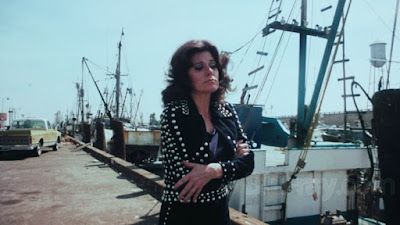
Approaching Lady Street Fighter, be aware of what this is, an ultra low budget film clearly wanting to follow, least in name, the wave of action films of the seventies, the title clearly evoking the likes of The Street Fighter (1974) with Sonny Chiba. The acting wavers in style, the martial arts is performed not by trained fighters, and the film's lead is Renee Harmon, an older woman whose presence as the ultimate badass and sex object is sometimes accidentally challenged by the plot itself she wrote. Sometimes it is unintentionally humorous or weird that, yes, Harmon does lick a yellow telephone receiver to denote her horniness for the male lead over the phone.

The story of Lady Street Fighter off-camera is compelling and adds to the narrative, of a German war bride who encountered director James Bryan, whose most well known film is the video nasty slasher Don't Go In the Woods (1981), and as her own one woman producer-director-creator worked with Bryan over multiple films, her Bryan her muse as much as the other way around who together made low budget genre films. That she made herself central in them would, if she was a male creator, be dismissed as hubris, though here there is a delight in Harmon as a woman doing so for herself whilst creating films this curious like Lady Street Fighter. The MacGuffin of this film, whose narrative becomes vague at times, is a master file on microfilm of all the members of an assassin's guild, possibly hidden in a plush stuffed dog. Harmon as Linda is caught between Assassins Incorporated and a member of the FBI uncover between their midst who she falls for, with the added tension that her sister was killed and she wants to find the cause of this. In centre stage, Harmon is idiosyncratic with her distinct accent and acting style, and this is a rare case, as the producer, you cheer her on as selling herself as the action star and the most beautiful woman on the Earth because this is a woman, who worked and worked over multiple films, and at least committed to these films on and off-camera. Honestly, considering the many men who did so in straight-to-video and exploitation era cinema, someone like Harmon deserves even mild vanity, especially as between her and Bryan, this is a film clearly built from duck tape and dreams that managed to be inspiring and entertaining.

Certainly as an exploitation film, they threw the kitchen sink in. There is a verisimilitude for how everything feels real even if they have to work around their limitations - that real cars are used even if fast cranking is clearly used in a couple of car chases, that these are still shot in real locations and that even the orgy sequence has numerous extras who stand out. That the film even has personality in its set dressing and locations is a delight, even in some of its more idiosyncratic decisions like locations and decor which evoke religious iconography, filming in what feels like a rundown church or the inexplicable but distinct aesthetic of French magazines in picture frames on the wall of one bedroom. The time period, clearly made in the cusp of the seventies even if into the eighties, is captured as much as a time capsule as this is an entertaining romp, between witnessing a go-go strip club where Liz Renay manages to cameo1, to the sight of a Van Halen t-shirt (of their first album). Even that little detail leads is worn from one of the most entertaining extras I have seen in cinema for a while - part of a trio of a guy with the t-shirt and his possible girlfriend, the later a dog collar on to be walked on as a submissive, who meet a nerdy guy; after the bespectacled guy is nervous after being passed the lease, he finds himself almost chummy with the pair in a silent little narrative, the trio sat together happily even when the murder mystery game at the orgy they rocked up at turns into an actual murder.

There is absurdity mixed with scenes which are awesome in their own way, the absurdity intentionally and not really unsurprising when James Bryan's infamous Don't Go In the Woods, a more acquired taste of slasher film, had a lot of ridiculous moments which sometimes felt intentional, such the film continually cutting to a man pushing himself up a giant woodland hill in a wheelchair only to be decapitated when he gets to the top. Here Harmon also gets to be awesome and does so in a way, as the creative voice, which is inspired at least, when she knocks a car off a cliff with hers, than drops a lit cigarette down on the male assailant's petrol strewn wreck, when he screams like an Austin Powers henchman that he cannot move his legs and there being gas all around off-screen, with the cherry on top the middle finger he presents in his dying breath which is on fire back at her. Awesome and funny moments like this contrast a film which thankfully has few dated aspects, the only one of real note being the adult daughter of Max Diamond, a businessman who has assassin connections, being depicted in terms of a person with severe learning difficulties, like a five year old, with a complete lack of grace. Most of the film is thankfully sillier than tasteless.

Even in mind of how much female nudity this has, it always comes in mind the most distinct artistic influence alongside Bryan is Renee Harmon herself. Her character, varying between confidence but occasionally the character being lost in (accidental) weakness at moments, is meant to be the most gorgeous person on Earth and, whilst she hides her figure, she is still doing nudity herself even if not from the front, whilst still proudly cavorting in an almost white knitwear whole body stocking on a bed in erotic ecstasy for one scene. It does not feel she is being told to, but that Harmon throughout, even with the leering creepy villains lusting over her, is pushing for this erotic aura around herself, and honestly a little vanity here is completely acceptable with utmost charm. That it comes with unintentional aspects, such as Ramon constantly sucking on celery seductively, always coming with her drinks, adds an absurdity which contrasts the purely exploitative aspects, such as the death of her sister involving an actress topless in an opening torture sequence.

Lady Street Fighter's sense of cheek and fun is found even in touches like casting Trace Carradine, the most elusive of the Carradine family tree, from the lineage from John Carradine to David Carradine, in that he may not actually exist and the actor who plays him is only in this one film. It is a movies that plays to the tropes that were being used to sell films at this point in cinem,a - sex, action, car chases - and in context for the ultra cult fan it succeeds just as an idea of anyone making a film like it. The quirks are there too, even in the aspects you would not find in another film such as a gratuitous scene of feet licking or the seductive stroking of champagne for blatant symbolism. The lacksidasical attitude to event too, where the plot itself is the vaguest of MacGuffin, and an orgy can inexplicably have a trio of men in their own toga party edited in, adds to this when, if you are not put off by the presentation of the film, a viewer can feel greater emotional connection, and joy from this for its absurdities.

This type of movie is of course an acquired taste. The "sequel" Revenge of Lady Street Fighter would in another context by indefensible. Whilst it has some new footage, with the initial set up being of an older Linda targeted for trying to delivery her memoires to a younger woman (Ruth Peebles), the moment Peebles is kidnapped leads to the sequel playing all the footage from the prequel, some in opposite order but 90% in its original order only intercut between Peebles being tied to a chair in a room as a procession of men read of the original film in documents to her. It is a really weird attempt to sell the original film again, but it was not that rare at times for a viewer to be trapped in such a scenario if they bought a film, sequels which turn out to just replay the original film's footage. The Silent Night, Deadly Night franchise infamously did this, and this is something I can attest to from experience when, rather than the original Boogeyman II (1983), the most common version of Ulli Lommel's sequel to his 1980 horror film on second hand DVD was inexplicably a re-cut, with him talking directly to the screen in new footage, as a character recounting the first film as footage of the first Boogeyman film played. I never finished that version back when I go to the second hand DVD and was tricked like this, never knowing if footage from the original sequel was on there.

Renee Harmon and James Bryan did this a bit, but whilst Run, Coyote Run (1987) is beheld as truly surreal, crow barring in new footage with her acting students in roles with footage, spliced mid-scene, from any film of hers before, Revenge of Lady Street Fighter would be an irritant. I do not look down on it, merely a curious remix which I cannot hate; instead, I merely find it the curious and amusingly weird cherry to a film I like. It befits a work from this history of cinema that, despite their budgets, they push themselves to provide more bang for their buck, whose limitations are compensated by someone like you trying. Renee Harmon even sacrificing her husband's car, without telling him, to be pushed down a cliff for one shot, and whilst I wished to have been a fly on a wall for that marriage conversation afterwards, it compensates for any sequel made after which just repeats the footage from the scene and the entire prequel entirely. This is a film build from devotion and sheer passion, even if a little eccentric in the best ways.  


======

1) In a really interesting crossing of paths, a person like Liz Renay with such a fascinating story to look into makes a cameo happily stripping on camera here. At this point, the former Las Vegas showgirl had been the girlfriend of mobster Mickey Cohen, starring in sexploitation films in the sixties, starred in John Water's Desperate Living (1977), and in 1974 was arrested after running naked down Hollywood Boulevard only to be acquitted by a jury at the trial. It is truly in these little moments, and little cameos, where you can find really fun and fascinating real life figures, and she lived and made films/wrote memoirs until her 2007 passing.

Monday, 31 January 2022

About Some Meaningless Events (1974)


Director: Mostafa Derkaoui

Screenplay: Mostafa Derkaoui

Ephemeral Waves


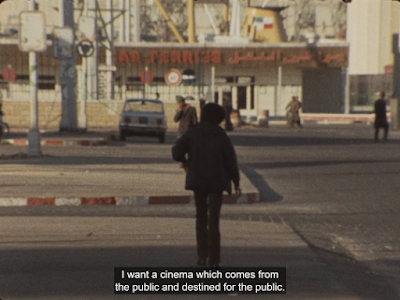
In Casablanca, Morocco in the 1970s, we are in the middle of a bar among drinking patrons. The energy is that even a shoeshine boy is encouraged to come in, if just for cruelly getting him drunk and then kick him out. The film itself is a curious historical fragment from Mostafa Derkaoui, who here in this docu-drama makes what begins with a discussion of what Moroccan cinema should be, but ultimately leads to this question having wider implications.

Mostafa Derkaoui with his tiny crew eventually go on to have to question the ethics of filmmaking in this fictionalised documentary. At first however, they follow into the bar and the area in urban Casablanca among the cafes, filming the bar patrons and asking members of the public of what their nation's cinema should be. They will eventually be forced to view their medium and the society in a new light when, during a squabble in a bar, a younger man stabs another man, which forces them to think of how to depict reality, and the implications of this, when Derkaoui wants to talk to the arrest suspect.

Derkaoui's film, scored by Polish jazz for a very unconventional music choice that keeps this film's tone unpredictable, is compelling. What the film is in genre is less important, and apt, for a film whose title, denoting an insignificance, belays that Derkaoui's film completely deconstructs any image for outsiders of his country of Morocco. Even, to not be crass, to see a world here where some mentions a trip to a mosque, but is set in a location where the bar is populated and being drunk is not frowned upon, really offers an image that is distinct, one which undercuts what you would presume this world is. Firmly planted in the seventies, with the up-to-then current fashions, the Polish jazz in the score adding vibrancy, this undercuts any image a viewer not from Morocco can have of the country, including the famous 1942 Warner Brothers film made on Hollywood sets, by showing the real environment of the time itself. Even if clearly fictionalised, this has full verisimilitude we see, helped considerably that, before the ethics comes in, it is not actually a treatise on Moroccan cinema at first but a series of skits which let you listen in on the world, with many amusing moments. Drunken people ramble regardless of their language, and here a man will inexplicably appear to offer a weird fish to patrons to buy against their will, whilst one man is so annoyed a co-worker is drinking there that, at first appearing with a hook, he returns with a giant net to finally drag the co-worker out.

That Mostafa Derkaoui depicts this, played as real but staged, is him showing the ordinary world where the questions he has to ask are in context of, an energy letting one become comfortable to as you love the mood and atmosphere. This is especially in mind that the initial premise and the film itself is esoteric, a film-about-film, specifically a time capsule banned in his homeland, even if Mostafa Derkaoui is dealing with universal themes eventually. The discussion of Moroccan cinema, in casual interviews, continues from this in how the time is reflected, in the segments offering a snapshot of the culture where they are a country who mostly imported genre films from other countries and barely had their own cinema. With a diet of westerns and "karate films" like The Big Boss (1971) with Bruce Lee, Moroccan cinema is not as seen as reflecting the world, or as one female interviewee here suggests is too "intellectual", rather than covering issues for the regular person on the street has to deal with in their lives. One man refers to wanting "intimate" cinema, not wanting Morocco's to be like the commercial cinema of Egypt, and there is a sense in how, with the cinema itself mostly imported, that the voice itself is complex in what will be unique for this nation.

To know this docu-drama was banned by the Moroccan government is a surprise, except that, a literal fragment of life, this does show a bustling world of people who live and yet is one of living a life which is difficult, not hiding the uglier side when the figure who stabs another is introduced and heard, revealed as not a one-dimensional figure. When this figure is introduced, and when Mostafa Derkaoui finally gets to interview him in a jail, the notion of wanting to document even his side is suspect, to the guilty man himself who finds Derkaoui an irritant with no grasp of his situation. This film of some events is itself eventually thinking of how cinema, when thought of, has a lot of difficulty to try to understand the truth. The discussion just after the stabbing has the crew argue of how to depict the guilty party's side, or whether to actually do so, with the fear of becoming the capitalist commercial filmmaking they wish to condemn. That they openly talk of the seventies American cinema of the time, dubbed the true era of innovative and radical American cinema, having just been commercialism appropriating political cinema negatively shows that, in another time, hindsight of politics' virtues of art was less important that the truth being sincere. That the incident is about a disgruntled dockhand having killed his boss opens up the moral issues of how to deal with the subject where, with the issue of transferring a real story a film, you have to except that the figures involved are real people. Finally uncovered by the Filmoteca de Catalunya and scholar Léa Morin, who helped get the film restored, a film like About Some Meaningless Events truly denotes "world cinema" as I want it to be, completely unpredictable even if it was a narrative with conventional plotting in how you cannot predict what the trajectory is, with this as not even being a traditional narrative revealing more in its subject by how unconventional it actually is.

Saturday, 29 January 2022

Vinnie's Tomb, Chapter One - The Road To Vinnie's Tomb (1997)


Developer: Global Star Software Ltd.

Publisher: Reldni Productions

One Player

Windows

Oddly enough you did not die. Instead, you landed on a strategically placed mountain of breakfast cereal.

Author's Note: This review only covers Vinnie's Tomb Part 1, which as is documented in the review, had a sequel game of a trilogy which never was completed. As of 2022, the second game, Vinnie's Tomb Chapter Two - Shine and Glow Vinnie (1997), is only possible to play if you can boot up an old mid-90s emulation of Windows, which emphasises that, in terms of emulation, PC and Mac software is its own vast land I have yet to even figure out, whilst Vinnie's Tomb Part 1 was converted for Newgrounds. Befitting this bizarre cultural item, even playing it is a story.

Vinnie's Tomb, Chapter One: The Road To Vinnie's Tomb, thus from here to be addressed as Vinnie's Tomb Part 1, is fringe as you can get. It is the creation is made more perplexing because of its context in the modern day. In Canada, there was a man named Troy Scott, and it has been addressed, though is vague, that he died of medical complications on the 4th December 20001, his work in music and games as a completely outsider now in the fringe preserved by a group he founded called Reldni Productions. His story, in the obscure vast planes of the internet, now has been mythologized by the holders of Reldni Productions with questions of validity, or at least a sense they want to tell their own strange take on his life. His story through Reldni is now part of the internet's Chinese whispers and mythology, as only fragments of his work, a couple of independently made games and music albums, which are available with an exaggerated back-story. Vinnie's Tomb itself was meant to be a trilogy of games, only for the Reldni Wiki for to talk of the late Troy Scott being kidnappped, mid-interview in 1997, by " by a ski masked figure in a black limousine" preventing the third game from happening2. With the timeline involving Scott being frightened into isolated in 1999 by a figure by Mike Alfano2, who is likely the same figure in Year of the Alfano (2000), a concept album where Alfano is a gangster figure with a temper and innovated a dance style called the Alfano about shuffling back and forth, undeniably this is a mythology. It does not include the actual truth of who Troy Scott was, if he died in the 2000s or not, and why Vinnie's Tomb, alongside other games documented in these preserved articles, existed in partial form.

The game alone, an ultra-low budget point-and-click adventure which plays to irony, would put some off. Playing to an absurdist humour that is deliberately random and clearly to amuse the creator, Vinnie's Tomb itself is an electronics store that, as time passed, became a tomb, the ancestor of its owner, a pierrot also called Vinnie, setting out to find his rightful hand-me-down. With deliberately bad craftsmanship involved too, this is also a work from the mid-to-late nineties, of the many deceased formats of Windows, to which this was made available for the shareware, with an aesthetic entirely of MS-Paint crudely drawn. I admit, as in all those weird fringes of the internet, all in danger of being lost if it ever was turned off, this belongs to that culture which many would feel would not be even worth preserving, but for me is compelling as part of the weird fixations and foibles of my fellow human being. Probably soaking myself in another's obsessions is a dangerous thing to do, and Vinnie's Tomb Part 1 has one joke which reminds one, as to discuss later on, where this interest in connecting to others should not forget when it is morally dubious, but this is one of those artefacts which was perplexingly fascinating.

Vinnie's Tomb Part 1, in spite of its long introduction, is a slight game, made available in 2016 by a Newgrounds user and coder Mike Welsh, whose interest in preserving over fifteen years of flash animation and work on Newgrounds in itself is to be commended. It is also befitting how this ended up on Newgrounds as the strange uncle of a site which, alongside being a hub for Flash animation before its creator Adobe ended the software in December 2020, is a hub of a variety of internet culture, be it indie games (even known ones), fan art, even animated and video game porn, and everything potentially cool and strange in-between of a variety of qualities and strange humours. Vinnie's Tomb, only from 1997 but a grandfather by now for internet culture, would have at least won a person over from the later generations for its ironic touch. You are warned of what to expect on the first screen when, with a crudely drawn sea creature nearby, the narrator with a strange accentuated accent does so to the player, and you hear what can only be described between a MIDI cacophony mixed with a knock off version of music by The Residents blaring out. You need to get past the bridge, a trick where you needs to find a way to cross without it collapsing, and if you manage to succeed with having to have to restart the game as you fell in and drowned, this turns into a rudimentary point n click with stream of consciousness wackiness.

Even this forced me to realise my taste for point n click games is still to be dealt with, impatience likely a factor for even the most rudimentary of presentations, with icons onscreen the only things to clearly click, to lead me to miss things. Vinnie's Tomb to be honest though, however, also has its fair share of esoteric decisions, especially as Part I has a lot of outright irrational ideas, where key items like cheese and underwear are acquired through a dialogue exposition text when you get certain combinations, or that the diamond you need to open a door is still needed, and needs to be wrenched out of the place it has been placed into. Or that you need to wear the glasses before knocking a yellow ball presumed to be the sun out of the left corner. Yes, even if this is rudimentary, it emphasises my disinterest in the point and click genre I need to overcome with, in how it feels like the puzzles are vague to procrastinate rather than ones based on actual common sense. Here the absurdist tone almost feels justifiable only because this game is very short and you can get back to the sections with ease, when others are longer and could even have game over conclusions.

Many will not even get through this, regardless of short length, as cacophony is apt for it all, a game truly weird for just the sake of being weird, sometimes inspired even if by accident for me, other times even for my forgiving taste in strange cultural objects feeling like it is trying and failing. Some odd cultural references that would be dated even in the nineties appear, of a snake in the garbage you need to talk to being bigger than Wayne Newton at Las Vegas, that "Donny Osmond is hosting a benefit concert there for seven legged spiders from a windy city...", or that one concern to get key items is to shut up a monster who sings like Leonard Cohen at night and keeps everyone up. These at least reveal the tastes of its creator which, in hindsight, is fascinating to learn of, but other jokes are not like this. It is random for the sake of it, sometimes succeeding for me even as accidental surrealism, but there is a fine line between succinct surrealism and just trying, or rambling humour which is a greater issue. All the voice acting, crudely recorded, has weird accents and intonations, all non-professional and crudely recorded in the modern day, and the music is likely to be maddening for some. (The Residents comparison, even though that band is superior and honed their music, is apt in mind that, if you played a song like Constantinople from Duck Stab (1978) in a loop, it might drive someone mad too, with the same manic energy here from a professional recording). The humour is the kind that amuses oneself but required your own codes of what you find funny, rather than what is funny to yourself but could gain a reaction from others even if shocked laughter. One joke, only one thankfully, crosses a potential line where the aforementioned snake you need to talk to, whose brother you meet instead, is meant to be a "queer snake". Not the worse language to use, and what Troy Scott meant with the term queer, either the derogatory term re-appropriated by LGBTQ people or the old term for being "odd", is up to meaning seeing how quirky the game is, but this is a good reminder to be aware when you even find entertainment or interest in soaking in these strange cultural objects to be aware of this.

In terms of aesthetic, most will be put off by it too. As mentioned, it is Microsoft Point to the point Scene 3, in grassy land before you enter the central cave of the narrative, has flowers drawn by the spray paint function of the software that are just dots. Text boxes, the old ones from old computers where you have to press okay to continue, present the exposition, and dialogue scenes are progressed by clicking a click-at-a-time slider at the bottom. One non-playable character you encounter is an invisible horse, only invisible (until you get to look at him) because it is explicitly said that the creator cannot draw horses. This is the moment where I find myself having to figure out what I feel for Vinnie's Tomb Part 1, a curious artefact I am glad to struggle through, am glad to learn of more even if it means having to go through the juvenile mythology behind it which obscures the actual history, maybe find joy slowly with that weird mythology, and admitting that this is not a game many would want to play. The game itself is a time capsule, not a great game, but alongside the fascination with this content, even this crude art style done without irony and deliberately could be appropriated for an indie game and you could get something that sells like a cult gem on Steam.

That later bit is not a joke, as considering the steps into old and even "ugly" aesthetic, like the embracing of old Playstation One era polygonal aesthetic, even Nintendo 64's Vaseline smeared polygons being looked back to for artistic interest, old crude low budget PC software, even Microsoft Paint-core, could be something you get a great game from. This, even if a mess, still has the whit around it to have secrets within it, even if such secrets involve a mini-game where you have to slowly manoeuvre your pierrot up screen, unable to even see the traps you have to avoid and thus having to go by pure luck. This is the type of work which, to be cruel, would be looked at as a exhibit to gawk at for how unnatural it is, a misfortunate creation in the world of video games which is yet artificially made to be like this too. The paradox is that, in among this, there are moments which captured my own taste in the weird which felt good, even if you have to scrape off so much which is not really that inspired.

And even that questionable content can be digested as it fascinates me as a cultural object from a different era like a museum exhibit, which makes this a confused one to deal with. Truthfully, only those intrigued by any of this should try Vinnie's Tomb Part 1. Part 2 was released in 1997 too, but still exists in form that has not converted to a more accessible form, one which requires a knowledge of how to run an old Windows emulator from the past. Part III itself never existed or is lost, and there is an entire history of titles which Troy Scott was said to have created, possibly lost for real from a time where immediate preservation was not common online. That this is all part of the mythology itself confuses things further. This follows the same camp as when fan fiction, both the truly worst and memorable, is exonerated and preserved online, though Vinnie's Tomb is an obscure work few may know of.  

This is, to be harsh again, a work of whims and rambling sense of humour, a stream of consciousness alongside the music Troy Scott made which Reldni Productions have made available for free, made as home-produced improvisations on what he could create. This is something most would not appreciate, but I have come to this entire catalogue with empathy even if I am to be cautious in that too. To openly borrow a joke from an actual video game critic and author, Ben “Yahtzee” Croshaw, this is exactly like finding a dead squirrel with a fez on its head3, a curiosity to look at that raises questions. I find that metaphor cruel as, rather than being distracted by something odd on the side of the road, I came to Vinnie's Tomb willingly and with empathy for any misfit. The metaphor is more apt, artificially being kept back by Reldni Productions' mythology, this raises interesting questions, such as whether that is a hat or if the squirrel fell out a tree eating a yogurt3, and here whether Vinnie's Tomb is actually the outsider art piece uncovered from a passed creator, or this is entirely fabricated for some strange in-joke. That fabrication is harmless, thankfully not used for cheating people if it was revealed to be the truth, but it just asks further questions to scratch your chin about.


====

1) This is referenced in Scott's biography on a fandom wiki, and is referencing the following on RootsWeb.

2) As documented in the third game's wiki.

3) This was befittingly taken from a review of The Good Life (2021) as premiered on November 10, 2021 on Escapist Magazine's website and Youtube, a game from the cult figure SWERY, the Japanese developer/Buddhist monk behind such strange video game titles to cover one day like Deadly Premonition (2010), which just from the review is a befittingly weird game one wishes to just play for its own bizarre content.

Thursday, 27 January 2022

Workbooks Collection (2005)


Director: Guy Maddin

Screenplay: Guy Maddin

Canon Fodder


Known also as Love-Chaunt in the Chimney, at least in the Zeitgeist DVD release of Cowards Bend the Knees (2003) which have these as an extra, this is among the many of Guy Maddin's career of feature length and short length films, but with the irony that, long before the Seance (2016) project, where he resurrected the lost movies of directors from Mikio Naruse to Ernst Lubitsch, Maddin himself has a lost film these are connected to. Seance, originally set up as a recorded live performance between Paris and Canada, became The Forbidden Room (2015), Maddin's delirious multi-narrative-within-narrative film, whilst the films also called the Workbooks Collection are just shorts from a project which was lost in a fire1. This is a ghost, fused together and rebuilt from the remnants, including a tie-in to Cowards Bend the Knees.

The films are FuseBoy, Rooster Workbook, Zookeeper Workbook, Chimney Workbook, Audition 01 and Audition 02, blurring the lines between what survives of this project from the late nineties and Audition 02, which connects to Cowards Bend the Knees, a Guy Maddin film which does exist. This lost film started after Twilight of the Ice Nymphs, a 1997 production that for me was a pleasant experience but is not historically the best period for Guy Maddin. A documentary from the time, Guy Maddin: Waiting for Twilight (1997), shows a miserable Guy Maddin, who eventually hated Twilight of the Ice Nymph, which was not seen as a popular work, and a terrible and frustrating experience to the point that the documentary almost has a near-memoriam tone of Maddin imagining his career ending. Made in his garage, some at the Winnipeg Film Group Studio1, his solution to overcome that experience was a film entirely self produced with improvisation.

How it would have compiled together, an amalgamation of Herman Melville short stories stuck together with assistance from George Toles, is a question for me of interest as, including the two Audition films, the lost film's surviving forms are a curious set of experimental pieces entirely about mood. They precede the fetishishtic nature of Cowards Bend the Knees, the most overtly sexual film of his career, as well as touch a similar nature to old George Kuchar and Jack Smith films as improvised low budget productions literally filmed at points in the director's garage. Rooster Workbook is probably the most explicit, in which a nude woman crawls through homemade crawlspaces, whilst feathers and a rooster populate the visions in rapid fire, repeating scenes in the editing. Fuseboy, starring Guy Maddin regular Louis Negin, is the most implicitly erotic, at least in how Negin, in just tighty whities, plays a man possessed by an erotic memory of three younger men (or one his younger self with two) shirtless erotically mucking about fixing electric fuses.  

With Zookeepers Workbook, Maddin even explicitly references Les Chants de Maldoror, Comte de Lautréamont's transgressive novel which, cosnidering its high art status, is also a work where the God-hating transgressive lead has sex with a female shark, surprisingly more transgressive than even Maddin's own work at times but befitting someone, whilst more whimsically transgressive in his films, to reference. Most of the shorts also, shot in standard definition, feel even if from afterwards like prototypes from The Heart of the World (2000), a short film that, when it was commissioned and debuted at the 2000 Toronto International Film Festival, was a huge turning point positively for Maddin with its Soviet rapid fire editing and aesthetical tributes. These shorts are to be absorbed, his obsessions felt like mood tapes with their repeating images, the Audition shorts, the first for Fuseboy, the later with cast from Cowards Bend the Knees, a curious pair to include but yet befitting, suddenly Maddin turning the viewfinder on his productions themselves. They all, whatever they call them, are a fascinating collection.

=======

1) As talked of briefly in Offscreen for An Interview with Guy Maddin: Dissecting the Branded Brain by David Church for Volume 10, Issue 1 in January 2006

Tuesday, 25 January 2022

Cowards Bend The Knees (Or The Blue Hands) (2003)


Dir. Guy Maddin                 

Screenplay: Guy Maddin

Cast: Darcy Fehr as Guy Maddin; Melissa Dionisio as Meta; Amy Stewart as Veronica; Tara Birtwhistle as Liliom; Louis Negin as Dr. Fusi; Mike Bell as Mo Mott; David Stuart Evans as Shaky; Henry Mogatas as Chas; Victor Cowie as Maddin Sr.

An Abstract Candidate Re-Evaluation


Guy Maddin is an experimental director yet he is not stereotypically avant-garde, his trademark style completely linkable to past aesthetics - silent film aesthetics with intertitles jostled against dialogue films, post-CGI affects, or between specific colour styles to monochrome. Varying per film, they are still his own. Guy Maddin can proudly claim every film of his is unique and distinct to the others, which even applies to his short film making, which few directors can do. Originally designed as an installation piece made more candid as a peepshow exhibition, separated into chapters as sixty plus minute epic altogether, Coward Bend the Knees even for Guy Maddin is his most overtly lewd, sexual and at times perverse whilst Maddin drags Maddin through the dirt.

Literally, as Guy Maddin (Darcy Fehr), an ice hockey player, is introduced, at a back alley abortion clinic in the back of a hairdresser's which is also a bordello, leaving his girlfriend Veronica (Amy Stewart) to die of an illegal abortion to lust after Meta (Melissa Dionisio). All is this is whilst in mid-operation, as he eyes the daughter of Liliom (Tara Birtwhistle), owner of a hair dressers. Meta wants revenge on her mother and her younger lover Shaky (David Stuart Evans), the captain of the ice hockey team, for murdering her father, loving to her and his hands blue because of the dyes used in his hairdressing work. Very clearly fixated on him to the point it is uncomfortably sexual, Meta plans to have her late father's persevered hands grafted onto Maddin, only for Dr. Fusi (Maddin regular Louis Negin) to throw them in the bin and paint Maddin's hands blues to pretend it was completed. I would not be surprised if Guy Maddin was evoking films like The Hands of Orlac (1924), the Austrian silent film great Conrad Veidt, as a pianist whose hands are destroyed in a train accident, is horrified to learn he may have had the hands of a murderer surgically attached to him, Maddin the director, having Maddin the star as a figure tempted by Meta to murder her mother and Shaky with the promise of her body, his hands seemingly possessed by the ghost of her father despite being his original ones painted blue.

And yet he ends up with Liliom, and Veronica, despite dying, comes back as a ghost/doppelganger working in the hairdressers and is having a relationship with Maddin Sr. (Victor Cowie), Guy's father. Somehow, in only sixty minutes, this perverse blackly humoured work juggles between intentionally falling off the rails and being tied up in a cohesive structure. Maddin deliberately goes against the notion that any event has to be the same as the rest of a story's structure, letting the events dictate the structure instead, including those that go into the completely absurd and goes against conventional rationalisation. For those not used to his cinema, this content exists in its own logic, that of lurid and unpredictable cinema from a yesteryear, a yesteryear that does not exist and comes from its own plane of reality. For those used to Maddin like myself, Cowards Bend the Knees is, even for a director who tackled taboos from the beginning, his most overtly lurid film.

Details like the onscreen male full frontal nudity in the post-hockey game showers, to Melissa Dionisio's nude scenes, to the set-up being that the narrative is taking place in semen being scrutinised under a microscope, Maddin is not kidding himself in the explicitness here. Gender balancing is found the poking of the male body as well as the female, which actually does happen when a large pare of buttocks is confused for a doorbell, scrutinising masculinity even to the point of a large close-up of Maddin Sr's penis as he used a urinal being witnessed when someone has the unfortunate position of trying to use the one just by him with no hands. Even the weird kinks the director-writer is known for feel more perverse here, like Maddin Sr. having, whilst commentating on hockey games, a breast carved from ice he fondles mid-match even with Vernonica's double on his arm. Even without the sexual edge, Cowards Bend the Knees befittingly is not your ordinary murder revenge story, particularly when it also has an ice hockey museum in the lofts of the ice rink, full of wax mannequins of dead hockey players who may not actually be dead, a clash with the elite Soviet ice hockey team of concern, out-of-left-field sexual practices not even seen in some porn, and blue filter, in a black and white film, to show the majesty of blue hands. It feels like Maddin, to the point he puts himself under the guillotine, fully investing in emasculating the male gender in its worse. A trademark I have seen in his films has been how much his work has been about men and their sexual libidos for all the worst aspects, emasculating them in the process.

Guy Maddin is a director to draw on obsessions and material almost dreamt of and does not soften them to seem conventionally rational to the viewer. To purposely undercut narrative conventions with non-sequiturs, absurdity, and bookend his works in narratives-within-narratives, here it is more intimate as, if My Winnipeg (2007) is entirely accurate in telling his own biography, Maddin grew up living above a hairdressers, whilst having both ice hockey part of his blood and a father who ran their team in Winnipeg.  His work is also an ode to cinema, not only to the film making techniques of the past, arcane rather than nostalgia, contacting once dead cinematic practices, but also an ode to the lack of pristine gloss. The concept of viewing films scratched up and with jittering frames is something we find sad to witness, desiring these films preserved, but there is something irresistible to seeing them with scratches too, textures that makes them unique compared to other films. In Cowards Bend The Knees, the images are also shown through a circle surrounded by complete black, of its peepshow origins and very old silent films, made to look like a blurred and damaged film print Maddin discovered in a basement of a Canadian home, sordid hyper stylised thrills that would have gotten the scissors on it by censors back in granddad's day. Frames moves and the actors are at points distorted into figures of pure grain as they are clear and beautiful in portraying these exaggerated archetypes. Entirely silent, with intertitles, it charges ahead with its content in quick, sharply edited images clearly learnt from Soviet propaganda cinema. The content itself manages to be shocking and surprising, yet this style compiles it all together into one cohesive whole.  He manages to depict consensual fisting just in Soviet montage, whilst being entirely unsubtle about it in a way evoking Sergei Eisenstein, a man who, alongside his genius was also very sexual open, someone who would have probably approved the scene with delight.

What does it say as well about the director when he names his less-than-great protagonist after himself? It may be fantastical in tone, but the ecstatic truth, to quote Werner Herzog, is that in doing so, Maddin admits with Maddin the character - spineless, a coward, a killer - failings he might have encountered in himself or other men subconsciously shown through the scenarios shown onscreen, exaggerated to an extreme. Then there are the autobiographical aspects. Maddin's mother in the role of Meta's blind grandmother, that he grew up with ice hockey, his father coaching an actual hockey team, as well as hairdressing being part of a family business. He would later go on to make the poignant and funny My Winnipeg which directly examined his titular Canadian homeland and his life, but in placing his own memories within content like this with its killer hands, and Elektra based influences and perversions, it is far from undermining it but using the absurd and perverse content to amplify and examine the effect these reminiscences. By way of dreams and the logic of a b-movie cum German Expressionist influence horror movies, what is enjoyable as a spectacle by itself means more when he is bringing a subconscious confession to this film, even through psychotronic, erotic murder melodrama and literary meanings. It also makes this a far better cult film than many others for providing more in its sixty minutes than most films. That the film does not end happily, yet feels perversely charming for the deaths, disappointments and someone taking their place in the wax mannequin hall of fame feels apt.

Abstract Spectrum: Avant-Garde/Eerie/Perverse/Weird

Abstract Rating (High/Medium/Low/None): High

Sunday, 23 January 2022

Games of the Abstract: Peggle Deluxe (2007)


Developer: PopCap Games

Publisher: PopCap Games / Electronic Arts

One Player

Microsoft Windows / Mac OS X / iPod / Windows Mobile / Java ME / BREW / Nintendo DS / Xbox 360 / PlayStation 3 / iOS / Zeebo / Android / PlayStation Portable

We can forget, more so now that we have games made with the budgets of mainstream Hollywood films, with storylines and cut scenes using the shiniest graphics, that games which are simple and focus on their game play are themselves to be appreciated, alongside the concept of games which can be appreciated by non-gamers, something which the mobile phone app market has been more commonplace with and is a holy grail in its own for companies to win over. Angry Birds (2009-) for example, playable with just a mobile touch screen, became so popular for its Finnish creator that it managed to have film adaptation, and even a tie-in Star Wars versions for a game. This is all for a game, in spite of controversially having a similar structure to Crush the Castle (2009), where you fire colourful birds at limbless green pigs in easily breakable castles, whose addictiveness for anyone, even non-gamers, I can attest to from playing the Facebook version when I was away from videogames. Peggle is the same too, the creation of PopCap Games, a company who just from two other franchises, Bejeweled (2001) and Plants vs Zombies (2009), have made themselves frankly the best of the best in terms of games for casual and non-games which, on phone apps but also available on multiple formats, gain an addictive foothold.

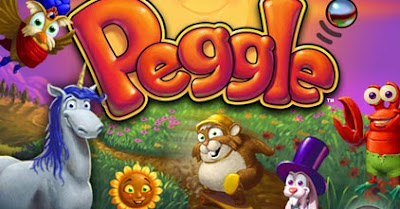
Peggle takes its inspiration from pachinko, the Japanese recreational mechanical game that is played for gambling which, as a cultural concept, is so dominant in Japan it is probably played by far more people than video games themselves, to the point companies such as Konami started to prioritise working on them. Pachinko, which has had video game adaptations too, is however randomised, entirely about sending the ball out and luck being on your side. Peggle, as played here in the Peggle Deluxe version, plays differently, where rather than firing the ball from below like a pinball, up with the intention of hitting the right target to gain pachinko balls, you can fire the ball in whatever direction you wish from the top of the screen. The desired goal here is to hit all the orange pegs onscreen with a limited number of balls to use. If you are lucky, you can get them in the bucket at the bottom of the screen, moving back and forth, to avoid losing a ball out of play, and the game has bog standard blue pegs, which give points but are less important, alongside purple pegs, which change position and give a points bonus, and green pegs, which are connected in the Adventure mode (or when you unlock them for other modes) to the Peggle Masters. These are a menagerie of cartoon figures that have their own special abilities, be it a magician rabbit that has a random wheel of luck, or a dragon with a fireball that burns through pegs. If you are lucky, getting enough points, including skill shots, can increase a bar up at least three times to be able to get a free ball (or two) to continue.

From here, the mechanics of the game are pretty much explained, which presents an obvious issue in terms of reviewing a game like this. It is so simplistic in premise, with the aesthetic dressing and a plot being the best peggle master, to really review without the danger of bizarre pretentious musings on tactics. I will be upfront in saying the game, as it plays, is exceptional though, admitting my laissez-faire attitude to shooting the balls out on whims, and enjoying myself, whilst growing some tactics as fewer orange pegs leave you having to figure out how to hit them with fewer ways to ricochet the balls to the. It is based as much on luck as it is skill, bouncing the ball off walls, the other pegs and hazards, but it works and it is a testament to the creators that this allows casual entertainment, luck in winning rounds, but you can play and learn how to succeed especially as there is an unlockable Challenge mode which ups the difficulty with specific goals to work through. It is fine tuned in the Peggle Deluxe version to the point that, over an Adventure mode, or the other modes, that you cannot complain in the slightest about it. There is nothing unconventional about the game, any strange turns, but I appreciate the skill from PopCap Games to have a game which does tap into an aspect of these casual games, deliberately engaging the player with quick hits of dopamine when you succeed, but is actually a well made game with a distinct gaming mechanic to it.

This does get into the one detail against this game, the one mark against Peggle that, for all my joy of it, undercuts the experience in being able to give it a high status even though I enjoyed the experience greatly - that being the aesthetic, which for me personally is very bland. This does not include the big trademark of Peggle, being that when you hit the final orange peg, with slow motion zoom when the ball is near it, an excerpt of Symphony #9 - Ode to Joy by Ludwig van Beethoven plays as the ball has the chance to enter one of multiple slots for a final points boost, which is that joyous dose of energy to the brain that is charming in its inclusion. The issue is entirely that, for a game perfect in mechanics, never was one where I wished it had such a better aesthetic. The look of the game is a cute, pastoral aesthetic, very Western, of unicorns and cute critters. Some of them are frankly stereotypes, like the dude hamster, to the frankly dubious guru owl, whose Zen Ball is still a great special, as the computer for 75% percent of the time worked out a better shot for me, but is still appropriating Eastern mysticism in an eye rolling way. Peggle, to be frank, and in respect to the creators' hard work, does not suit my aesthetic in the slightest. If there ever was a game, without changing the mechanics or including anything that compromised them, would have been such a better game with a lick of paint, this would be it, and never was there a case of even the most stereotypical of Japanese video game clichés being welcomed if from an actual Japanese studio having been brought in just to renovate the look and nothing else. Even if Peggle as a game kept me compelled throughout it, that one touch, if the aesthetic was entirely different, separates this from a great game to just a good one. Peggle 2 (2013), created after PopCap Games were bought by Electronic Arts, has a far more cheery aesthetic when looked at, but this review exemplifies a factor I will take into consideration for what I find are great games, even when they possess very clear flaws.