Wednesday, 14 August 2019

Naked Desire (2015) [RE-REVIEW]

From https://images-na.ssl-images-amazon.com
/images/I/81MahA2gLZL._SY445_.jpg


a.k.a. Onanie Sister Tagiru Nikutsubo
Director: Hideo Sakaki
Screenplay: Kôichi Miwa
Cast: Ui Mita as Akane Kanzaki; Shô Nishino as Kayoko Fukuya; Yasuyo Shiba as Rina Sendô; Shigeru Harihara as Kanzaburô Yamanami; Yûta Kogiri as Shinji Okada; Tadashi Mizuno as Kensuke Saitô; Matarô Umeya as Shigeyuki Kimura; Ayumi Tomiyama as Junko Machioka; Kôichi Miwa as Tejima
Obscurities, Oddities and One-Offs

I know what you're thinking reader - why am I re-reviewing a film just covered a month ago which I didn't like particularly? Simply put, I can write better. Also, there's something more meaningful in returning to a film with hindsight of what already happens in the plot, with the context of what it is, and review it again without discrimination. In fact, contrasting it with the previous review I will link HERE will provide a surprising contrast.

[Spoilers Throughout]

The history of pinku cinema from Japan, as Jasper Sharp has written about in his book Behind The Pink Curtain: The Complete History of Japanese Sex Cinema, attests to its virtues. Designed for pure titillation, it however had the advantage that, made on a low budget and creative control being possible, a filmmaker like Kōji Wakamatsu could make the most striking and transgressive films as long as they still qualified as erotica. There are many films made afterwards, such as from the likes of Takashi Zeze, that can attest to the fact you could make cerebral and adult dramas from them, even erotic musicals as Shinji Imaoka can attest to with Underwater Love (2011). There is, however, as much of the cinema which is still titillation and titillation alone, so it varies in quality. OP Eiga, behind the production of Naked Desire, is one of the oldest pinku companies and arguably the producers of the first, Satoru Kobayashi's Flesh Market (1962), so after all these decades they've both a huge historical importance and have made a lot...

Certainly from a premise perspective is fascinating - a pinku that explicitly references the issue of Japan's rising elderly population, the malign yet increasing aging populous depicted in the disabled Sabu, a former political protestor who is being taken care of by Sister Akane (Ui Mita), a literal Christian nun who means that the premise will also involve dealing with Christianity, a small but significant religious minority in Japanese culture, and the issues of said faith against one's sexual desires. Also aesthetically, the fact it's very low budget to the point they a) have to visibly blur out a car license plate and b) blur out cup noodle, with onscreen digital effect, is actually appealing for me in how the lowest budgeted of cinema, far from being detracted from in terms of technical hurdles to climb over, offers a vaster wealth of potential imagination due to these limitations.

I confess a growing fascination for the raw flaws of this type of work in general. Even if the DVD transfer from the DVD I viewed, a 2019 Redemption Films release even on an old TV and old Blu-Ray, is probably one of the worst I have seen, many might be put off by the frankly gristly depiction of sex. Here is a world where a classroom is apparently a set in a roofless shack with a picture of an egg and sperm on a white board and an (uncensored) Adidas football inexplicably near where the sex between school teacher Rina (Yusuyo Shiba) and her student lover Shinji (Yuta Kogiri) takes place,  where even for them, when they flee to the coast with the police after them as he's the dean's son, they first seen sleeping in her car until luck shows they're outside Sabu's house.

An ultra-love budget sex drama set in one main house at the coast could've led to so much interesting creativity, especially as the house is distinctly elaborate and the coastal setting is invocative in its isolation, from the vast plains of browned wild grass to the elaborate stone sea barrier Sabu is found wandering upon later, but I also perversely find as a charm in the grimy, realistic banality as well. Where the female police officer, having an intimate moment by herself watching porn in the office, visibly has a hole in the toe of one of the black socks she is still wearing, or even the perversity of Kayoko (Shou Nishino), a self-proclaimed nymphomaniac free spirit who ends up in the life of Sister Akane and, wanting to bring (sexual) pleasure to Sabu's life, will even consider doing so whilst first helping him on the toilet.

There are obviously two transgressive topics here, that Rina and Shinji are a teacher and her male student which raises a lot of potentially controversy. There's also the fact, as Sabu is through most the film a decrepit old man in his own world, that Kayoko's desire to sexually pleasure him crosses a line of consent that also Sister Akane raises; Kayoko's philosophy, openly speaking of previous examples as a former carer, that a person regardless of age should be allowed to be human and have sensual pleasure, the film potently attempting to tackle this in mind of Japan's growing elder population, does even in a less than intellectual form raise questions about standards of life for a person incredibly incapacitated by illness/age even if the result would obviously be uncomfortable for many viewers. If Naked Desire had been openly transgressive with a purpose, it would've at least been interest even if still uncomfortable. Even if it had been a comedy, it could've done a John Waters and deliberately been bad taste. The issue is that, for its good moments, Naked Desire by its ending falls on an empty conclusion which makes these two plot points, and Akane's existential issues, more trivial.


On another viewing, I like that a lot of the film is a quiet work, literally as there's minimal music on the soundtrack and, barring a porn music bass line that'd be an embarrassment to its ancestors, it's used sparingly. It's a slow burn light hearted drama which has a lot of obviously problematic content to try to juggle, but slowly builds towards what you hope is an ending that deals with all this, at least being compelling and of interest. This is especially the case as the three main woman are the strong central figures who have most of the scenes, the two male figures Sabu, who is a disabled figure, and Shinji the side character whose trajectory is realising he has a fetish for the buttock, not only Rina's but his own being touched which turns into a surprising progressive end reveal.

This isn't concluded upon. In mind, as well, the British DVD removes what is apparently a rape scene, which is an uncomfortable thought even if the film's trying to be a lot more complex and on the side of the female cast, there are aspects that just shoot the film's best virtues in the foot. Say in contrast to Ui Mita actually playing her nun character with a charmingly innocent chastity and yearning to do good, even if there' something odd about her suddenly undoing her hair and masturbating in front of a statue of the Virgin Mary, you have the two male cops, who are absolutely unbearable. Even without the tasteless joke of the pair constantly groping their female side kick, they're played as broadly and sex obsessed as possible, like two obnoxious teenagers whose gurning is embarrassing; one scene, shot in a city centre, where they are lulled by two female sex workers is painful in how broad the duo are. In contrast, you immediately have sympathy for their meek, thin faced female fellow officer, who puts up with them and at least can have a scene of beating up a pervert and the bizarre moment, with the same actress, when she realises a woman in a porn video she is watching looks exactly like herself.

All of this may put off certain readers anyway, a stigma attached to many erotica that it's crass and really gauche. Some of the descriptions of what transpires may have put you the reader off already, and knowledge of what was excised, probably in relation to Kayoko's introductory scene of gladly having sex with two men in a countryside ditch only for her comments that they're practically useless in bed not going down well, doesn't help with the image I have painted of Naked Desire even if the film itself is much more interesting than the synopsis. Naked Desire isn't terrible but you'd feel embarrassed to recommend it, mainly because it never resolves its complex themes at all or hit its fullest potential. Any genre, type and form of cinema and motion images should be defended, all capable of great work, all capable of at least entertainment too. Pinku cinema is the same as, when intelligent and risk taking, it is, when fun and titillating, it is, and in the case of The Glamorous Life of Sachiko Hanai (2003), which became an unexpected cult hit in the West for its many aspects including then-president George Dubya Bush's finger being an unexpected plot point, even hitting a cultural zeitgeist. But it can also miss the mark, as seen in Naked Desire, even if the ending tries its hardest.

It's impossible to forget. The old man, awoken by the police outside his home triggering his memories of being a protestor, suddenly turns into Yukio Mishima during his fatale attempt at a coup d'état in 1970, becoming alive again when the two male police men's arsing about with a megaphone stir up his youthful strength. (The film even references the 1960 Treaty of Mutual Cooperation and Security between the United States and Japan that caused incredible outcry and political demonstrations as part of Sabu's back story, which should've been ran with further). In probably the most unexpected scene, the youngest cop and Shinji  decide to have sex, in probably the most progressive moment of the whole film as, rather than for comedy, it's seen as two guys regardless of sexuality finding themselves enjoying jumping each other on the kitchen floor, Shinji further finding a higher state of pleasure in his anus, having included a scene earlier of him asking for his to be licked scored to what appeared to be baroque music, and the younger cop finally after all his desperation to get laid getting his wish too. And the main female cast take an actual risk as, on even a very slow moving car, Shou Nishino and Yusuyo Shiba posed naked hanging out the open passenger doors and Ui Mita posing naked in the open car boot, still impressive in allowing themselves to be in such a position on a moving vehicle (and probably freezing as it doesn't look like the scene was filmed on a hot day). It still doesn't completely work mind. That female trio literally become posed models, improvised "artillery" in a sex display in front of open windows, which completely undercuts the fact that they were the strongest and most in control figures of the entire movie and comes off with a demeaning end with Sabu barking orders at them as subservient when there's an obvious, more liberating conclusion where everyone's in control the cops (baring one) are left the losers and sans working car.

Altogether, Naked Desire is slight. A curiosity, completely so, but a reminder (again to Jasper Sharp's tone) that considering how many films are released in the pinku genre still to this day, consistency is variable. This is pertinent as, early in their DVD releases, Redemption Films were releasing some fascinating titles. Films like Tokyo X Erotica (1999) are very idiosyncratic, but it seems that sadly, barring a few fascinating choices I want to visit, Redemption Film's choices have sadly slid into sex films which don't live up to their potential, an utter shame as the British company for a long time (before they focused as much on the US market) did a lot of admirable things, such as their Jean Rollin releases to even debuting Valarie and Her Weekend of Wonders (1970) on DVD in the UK, all in spite of their utterly cheesy Satanic lesbian vampire aesthetic. Naked Desire is more than the sum of its pink DVD cover hidden in the World Cinema DVD section of HMV here in England, and in honestly I have developed a fascination for it as a result of reviewing it twice, but even for titillation, it still the kind of film lost in memory due to some very obvious flaws.


Thursday, 8 August 2019

Moses and Aaron (1975)


Directors: Danièle Huillet and Jean-Marie Straub
Based on the opera by Arnold Schoenberg
Cast: Günter Reich as Moses; Louis Devos as Aron; Eva Csapo as Junges Mädchen; Roger Lucas as Junger Mann; Richard Salter as Anderer Mann; Werner Mann as Priester; Ladislav Illavsky as Ephraîmit; Elfriede Obrowsky as Kranke

[Full Spoiler Warnings]

In the cerebral, structuralist mood I have sat through with Straub-Huillet, Moses and Aaron for them is a sudden shock for a viewer like myself after very intelligent but dry work. They still shoot the story of Moses, the chosen prophet of God, and Aaron, his mouthpiece who argues with him about the representation of God, in their extremely formally rigid style, lengthy minimally edited work which ends segments of the three act film with long scenery tableaus. The sudden jolt of emotion comes from the fact the directors are directing an adaptation of an opera by Arnold Schoenberg, an experimental work which deals with Jewish mysticism, the central issue a transcendental invisible God versus one symbolised in form, an argument which descends, during Moses' forty days plus exile to talk to God, leading to the Israelites worshipping a Golden Calf and all manner of content from there you'd never expect from these directors - nudity, gore and animal sacrifice, even a synchronised dance sequence of all things.

Even before then, the issue I have encountered in a couple of their films, the monotone acting in some of the productions, is disregarded in favour of opera performances, which even if its two patriarchs bellowing at the top of their voices religious views is still thunderous and striking. Inherently the musician or the opera is abstract, whether a work is willing to push their format or content into the artifice of the material, but as most human civilisations didn't base communication on singing, it's a striking effect when you see a film which does. Arguably, the rigid style of the directors emphasises this as much, even if there's a sense you couldn't get monotone singing like the directors might've experimented with if they tried. Inherently as well, Schoenberg's music even to a novice's ear like mine is very unconventional, nearing atonality at times, also having choices like depicting the voice of God, unseen, as multiple unisex performances off-screen singing at once, almost hallucinatory even in context of this very naturalistic looking. There's also the concept of "Sprechtstimme", which is a concept created by Schoenberg's that has lead to the original Moses and Aaron opera being a challenge to perform, in that performers must sing and speak interchangeably - its compelling, and actually with a great nuisance that I have to admire especially as, merely presuming this would be a regular opera singing style, learning this details means I also know it would've been a challenge to the performers as well.

The result, even in light that Schoenberg's is already dense and esoteric before Straub-Huillet adapted it, has a sense of passion alongside the intellectualism. The film follows three acts - the attempts to convince the Israelites to rebel against Egypt, their growing despair in the desert and the third act resolution that I will get to later. It also has content you'd never expect from these directors, sudden stabs of mondo shock closer to a psychotropic genre film. Particularly Moses and Aaron's attempts to convince the enslaved Jews in the first act shows this, Aaron realising they have to show their side in greater power by having Moses' staff turn into a snake or Moses turning his spare hand into a leper's diseased one which even brings in a practical effects artists, again something I'd never expect from these filmmakers. That its underscored with the power of the music is a reminder how the more profound art and the more lurid/populist can sometimes embrace each other in surprising ways, easily intermingling with ease.

From https://assets.mubi.com/images/notebook/post_
images/28326/images-w1400.jpg?1560784477

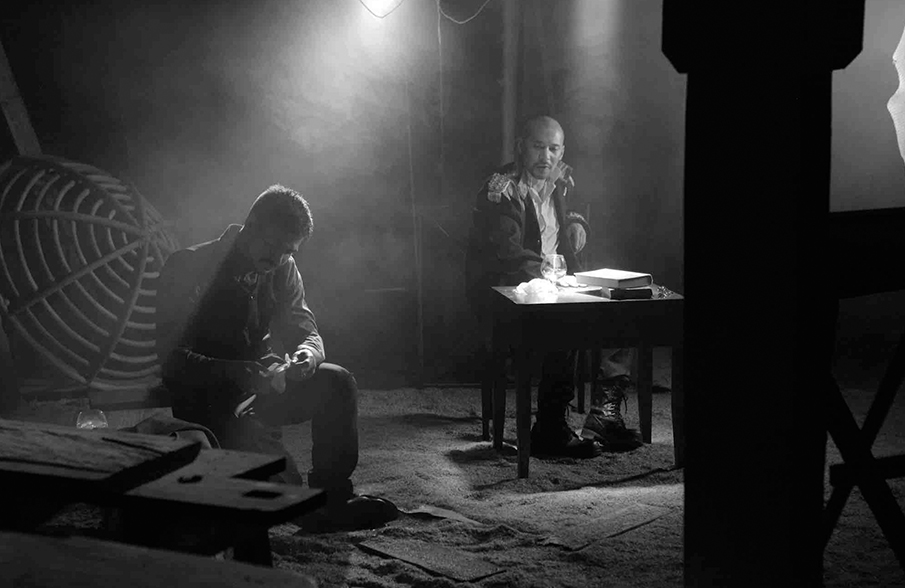
And eventually, when we get to the existential despair of the second half, the unpredictable happens, that dance sequence for animal sacrifice between four male waving swords takes place. Animals are brought in on mass in a herd, and whilst we don't see any animal death onscreen, very real animal body parts are seen. A man strips a woman in lieu of sensual congress as a lyric literally sings "Holy is genital power!" with complete earnestness. It is somewhat ridiculous but it however with a meaningful purpose - the entire film, and the opera, stems from a hugely fascinating and profound centre to the text being adapted. Arnold Schoenberg, Jewish by birth and hence dealing with this material with great weight for him, is working with the idea Moses has of God being “unique, eternal, omnipresent, invisible, unrepresentable" and the obvious issues of how, trying to depict this figure in human language and our senses, this poses a problem. Aaron, as Moses has literally vanished into the mountains on what is revealed to be when the Ten Commandants, placates the fearful Israelites, who fall into crimes against each and lack of organisation, with a God they can see, a Golden Calf merely a representation, but unfortunately leads to a further slippery slope. You can argue in context Aaron is the one to have made a terrible mistake, his act even leading to human sacrifice, with the most coldly unnerving fade to the black with its implication you can get, but it isn't without the issue that Moses himself isn't perfect. He cannot convey his words well, hence why Aaron was assigned to him as the public speaker of his ideas, and hence we also have a populist in Aaron against the internal, rational Moses. Moses in his forcefulness and inability to help others understand God is as stuck with some of the blame.

The third act has a complication as Schoenberg himself never completed one himself, the final of the second half effectively the ending as, appearing to see all that has transpired, Moses in rage throws his stone commandants to the floor and is left effectively defeated. Pointedly, surprisingly, Aaron's comments back to his actions even includes the idea of a land for the Israelites, something which has been referenced through the film, something which has greater wontedness in lieu to future history. Straub-Huillet however include between them a segment that Schoenberg never finally, a non-sing final scene with their traditional minimalist acting which is however emotionally engaging due to what we have witnessed. This scene has Aaron on the floor, hands bound, ready to be made the guilty party for his decisions to placate people by Moses. Alongside the segments of long tracking shots of the desert locations found throughout, what the directors themselves add to the opera do help considerably without detracting from it, none of the issues an Othon (1970) had for me in any creative decision being flawed.

The result is a personal stand-out of Straub-Huillet's, an acquired taste for sure, but one I would sincerely love to revisit. It's certainly the one film of theirs I'd beg to see on a cinema screen, because it is just a complete one-off, a unique creation whose content due to the source material is rewarding, as the difficulties of worshipping an intangible God is a subject I find compelling, but is also in presentation unique to the film also rewarding. An avant-garde minimalist opera in general, when it's as successfully pulled off as here, is enough but one about spiritual existentialism which you can engage with on an emotional level is incredibly idiosyncratic to have created.

Abstract Spectrum: Avant-Garde/Existential/Grandiose/Minimalist/Religious
Abstract Rating (High/Medium/Low/None): Medium


Fromhttps://worldscinema.org/wp-content/uploads/2018/11/Dani%C3%A8le-
Huillet-Jean-Marie-Straub-%E2%80%93-Moses-und-Aron-19757.png

Wednesday, 7 August 2019

I Heart Huckabees (2004)

From https://cdn.shopify.com/s/files/1/1416/8662/products/I_Heart_
Huckabees_2004_original_film_art_2000x.jpg?v=1556906560


Director: David O. Russell
Screenplay: Jeff Baena and David O. Russell
Cast: Dustin Hoffman as Bernard Jaffe; Isabelle Huppert as Caterine Vauban; Jude Law as Brad Stand; Jason Schwartzman as Albert Markovski; Lily Tomlin as Vivian Jaffe; Mark Wahlberg as Tommy Corn; Naomi Watts as Dawn Campbell; Ger Duany as Stephen Nimieri; Isla Fisher as Heather

[Spoilers Throughout]

David O. Russell has called Huckabees his least favourite film to make, stating it as his mid life crisis work that became arduous1. It didn't help, adding an infamy to his career, there was a certain behind the scenes moment on this production, recorded and made available online, where he had a meltdown and screamed at actress Lily Tomlin, marking him in cinema with a tarnish even though he became an acclaimed director of Oscar nominated films into the 2010s. It's a shame as, even if its philosophy for dummies, I Heart Huckabees perfectly fits into my interest in those projects doomed to fail at the box office, yet nonetheless be commissioned by major Hollywood Studios. Admittedly in this case, this was a Fox Searchlight Pictures production, a subsidiary that has made its career producing major gambles, even the likes of Terence Malick's The Tree of Life (2011), so this isn't necessarily the biggest gamble for them among very idiosyncratic productions over their careers, but in this particular case we have one of my growing obsessions of the idiosyncratic film in a popular or recognised director's career, the kind that can be maligned or even viewed as disasters in their career but prove to be the most rewarding for me. The context is also pertinent as the last film before this for Russell was Three Kings (1999), his breakthrough film, to which the elevator pitch for Huckabees must've been really good to get this funny peculiar comedy produced even by the people who'd wait patiently for Malick to make something.

Immediately after the company logos, a string of obscenities, spoken in panicked anxious internal monologue, fill our ears as environmental campaigner Albert Markovski (Jason Schwartzman) presides over the fruits of their last campaign, a mere rock protected whilst everything in a woodland environment is still in lieu to be concreted over. An awkward, childish poem of his about that rock rocking is merely a prelude to his awkward life where he has been made uncomfortable by a series of coincidences bumping into the same stranger repeatedly. Coincidence, wearing someone else's jacket, as if this is a Gustav Meyrink novel where someone falls into a surreal adventure accidentally wearing another man's hat, leads him to "existential detectives" Bernard and Vivian Jaffe (Dustin Hoffman and Lily Tomlin), who take him on a metaphorical journey between humanitarian philosophy, where Bernard argues all life is connected using a very large white blanket, and nihilistic philosophy when a breakaway European philosopher Caterine Vauban (Isabelle Huppert) comes into play with full stereotyping of the kind of French intellectualism painted through the likes of Jean-Paul Sartre. And it's meant to be funny.

Whilst it'd take 2008 to fully immerse myself into being a cineaste, I grew up in the early 2000s and I can attest to this bubble period, which Fox Searchlight Pictures was a major contributor to, of very idiosyncratic off-brand studio productions, controversially called "indies" despite the fact they weren't exactly produced by independents and can have named stars. These films, really from the late nineties, even 1999 when you have the likes of Being John Malkovich, and headed by Spike Jonze and French director Michel Gondry, started to become very popular or at least prolific, enough that they were a staple in the burgeoning DVD rental stores from around the same year Huckabees was released where video was cancelled in my country. The immediate thing with these films is that a lot of them are very mainstream - this having the same zippy pace and production quality of a lot of mainstream Hollywood films, from the quick simple story to shots clearly taken with stand-ins for the famous actors when they weren't available - but in hindsight Huckabees is strange due to the fact it's trying to milk comedy from existential philosophy. Why it lingers in my mind rather than becoming one of the many disposable films in this era that'd appear on rental and retail DVD is that, whilst it does zip along, it's all surrounding material even dialogue and ideas even simplified you're forced to absorb.

It helps the film is as bright and paradoxically profane as it is. Jon Brion's score, also scoring Gondry's Eternal Sunshine of the Spotless Mind in a perfect symbolism of these type of eccentric American films just being released together in 2004, is whimsical and full of pep, and the visuals are as appropriately bright for a film where the titular Huckabees is a bloated, flashy hypermarket chain that sells everything. Cut out and stop motion animation, intentionally childish, is used to orchestrate absurd images especially whenever Markovski or use Bernard's meditation techniques, the kind of illustrative scenes in their bold colours which were pretty common at this time and influenced by the playfulness Gondry and Jonze together were bringing to their films. Yet with mind to Russell's origins in darker minded films, just Three Kings by itself a cynical war film dealing with the USA's conflicts in the Middle East, but with moral centre, its befitting his views are much more meaner, be it Markovski constantly taking a metaphorical machete to his imagined phantoms, especially Brad Stand (Jude Law), a member of the Huckabees corporation deliberately becoming part of his environmental group, and hiring the existential detectives, just to boot Markovski out and gain capital in his own company.

From https://cdn.onebauer.media/one/empire-tmdb/films/1599/images/j2xuK1
BqhIF8MUryGpjIKufnLvU.jpg?quality=50&width=1800&ratio=16-9&resizeStyle=aspectfill&format=jpg

Again, the package itself is the kind of film that would've sold in this time, what with the surprising success that'd appear when films like Eternal Sunshine of the Spotless Mind became successful. Probably the bigger issue is that, returning to the first paragraph wasn't that the premise of this film was weird at the time, but that American middle-budgeted cinema is so less common and safer that I Heart Huckabees is a much odder production to sign off on, especially as Fox Searchlight Pictures is owned by Disney now. Nowadays the elevator pitch would raise eyebrows unless they were talking about It is, but again that elevator pitch must've come off with some raised eyebrows unless they were talking about Mark Wahlberg as Tommy Corn, a depressed, petroleum obsessed fireman who is put together with Markovski in a buddy system.

I think notably, if you want to distil the experience of the film in the best aspect of the production, your appreciation will depend on whether Wahlberg's character and performance works or not as it feels the centre of this premise, a depressed fireman which Wahlberg steals the film with who, implied to have been there at Ground Zero on 9/11, has developed a paranoia against the environmental and political damage petroleum has caused, cycling to fires on a bike, which proves an advantage later on, and telling his youngest daughter her mother's shoes are make by starving Indonesian children going blind in dankly lit sweatshops, whilst drifting in nihilistic philosophy. The former head of Marky Mark and the Funky Bunch is far more interest playing a vulnerable male archetype than he is the cool action lead, always coming off with an absurdity in even a Peter Berg film as, rather than the eighties action star film makers still try to create or the gritty post-9/11 action films we also get, he's always come off as the everyman, literally a guy in Boston in Massachusetts who just pumps iron a lot and can defend himself in a fight but is also lovably a dolt and vulnerable, something with his uncombed hair and hangdog eyes David O. Russell  exploits perfectly in this film. Even if the philosophy is simplistic, there's a quirky humanity that (in spite of Russell's infamous outburst to Lily Tomlin) is ultimately sweet for all the anger and profanity within the film, advantage taken in having chosen actors like Wahlberg whose persona and character in dialogue is going to look befuddled at Dustin Hoffman, grey mop of hair and eccentric professor personality, about his theories of interconnectivity but, as the character says, still wants to argue with him out of legitimate interest.

A large part of the film's greatest joys is just Wahlberg and Jason Schwartzman's major plot of becoming BBFs, ultimately the crux of the film as the later, in his constantly dodging of Brad Stand, is forced to confront their tether connecting them, even if it's through pain as Markovski set Stand's jet ski on fire and the flames accidentally spread over his home. The pair of charming together, contrasting Schwartzman playing an absolute bundle of neurosis un-helped by his egotistic, middle class parents and shit position in the midst of Stand trying a coup on him, with Wahlberg playing a figure who has a bad hair trigger temper but is ultimately a giant soft hearted fireman who has developed growing environmental concerns, likely from a PTSD scenario implied, and existential fears. It's also a fascinating cast beyond this, though interestingly Hoffman and Tomlin really do come off as those who stay the most off to the side, strangely befitting as their romantic life as a couple is strong and their work even allows them, monitoring their daily life, to take in bathroom breaks and sex lives.

Law, his American accent non-descript but befitting his role as an empty superstore conglomerate who is actually selling the woodland the environmental group wants to protect to be constructed over, has an interesting route where as the stereotypical bad suit actually has an existential crisis due to his belief he could just wrap the existential detectives around his finger; a anecdote about Shana Twain, which does lead to her having a cameo beyond a vapid cardboard cut-out and plays off her real vegetarianism, is literally all the personality he has as its revealed, leading to the suit having the kind of existential crisis that Talking Heads wrote the perfect lyrics of in Once in a Lifetime. In danger of being maligned but thankfully having still a strong role is Naomi Watts, a very underappreciated actress, as Stands' girlfriend Dawn Campbell; the face of Huckabees as their main model for promotional videos and images, her boyfriend's whim to hire the existential crisis inadvertently raises their empty relationship and her own fears she is merely a pretty face, something that even if it involved dressing as "an Amish bag lady", does lead to Watts showing her own sweet comic timing and a happy ending for Campbell when a certain fireman crosses into her life and loves the bonnet she wears.

From http://photos1.blogger.com/blogger/7263/1279/1600/huckabees03.jpg

Finally, there's Isabelle Huppert as Caterine Vauban, who proves the most unconventional and fascinating casting decision, not because of the character who is clearly a parody of French existentialism as she brings together Corn and Markovski into a rival philosophy of nihilism whilst creating friction in developing a sexual relationship with the later. No, it's that with the exception of two voice roles in Wes Anderson's animated films, Huppert has barely crossed the ocean to star in American films, the only real exception the notorious Heaven's Gate (1980), Michael Cimino's notorious box office, making the twenty four year delay like an alien from an entirely different type of cinema, European filmmaking, suddenly appearing and bringing her own incredible star power from a different state of reality. The clothed sex scene with her and Schwartzman dunking each other in a muddy pool is the least transgressive thing in a career including posing nude by a farm animal in Jean-Luc Godard's Every Man For Himself (1980) or Paul Verhoeven's Elle (2014), but the fact she shares scenes with Hoffman and Mark Wahlberg is still bizarre to say the least, probably more so now as she's stayed in Europe for most her career and someone like Wahlberg became a main star in the Transformers films.

The potentially difficulty with the philosophy being thrown about is belied by the fact the film does have these absurd characters to pin them to even if broad facsimiles - Huppert also dead pan in her views whilst Hoffman and Tomlin almost play new age existentialists, Jude Law the perfectly shallow business man who accidentally gets pushed into existentialism through his vanity, or Watts getting a nice journey of self discovery, and of course Schwartzman and Wahlberg becoming BBFs where Markovski is eventually dissatisfied with both options in front of him and finds, alongside all his psychological baggage, that he should find a middle ground. All of it is framed in the type of "eccentric" American film of the 2000s, a lot of the more stranger and inventive moments in how Huckabees tried to visually depict material. You do got the mortifying image of Jude Law breastfeeding Jason Schwartzman  with what appears to be prosthetic breasts, even if Jude Law is an incredible attractive man, but also a lot of funny and poignant moments. As mentioned, it's all simple animation, but it also leads to one of the best scenes, the moment where Corn does want to argue with Bernard about the latter's interconnection theory with their faces the air in front of them constantly fragmenting into smaller cubes in smaller cubes in smaller cubes to the point of molecular connection, a very simplistic but perfect attempt at depicting this idea whilst being playful.

Arguably only one scene, whilst funny, feels below the greater sense of whit involving a stereotypical Christian family (with a young Jonah Hill looking barely out of childhood) as it comes off as heavy handed and cheap baiting of that kind of family. The rest of the film is surprising as, whilst broad, it leads to a very authentic and honest conclusion, of the chances of life sucking but nihilism and naive positivity both being problematic when a sense of hope (or friendship smacking each other in the face with a space hopper) mixes with healthy scepticism would probably help these characters. Markovski finally believes in the interconnectivity idea but in his mind because it grows from the manure of human interaction; everyone, even Jude Law's character, gets a sympathetic moment and a conclusion which attests to this idea, and whilst it's obvious, the subject matter of becoming complacent, fake or lost is an innately modern concern and Huckabees even still plays it with a pertinent sense of style.

It took six years, and the incredibly disappointing boxing biopic The Fighter (2010) for David O. Russell to make a film. Infamously there was a film called Nailed in production in 2008, about a woman who has a personality change due to literally getting a nail to the head, but leaving the production, Russell would have the indignity of the film finally appearing (after a time as an urban myth) as Accidental Love in 2015, in the midst of his career resurgence as a populist Oscar nominated filmmaker. In fact, revisiting I Heart Huckabees, its sad David O. Russell made a film as predictable and bland like The Fighter (2010), even if it also has a good Mark Wahlberg role, an average film which emphasised why I find biopic one of the least rewarding of film genres where they are usually so predictable.  Maybe the likes of Silver Linings Playbook (2012), his darkly humorous romantic comedy about people with mental illness, or even Joy (2015), a potentially unconventional biopic about Joy Mangano, the inventor of the Miracle Mop and entrepreneur, might have the same eccentricity, especially I do remember seeing American Hustle (2013) in the cinema and liking it a lot. I can only hope that barring the infamous backstage meltdown, David O. Russell would look back to films like this and still be influenced by it.

Abstract Spectrum: Eccentric/Existential/Philosophical/Whimsical
Abstract Rating (High/Medium/Low/None): None

From https://i.ytimg.com/vi/vJNVwpjU2RY/maxresdefault.jpg

=====
1) Reference quoted from HERE

Saturday, 3 August 2019

A Lullaby to a Sorrowful Mystery (2016)

From https://m.media-amazon.com/images/M/MV5BOWNkMjQ5M2UtNTY2MC00OD
A4LTk0NTktMmVjOTFjZjcxMDc2XkEyXkFqcGdeQXVyNTE3MTMwNjM@._V1_.jpg


Director: Lav Diaz
Screenplay: Lav Diaz
Cast: John Lloyd Cruz as Isagani; Piolo Pascual as Simoun / Crisostomo Ibarra; Hazel Orencio as Gregoria 'Oryang' De Jesus; Alessandra De Rossi as Ceasaria Belarmino; Susan Africa as Aling Hule; Joel Saracho as Mang Karyo; Bernardo Bernardo as Lalake / Tikbalang; Cherie Gil as Babae / Tikbalang; Angel Aquino as Androgynous / Tikbalang; Sid Lucero as Basilio; Ely Buendia as Musikero

Lav Diaz is a figure who can exist because of where cinema is at in the 2010s; he started in 1991 and directed his first film in 1998, and together with a fellow Filipino director Khawn, has taken advantage of digital camera technology and international film festivals into the 2000s onwards between them. Diaz more so is the product of the 2010s as someone whose work would've been hellishly difficult to try to see beforehand, as one of his trademarks is an average film running time of over eight hours long and even longer. Not only is a film festival a more likely place to programme such an imposing work, never meant to be segmented as a mini-series but as a film, but also the world of internet streaming (i.e. MUBI for the most part) has offered a way for a film like A Lullaby to a Sorrowful Mystery can be seen even temporarily by anyone.

The initial concern is that, on a normal day, Lav Diaz makes a film up to ten hours long, stretching his dramas so long that a small production for him, Norte: The End of History (2013), one of the only films easily available, is still over four and a half hours long and would qualify as major epics in another director's hands. There is a question to ask, in all honesty, whether A Lullalby... really has to be eight hours long when a lot of its story could be told in half or even less the time. In this case, the follows the 1896 Philippine Revolution, in which as a colony the Spanish occupier of the country found themselves against a Filipino revolutionary society called the Katipunan, eventually culminating (but not part of this film's narrative) with Spain losing and ceding sovereignty of the Philippines to the United States. From there, there are two main plot threads - one of the wife of a rebel Andres Bonifacio, real life figure Gregoria De Jesus (Hazel Orencio), who is trying to locate him in the mountains, and Simoun (Piolo Pascual), an instigator of violence in this climate finding karma devour him as a slowly unfolding fatal gunshot to the stomach leaves him being dragged across the jungle full of regret. The eight hours is spent in an extensive form of "slow cinema", a concept fully gestated in the 2000s where extreme glacial pacing is used to forced to soak in the atmosphere of the scenes as these characters go through their existential states.

In the midst of this you also have among many: the search for legendary heroic figure; a pseudo Christian rebellion group in the forests; and three half-human, half-horse figures known in Flippino folklore as Tikbalangs, the only overt supernatural aspects to a realist film which nonetheless steal the film as a mischievous and freakish Greek chorus, figures who interact with everyone as strange eccentrics but stand out as the most memorable characters. Truthfully, I have to ask myself what I gained from this - film writer Nick Pinkerton wrote of these films being those you must surrender to, that you become part of them, but for me personally I factor for this to succeed for any long term motion image work is how it should take advantage of said length for an expansive, long form work. Satantango (1993) was the film that helped me become the person who watches films like this, or even create an amateur film blog, at seven and a half hours actually cramping so much into itself and reflecting a novel, adapted almost exactly, which was a dense work in small pages. This is just one example however and length choices, if unrestricted come from various reasons. The scope, that the content needs the length or just if you've involved audience participation you need to make sure as many people are credited or have their answering machine comments on the work2.

From https://www.bfi.org.uk/sites/bfi.org.uk/files/styles/full/public/
image/lullaby-to-the-sorrowful-mystery-a-2016-001-trio-in-jungle-canopy.jpg?itok=j6TtXU56

Diaz
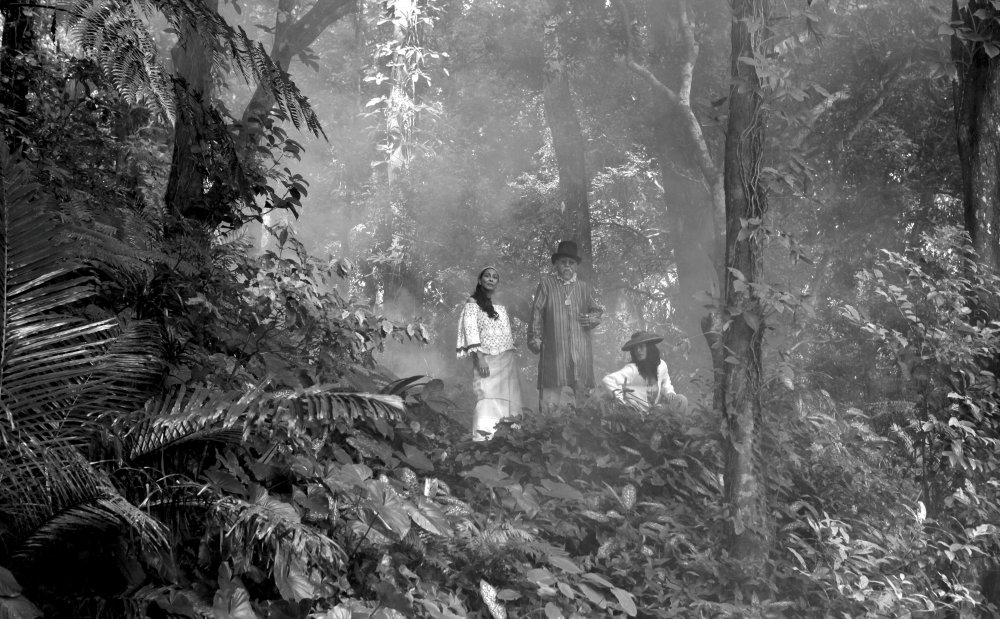
does have a lot on his mind, and A Lullaby to a Sorrowful Mystery looks gorgeous, but do the long moments of stillness really represent emotion? Time is a huge influence, enough in itself to be abstract if used to force a viewer. However it is a potentially poisoned chalice as, if you even cross over three hours, the passage of time must be earn, something I have learnt developing a fascination with this type of cinema from examples I have watched and written about, "long form" films not that dissimilar to a mini-series barring the removal of an obstructing segmentation of pieces as continuous works whose scale change their form completely. With A Lullaby... we are dealing with real history, where real figures were killed, pointedly following the aftermath of the 1897 massacre of Silang, but I feel that, in honesty, Lav Diaz could've gone further with this material especially with the knowledge that Norte, half its length, is a legitimately great work which contains a great deal by itself. He also found a way on a clearly low budget to depict a century ago, with strategically chosen architecture and period costume, so a low budget experimental period film with this tone is fascinating to experience when on point.

Probably the segment which proves an issue, as the film can be split into multiple two hour segments, is where Gregoria De Jesus is searching for her husband in the forest and her group, including a couple of work and a man revealed to be slowly dying of a lung disease, spend the time in contemplation in a long glacial and deliberately meandering segment. A lot of the film beyond this is very interesting, and Diaz when his characters talk gives them the time to talk, a lot of incredibly potent dialogue and a willingness to even make apparent villains, barring the Spanish, actually so much more complicated, both in how one female character who sells out a village to be massacred in the most horrible fashion during the Silang  skirmish was at a younger age treated horrifically by their own elders, and Simoun was already having honest reflections on his contributions to the colonisation of the country. The film is beautiful to look at as well, Diaz shooting in monochrome as is his traditional choice and creating an incredibly beautiful film, the Filipino forests both ominous and haunted.

The film is ultimately good, a challenge but one which I have come to admire the longer I have thought about it, the exorcism of his country's past found in how the weight of regret permeates the characters. If I was able to see the film more, it could easily grow in quality. The pace, when it succeeds, allows everything to grow and the complexity is felt in real time. Again though, does eight hours constitute a weight, when this complexity was possible from Lav Diaz in four hours? Probably in terms of a sombre, existential haze, but a part of me still hesitates as I did, much more negatively a few years back, with his 2011 Century of Birthing, that the director is going to continue going to these long lengths unless he changes his style, but with the sense that it could easily become a dangerous indulgence we as viewers have let him fall into. If he makes the weight felt fully, that lack of restriction will be an incredible virtue, but one of the odd things about slow cinema is that it can even be less the ninety minutes and felt in longer time than most films, so it is a dangerous crux to think nearly a whole day's time is necessary unless you intend to fill it with an entire real history.

It is a pertinent thing to end on, in lieu to this, is how when Jacques Rivette's Out 1 (1971), which is over twelve hour, was finally available for people to see I suspect its mystical lustre was actually damaged. When limited amounts of people could see the film, it gained a reputation as a sacred work, but when anyone could, people like me were as quick to suggest that it could drag (the theatrical performance sequences) as it had so much to admire. As much of this is that, sadly, we're not prepared in our environment to treat films and most media as an expansive work that takes hours to ingest, not helped by the fact that, in the case of Lav Diaz films, its sometimes impossible to rewatch and absorb the work as it becoming much more a concern for myself. As much of it, though, is the knowledge some of these films are really taking a risk that, even if you admire the work, might mar its lustre knowing the length could be edited down without losing its imposing but necessary weight in length. The irony is that Rivette, despite his reputation for long films, originally intended Out 1 for television but, when that wasn't on the cards, the whole work was screened on a non-stop length at cinemas thus causing its legend to take place. A film like A Lullaby to a Sorrowful Mystery wouldn't lose any power if it was cut up into chapter headings, but the question arises whether even then the film could feel spun out at times still even for someone (me) who absolutely admires it. The ritual of viewing a film in a cinema mixed with an incredible length does have a profound effect, but likewise, time itself must be used to an advantage and it can be possible to be indulgent.

Abstract Spectrum: Minimalistic/Magic Realism
Abstract Rating (High/Medium/Low/None): None

From http://fredassets.s3-eu-west-1.amazonaws.com/
uploads/sites/4/2016/11/alullabytothesorrowfulmistery3.jpg

===
1) HERE
2) A Lasagna Cat reference in a Lav Diaz film review? Why not, I covered it here and here anyway. Insanely long cinema exists even in web video form as much as acclaimed art house director and deserve to be compared. 

Friday, 26 July 2019

Naked Desire (2015)


a.k.a. Onanie Sister Tagiru Nikutsubo
Director: Hideo Sakaki
Screenplay: Kôichi Miwa
Cast: Ui Mita as Akane Kanzaki; Shô Nishino as Kayoko Fukuya; Yasuyo Shiba as Rina Sendô; Shigeru Harihara as Kanzaburô Yamanami; Yûta Kogiri as Shinji Okada; Tadashi Mizuno as Kensuke Saitô; Matarô Umeya as Shigeyuki Kimura; Ayumi Tomiyama as Junko Machioka; Kôichi Miwa as Tejima
Obscurities, Oddities and One-Offs

I wish I could appreciate Naked Desire, but in lieu to Japanese pinku cinema's history, there's still a lot of films which are just for titillation, something that Jasper Sharp, author of Behind the Pink Curtain can attest to; he wrote in that incredible text of how this medium of softcore sex films, on low budgets, allowed for such openness in creativity directors like Kōji Wakamatsu instead made controversial and political films, but he also attested to the many that have been forgotten on the wayside.

This is pertinent as, early in their DVD releases, Redemption Films were releasing some fascinating titles, many of which belong to the "The Four Heavenly Kings of Pink", four pinku directors (Kazuhiro Sano, Hisayasu Sato, Toshiki Sato and Takahisa Zeze) who started in the late eighties and imploded the genre with innovative work, and other figures who followed after them who took the material into more introspective creativity. Films like Tokyo X Erotica (1999) are very idiosyncratic, but it seems that sadly, barring a few fascinating choices I want to visit, Redemption Film's choices have sadly slid into sex films which don't live up to their potential, an utter shame as the British company for a long time (before they focused as much on the US market) did a lot of admirable things, such as their Jean Rollin releases to even debuting Valarie and Her Weekend of Wonders (1970) on DVD in the UK, all in spite of their utterly cheesy Satanic lesbian vampire aesthetic.

Whilst the prospect of ultra-love budget sex dramas sets in one main house at the coast could've led to so much interesting creativity, Naked Desire just decided to go for sex sells in odd ways. It's particularly an annoying case as the material is there; pinku's reputation is that even if you aren't dealing with highly cerebral work, there could be a wit or even fun to the material, as seen when The Glamorous Life of Sachiko Hanai (2003) became an unexpected cult hit in the West for its many aspects including George Dubya Bush's finger being an unexpected plot point.

The set-up here in Naked Desire is interesting as a premise for a film. A Catholic nun, reminding one of Christianity being a small but historically distinct aspect of Japan, is tending to an old man who is debilitated, a fascinating detail waiting to be used that during the sixties he was a political protester back even at the 1960 Treaty of Mutual Cooperation and Security between the United States and Japan that caused incredible outcry. Her life is effected by three abrupt guests - one a self-proclaimed nymphomaniac and a free spirit, the other two a female teacher with her young boy lover on the lam from the police, who are hunting them down presuming he's been kidnapped by her. The later pair are a controversial and potential icky choice but considering how pinku has the ability to tackle serious material there's a lot to unpack that could've worked - the chaste nun having to deal with openly sexual figures and how it effects her own sexual desires; the free spirit taking a very controversial stance of the treatment of the nun's patient; and the teacher and student, clearly in love, trying to find their safe spot away from the lives they've left whilst the younger boyfriend is discovering his various fetishes, particularly with his buttocks being fondled.

The set up presents a lot to go with - even with the problematic items at hand, with the addition that the free spirit believes the best way to help the old ailing man is through sex, even when he is not entirely aware of his surroundings, if Naked Desire had been openly transgressive with a purpose it would've at least been interest even if still uncomfortable. Even if it had been a comedy, it could've done a John Waters and deliberately been bad taste. The issue is that, for its moments, Naked Desire feels like a lazy production. The work is incredibly simplistic and flat in telling its tale, following the barest essentials.

I wasn't expecting a vast complex psychodrama of a nun's temptations, but a bit of nuisance about her faith crossing with sexuality should've have reached a point rather than the actress, visibly merely a cosplay outfit at points, masturbating in front of a crucifix in a darkened bare room, which really isn't inspiring and too limp to even consider blasphemous. Even the troubling takes on comforting a disabled old man sexually, or the young student, can be dealt with through far more than the film attempts, frankly half hearted. Even the involvement of side characters doesn't help; the student's male friend, a letch who'll betray his romance behind his back, is unused. As is the two male detectives and female officer sent after him and the teacher. The male cops are the worst part of the film, unfunny and boorish with a bad taste creative choice of them groping the female detective constantly; she in contrast, even here, is at least someone who could've been taken in an interesting direction just if it meant more scenes of her beating up male perverts. That and the quirk of a scene of her masturbating to porn in the office only to wonder whether the actress looks like herself.

Twice already, I've referenced masturbating and far from shame, it's more that there's a clinical lack of pleasure even in a childish way. Probably the biggest failure is that Naked Desire isn't even sexy in a crass way, just purely mechanical. It's a factor to take away from Sharp's book that, for every work his praised to the hilt, he devoted an entire chapter to even how pinku cinema when it slumps crashes badly in the worst. To try to review a sex scene is frankly arbitrary as, in truth, it neither elates nor provokes, merely causes a shrug of the shoulders, something no actor or actress willing to bare themselves even for simulated sex should end up with.

Naked Desire isn't terrible but you'd feel embarrassed to recommend it, which is a shame as, even for work less put together as this film, I have a growing fondness for how formats like video and digital camera recording technology, as well as allowing more people to create films, has produced its own world of infinite possibilities. Rather than use digital camera for big budget films over celluloid, digital should be the place for tiny films which with limited sets, even if I must confuse that the transfer for Naked Desire, for its UK DVD, has one of the worst looking appearances even viewed on an old TV on an old Blu-Ray player up scaling it.

It doesn't deny that, barring some different locations, a film moistly set at a large coastal home, by the beach, which becomes the heated environment of a predominantly female driven cast of characters, with sex and passion bottled up, allows for many tantalising dramatic possibilities, forced to have to improvise a film here over seventy minutes or so with only what one has. Sadly we don't get this, even with the options laid on the table of what to do with three female characters, two proudly sexual and the other conflicted by her duties and desires, with the two males (one wheelchair bond, the other young and naive) offering a minimal budgeted pot-boiler you could work with. Even if meant to be a comedy, intermingling this with erotica, drama and religious existentialism even in a cheesy way would've have been worth it, an enticement with "limited" and "no-budget" filmmaking that, even if the acting and technical quality were to question, you still have resourcefulness and unpredictability. You get predictability here unfortunately, only changing into something memorable in the finale.

It's impossible to forget. The old man suddenly, awoken by the police outside his home triggering his memories of being a protestor, suddenly turns into Yukio Mishima during his fatale attempt at a coup d'état in 1970, shouting like a mad man whilst possessing a lot of "power" between his thighs. Two male characters decide to have sex, in probably the most progressive moment of the whole film as, rather than for comedy, it's seen as two guys regardless of sexuality finding themselves enjoying jumping each other on the kitchen floor. And the female cast, naked, posing on the outside of a car which, even if moving slowly, is still impressive in allowing themselves to be in such a position on a moving vehicle (and probably freezing as it doesn't look like the scene was filmed on a hot day). At least I could leave this bad film with something memorable; the rest however doesn't compensate for anything you've had to sit through, or the moments of crass attitude to the female characters, or the lack of reward.


Monday, 22 July 2019

History Lessons (1972)

From http://sensesofcinema.com/assets/uploads/2017/
09/HistoryLessons-750x400.jpg


Directors: Danièle Huillet and Jean-Marie Straub
Screenplay: Danièle Huillet and Jean-Marie Straub
Based on a novel by Bertolt Brecht
Cast: Gottfried Bold as Der Bankier; Johann Unterpertinger as Der Bauer; Henri Ludwigg as Der Anwalt; Carl Vaillant as Der Dichter; Benedikt Zulauf as Der Junge Mann

Back with the Straub-Huillet connection and there's a sense, for every film so far that has succeed, there's examples like History Lesson which I am becoming fonder of in ambition, which is an odd pleasant sentiment to use for intentional didactic avant-garde cinema, but with the realisation that I would've done things slightly different if I could make these films, always a little detail which yet a huge construction flaw when amplified. Their structuralised forms don't always succeed as, in all due honesty, to completely remove a sense of sensation from a cinematic work, interest or/and emotional resonance, is to completely undercut one's work, a vast difference between challenging the viewer and a disconnect that loses most, and it's a shame here as the material, an unfinished Bertolt Brecht novel about a biographer of Julius Caesar being confounded by contrasting opinions, has so much that for the duo perfectly works in lieu of their political attitudes.

Like Othon (1970), ancient Rome reflects than then-modern day, and even today revisiting this film from the now past, as we have Julius Caesar turned into an unseen Charles Foster Kane figure, a being of power and stature who various Romans interviewed by a biographer tell differing versions of. From a banker to a former soldier who now lives in a hut in the countryside, these figures are all in period dress but being interviewed by a younger man who wears a suit and drives around the then-modern Rome in a car, the interview scenes inter-spliced between lengthy driving scenes that somewhat (a little) evoke Chris Petit's Radio On (1979) in slow contemplation of the driver dashboard and everything outside the front window.

From https://image.tmdb.org/t/p/w500_and_h282_face/
bDJ77aGMooIwUouKyQi573RdbWO.jpg

The problem begins in how entirely didactic History Lessons is, reminiscent to the issue between Jean-Luc Godard, who I once hated but have come to admire as an innovator, and the infamous Dziga-Vertov Group era of his career, where he renounced mainstream cinema and even his original experimental art films, and made entirely didactic films which History Lessons shares the same lengthy monotone dialogue sequences from, off-putting when there's a disembodiment to the material within them from the felt disinterest. This is worst as, even with this mute extreme Bressonian acting style, History Lessons (where four length dialogues exist in-between the driving scenes) is actually fascinating in its material, the four different views of Caesar between the military hero to conniving exploiter who worked for merely profit and for power, pertinently in an anecdote where he was captured by pirates, working with them and still had them executed after making a deal with them. It is fascinating text, more so as with modern Italy as the location there as juxtaposition, the timelessness of political powers and its many issues shining among the environments. Another issue is that, with knowledge that the source material had the biographer go through an existential crisis when he couldn't get an agreement on Caesar, I could've had more participation of the character even if he's still a neutral figure deliberately for the viewer to enter the story through. Again, it raises the issue of disconnect as such a character, even paper thin, is designed for the viewer to enter the film which the film itself belies in its obstructions.

The driving scenes, quiet and meditative, offer a calming form of slow cinema and are more successful, paradoxically more enticing as, if you can enter their tone, we see documentary footage effectively of Roman as the car passes along, camera in the back seat so we follow the vehicle along and watch outside the window. Bustling, crowded with cars, old women blocking the street and forcing the car to have to reverse, these scenes of Italian streets is strangely pleasant and somewhat amusing in very dried humour.

The issue though, again, is that the film puts forward a pointless structural tone, especially as with patience, the film can be understood and rewarding whilst still retaining the reason Straub-Huillet deliberately choose these problematic creative choices, of purposely removing an sentiment that might obfuscate their message in "cinematic" terms. Not Reconciled (1965), one of their most well known films, is an accomplished piece of art, compiling a dense plot into merely fifty minutes and yet not pointlessly obtuse, instead when watched repeatedly growing in weight as you understand what is going on. History Lessons however is like Orthon, which made sense (Ancient Roman drama in modern Rome) but made the mistake of mute acting for no distinct justification. Again, here, vastly different from Robert Bresson and Roberto Rossellini where muted acting was for clarity of meaning, one little aspect scuppers a perfectly sound construct.

Abstract Spectrum: Avant-Garde/Minimalist
Abstract Rating (High/Medium/Low/None): None


From https://assets.mubi.com/images/notebook/post_
images/28233/images-w1400.jpg?1559592043