Saturday, 22 October 2016

Halloween 31 For 31: Let The Right One In (2008)

From https://s-media-cache-ak0.pinimg.com/originals
/ee/17/d6/ee17d673cfa6582fdd9bfab173a4261c.jpg

Director: Tomas Alfredson
Screenplay: John Ajvide Lindqvist
Cast: Kåre Hedebrant (as Oskar); Lina Leandersson (as Eli); Per Ragnar (as Håkan); Henrik Dahl (as Erik); Karin Bergquist (as Yvonne)
A Night of a Thousand Horror (Movies) #46

A film that was in dire need of being revisited, Let The Right One In is a melancholic film, another modern movie which takes vampire mythology and intertwines it with a deeply introspective drama, here about adolescence. Many will know the film; for those who don't, it's set in 1980s Sweden, where an adolescent male outcast called Oskar (Kåre Hedebrant), living with his divorced mother, meets the girl that's moved in next door  called Eli (Lina Leandersson), a vampire who he starts to fall in love with and encourages him to lash back at the bullies in his class. What's surprising revisiting it is how important the fact that it's a drama at its heart is, very much a character study of Oskar as someone completely disconnected from his parents, the mother unable to reach him despite moments of bonding, bullied at school and very much filled with an anger that is in severe danger of appearing externally. The drama is very much in the vein of quiet, thoughtful characterisation one that Ingmar Bergman set the tone for, only in a work that does openly embrace its genre tropes in how Eli's vampirism exists in the film, both her visceral need to feed but also how her elderly male aide Håkan (Per Ragnar) will gladly knock a person out chemically, tie them up and bleed them out, his growing inability to be competent endangering her existence and ability to sustain herself.

The vampire mythology is far more relied on in this narrative than most, willing to even evoke the lore of how a vampire has to be welcomed into a house to be able to enter it, seen in a very disturbing moment when this isn't done with the blood seeping from the body in vast quantities. What makes this interesting here is that the setting is completely removed from traditional gothic or even modern neo-gothic mood, in the cold and snow covered suburbia of Sweden of night-time streets and the corridors of Oskar's school, the introduction of classical folklore into this environment turning it into a modernist spin on the subject. That it's set in the eighties is a subtle aspect you can easily forget, only realised occasionally such as when Oskar and Eli bond over a Rubik's Cube; because its completely removed from the flashy sheen of The Lost Boys (1987), wood textures and lots of mutated colours, the result gives the period detail the sense that it looks like Sweden at the time and brings the vampire character into a new and fascinating environment.

In fact, far from Bergman, times within Let The Right One In, especially with a subplot where a man named Lacke (Peter Carlberg) struggling with his friend (unknown to him) becoming one of Eli's victims, evokes Finnish director Aki Kaurismäki in terms of its working class tone, only with a gloss that replaces his trademark down-to-earth aesthetic. This grounded nature allows for the more fantastic aspects to stand out more, few but striking as a result, such as a vampire scaling a hospital outer wall or an incident (while with obvious CGI) where its revealed cats with gladly attack a vampire violently when they appear in a room. The horror tropes are in the background of this story of two adolescents, one distinct as a vampire, the other a disconnected boy, but when they appear in the film the results can be violent, unexpected and nasty without becoming tasteless.

From https://nordicfantasy.files.wordpress.com/
2015/05/let-the-right-one-in-2.jpg?w=700
The fact the film has to be put on the shoulders of two young people in the central duo was a risk but one which succeeds, the awkward romance in each other found in Hedebrant and Leandersson as Oskar and Eli, difficult for Leandersson in particular having to play a world weary, adrift figure in gender neutral clothes who has been twelve for "a long time", a task to have succeeded in accomplishing in being an alien entity but one with interest in Oskar as a person she commits to fully. That her view of Oskar is up to debate past the ending, real love and friendship to him or the need for another aide she can manipulate, really makes Leandersson's performance utterly commendable. That the film is blunt in its content, not afraid to reveal the crimson or Eli's clear monstrous nature, makes this emphasise on adolescent characters more impactful, as the sustained injury of a cut on Oskar's cheek from a bully hits home further from the perspective of them being young teenagers or the climatic act of mass violence which is only seen in the aftermath. It doesn't allow you to brace the shock of the violence, nor the more unconventional and stranger moments, such as Elle's real form being briefly witnessed, or humour in aspects such as a white poodle appearing at the worst moment for Håkan in his busywork, which occasionally puncture the mostly sober and elegant film and always have an impact.

That it's also able to have the aforementioned black humour and aspects deliberately grotesque in tone, such as the unexpected introduction of hydrochloric acid that comes out of nowhere, without it seeming out of place is a testament to how Tomas Alfredson's film is quite haunting and considered in tone, without need even in its violence to become exaggerated and raise its voice in mood, the author of the original source material John Ajvide Lindqvist able to conjure a rewarding narrative from his own material in story and dialogue. As a result, it feels like a necessary homecoming for me, as with quite a few films from my viewing past, that regrets the distance since I first viewed it. 

From https://s-media-cache-ak0.pinimg.com/originals/ab/
78/75/ab787587d95f59ca48297d1551c2b4c9.jpg

Friday, 21 October 2016

Halloween 31 For 31: Thirst (2009)

From http://www.raymondyeung.com
/movieadv/thirst_poster.jpg
Director: Park Chan-Wook
Screenplay: Seo-Gyeong Jeong and Chan-wook Park
Cast: Kang-ho Song (as Priest Sang-hyeon); Ok-bin Kim (as Tae-ju); Hae-suk Kim (as Lady Ra); Ha-kyun Shin (as Kang-woo); In-hwan Park (as Priest Noh)
A Night of a Thousand Horror (Movies) #45

I've had a complicated relationship with the filmography of Park Chan-Wook; naturally as I got into cinema fully around 2008 at nineteen, Chan-Wook had climbed in status since the early 2000s in the West. While other directors and films also represented the best of the new wave of South Korean cinema at that time and shouldn't be ignored, Chan-Wook for many would've been see, (whether rightly or wrongly), as the one carrying the country on his shoulders like Atlas after the phenomenon reaction to Oldboy (2003). A lot of my ambivalence once was a childish attitude of distancing myself to films everyone else liked. Also Stoker (2013) was an awkward attempt at an American film which may have likely backfired, Chan-Wook returning to his homeland to make The Housemaid for 2016.

Curiously though, Thirst above any of his films stood out away from any disinterest I had in the director's career, practically bulletproof in my admiration of it. Thirst, asking myself why this is for this review, is an incredibly original take on the vampire myth still. Particularly, as Chan-Wook attested to in interviews at the time, there's little in terms of the Western take on the vampire in Korean legend, leaving him in the position of dealing with a foreign concept he can purposely manipulate. The transitions are kept. When priest Sang-hyeon (Kang-ho Song) becomes a vampire, turned from a blood donation used to treat him in Africa after he volunteers to be infected by a dangerous virus, he cannot go out in the sunlight, having to improvise a coffin to sleep in, and can both fly and possesses superhuman strength. Where Thirst differs is how this figure of the vampire is wrapped around an emotionally complex plot involving morality, sexuality and a relationship in the middle, an erotic and violent melodrama that shifts tones as it goes along.

Having a Catholic priest as the central vampire certainly changes the dynamic, Thirst using this factor as part of the conflict nestled in Sang-hyeon's heart as a person when he becomes a blood drinker. A meek man, one side offers him liberation, freed to emote and fall in love with Tae-ju (Ok-bin Kim), a badly mistreated woman viewed as a step-daughter and a dog by matriarch Lady Ra (Hae-suk Kim) and foisted onto her son Kang-woo (Ha-kyun Shin), a sickly but also snivelling individual. However, in the best aspect of Thirst as a horror movie, these relationships are fraught with complexities, Sang-hyeon on a tightrope between his morality, mainly sustaining himself on the blood of a coma patient in the hospital he's working at and making sure not to kill them, and becoming a murderous and impulsive entity. The emotions between him and Tae-ju, who is a woman who has been poisoned by the terrible environment she's been raised in, causes their love to be fraught with extreme joys, sexually explicit passion that goes as far as biting and sucking each other's flesh lovingly, and extreme violence, becoming worse when she becomes a vampire and gladly takes delight in killing random bystanders to feed on them.

Like other Korean (and Asian) cinema, the film willingly changes in tone, between the utterly grim to even comedy, which in this case is a momentous reason why I love Thirst and held such reverence for it, both for changing the vampire story into something novel but also allowing its story to become more flexible. Over two hours long, it feels worthy of this length as it can allow its emotions for the character to be built over time and let the tonal shifts feel more natural as they play out, between the incredibly erotic scenes of the central couple's love to the most slapstick passage of the film in the middle, a figure in death haunting them by way of watery nightmares and being a comical nuisance at the worst times, able to work more when it becomes a small piece of the crux for a major shift in plot development. This also allows the shift in character's personalities to work far more as the emotional spectrum they can have can change with such variety, Sang-hyeon starting as a virginal and stoic figure and becoming more smouldering and charismatic as he "lets his hair loose" as a vampire, Tae-ju able to be more free even as a regular human being but exhibiting more chaotic and volatile aspects of herself created from a toxic upbringing and desire for revenge takes hold of the duo.

From https://extraimago.com/images/2016/06/19/15ac14.png
These tonal shifts, as Sang-hyeon's conflict with his religious beliefs clash with his Nosferatu existence and his love for Tae-ju, are helped by the luscious sheen of the film, cinematographer Chung-hoon Chung giving both the moments of beauty and utter grotesque violence a fullness to them, many scenes in Lady Ra's home scored to old Korean pop songs for a whimsical irony. The acting as well for this to work is perfect, Kang-ho the right actor here; a man able to be the portly comedic sidekick, the bumbling pigheaded cop in Memories of Murder (2003) and a handsome dark eyed stranger here, Kang-ho is one of the best actors from any country of these last two decades, helped along the way in this film by how Ok-bin Kim as Tae-ju suits her role fittingly as well. 

Returning back to Chan-Wook himself and his world, I find myself admiring how he's able to easily cross between tones with ease, all done in a heavily baroque directorial style that I regret having dismissed over these years, returning back to it with immense effect over myself relishing it. It's not just the obvious stylistic flourishes which stand out - the newly painted white walls of the vampire's lair being split with blood, the claustrophobic nature of Lady Ra's mah-jong table when Sang-hyeon and Tae-ju met again after their childhood - but details such as sound design, the use of music and the entire structure of what's on screen and heard all being carefully thought out. Returning back to his films with Thirst, I realise he wasn't the person who was style for the sake of style I dismissed him as but someone who is very careful in how he puts films together, even when he's flamboyant in many moments of the film with his camera movements and visceral content. It's interest, as the perfect example, how more important static camera shoots are in this film and how he's able to evoke as much for his gothic modern melodrama in them as he is the more kinetically dynamic moments. Plus, it's a godsend how well the CGI effects have dated, amazingly so, helpful in that they are used as much for the characters' personalities and the events taking place for them, as much emphasis on odder scenes as well as Sang-hyeon flying when, as he first starts to become a vampire biologically, he can even hear the dust mites on his own skin moving and other such quirks take place in the narrative.  

This sense of creativity with accomplished skill was why Thirst stood resistance during a very childish, stubborn change of opinion on its director. It's a film that ends with a buddy comedic slapstick scene at the beach before becoming emotional devastating, the kind of unpredictable filmmaking which always stays fresh on each viewing. Rewatching it, I feel myself wanting to return back to all the Park Chan-Wook films I had watched many years before with renewed interest...

From http://65.media.tumblr.com/5c9d930d5c9fb7ddc7633ed4e22bc3fa
/tumblr_mqtuovXgc31r4nyq4o7_1280.png

Thursday, 20 October 2016

Halloween 31 For 31: The Phantom of the Opera (1925)

From https://upload.wikimedia.org/wikipedia/commons
/4/45/The_Phantom_of_the_Opera_(1925_film).jpg
Director: Rupert Julian
Screenplay: Elliott J. Clawson, Raymond L. Schrock, Bernard McConville, Jasper Spearing, Richard Wallace, Walter Anthony, Tom Reed and Frank M. McCormack
Cast: Lon Chaney (as Erik, The Phantom of the Opera); Mary Philbin (as Christine Daaé); Norman Kerry (as Vicomte Raoul de Chagny); Arthur Edmund Carewe (as Ledoux); Gibson Gowland (as Simon Buquet)
A Night of a Thousand Horror (Movies) #44

Regrettably, while his iconic status is still held aloft in horror lore through older fans, this is the first and only film I have ever been able to see so far of Lon Chaney's, his body of mostly silent horror cinema incredibly difficult to acquire in the United Kingdom. One of the strangest anomalies of the DVD age, especially as the British appreciate horror cinema with incredible reverence, is huge parts of early American horror cinema (Val Lewton for example) have been barely released, Lou Chaney another victim of this. Considering this film, this is stupefying to consider because I immediately mesmerised by him; for once his sinister plastic mask as the Phantom, haunting the Paris Opera House, is yanked off its not only his (still) incredible makeup work that surprises, done to himself using fishing wire to sculpt his own flesh, but how much of a prescience he is. Not a ham, but like Vincent Price or Boris Karloff, he is giving a great performance in context of a silent film just from body language stalking the screen. His shadow is the first thing seen, hanging off a stone wall as a sinister entity preventing anyone but budding opera singer Christine Daaé (Mary Philbin) from playing the lead in Faust, but as he physically appears on screen he stands out incredibly just from magnetism alone, making the unavailability of his career to see in Britain irritating for me.

If there's only one major flaw with this adaptation of Gaston Leroux's original novel it's that, like films nearly a century on, the hero and heroine are a bland duo cast to represent wholesome, lovely normalcy when the diabolical (and sane) viewers like myself are on Chaney's side. Chaney steals the film continually and even if he's psychopathic, you're on the side of this melodramatic, organ playing entity who wants love even if it means kidnapping an opera singer, causing a giant chandelier to fall down on the audience, attempting to drown people in the cellar of his already underground canal lair, and threaten to blow up the entire opera house with gun powder. In comparison, Philbin as the singer threatened by the Phantom and Norman Kerry  as her dashing beau are merely stand-ins for the excitement of the story, out done by Chaney and the decadent production design.

From https://carrieannebrownian.files.wordpress.com/2015/10
/012-the-phantom-of-the-opera-theredlist.jpg
While it's not as elaborate and haunting as what was being depicted onscreen in Germany in the twenties, not just German Expressionism but the set design of films like F.W. Murnau's own take on Faust (1926), I appreciate how theatrical but also tangible the world of this tale is. Giant stairways, trapdoors which propel people up like springs as much as they fall down them, secret doors behind mirrors, a sense of mystery around each set to reveal in, let alone the Phantom's secret lair that requires a boat to get to it where he sleeps in a coffin. It does evoke as a result Les Vampires (1915) in how it's not only horror but a pulp tale where each door, each room is a prop that leads to a new event rather than set dressing, the sense of space felt as the environments engulf their characters and each room representing a new plot point. When viewed in the colour tints of the restored version (of blood red, vibrant green), a greater potency is felt to these sets.

Of course, this version of the Phantom of the Opera is also known for its environment with two tone colour in the Bal Masqué sequence. It's rudimentary but witnessing it in 2016, the sight of colour, of pink skin and the deep crimson of the Masque of the Red Death costume the Phantom wears, is awe inspiring, a magic to it because of its flawed appearance against the visceral nature of the colours themselves, seeing experimentation add new colours (literally) to the painter's palette. The sense of spectacle is felt throughout the film, more so because of its age and how it's from an entirely different era where such extravagant sets were built; famously, until it was tragically demolished in 2014, Soundstage 28 where the set was preserved in Universal Studio was still kept into the modern day. Any issue of the more exaggerated acting amongst the cast, particularly the comedic characters who work at the theatre, or the bland nature of the good protagonists cannot detract from the imaginative, exciting nature of the Phantom of the Opera altogether because of this.

From https://i.ytimg.com/vi/9fAd2phremk/maxresdefault.jpg

Wednesday, 19 October 2016

Halloween 31 For 31: The Red Queen Kills Seven Times (1972)

From http://image.tmdb.org/t/p/original/
vAfP008M7ONelJMMGWNkL6fYVNq.jpg
Director: Emilio P. Miraglia
Screenplay: Fabio Pittorru and Emilio P. Miraglia
Cast: Barbara Bouchet (as Ketty Wildenbrück); Ugo Pagliai (as Martin Hoffmann); Marina Malfatti (as Franziska Wildenbrück); Marino Masé (as Inspector Toller); Pia Giancaro (as Rose Mary Müller)
A Night of a Thousand Horror (Movies) #43

After The Night Evelyn Came Out of the Grave (1971), director Emilio P. Miraglia made one other giallo, one that is dressed in a gothic gown, a red cape in this case, but is far more explicitly a giallo in terms of a narrative. The prologue sets up a tale of dwelling sisters - Kitty and Evelyn - representations of the Black Queen and the Red Queen respectively, the later said to haunt people after her death by the Black Queen, returning to kill seven people from the grave every hundred years. Cut to modern 1972 and Evelyn is inexplicably missing and another sister Franziska (Marina Malfatti) exists to comfort Kitty (played by Barbara Bouchet). This begins the very knotted and convoluted plot of Red Queen; if Evelyn was closer to gothic horror, in how its plot of a man being driven mad by his late wife coming out of the grave fits that genre's many plots, this has a similar type of plot but structures it closer around the conventional structure of a giallo as a body count starts and a figure dressed in a red cloak is responsible, causing Kitty anxiety as a potential romantic interest Martin (Ugo Pagliai) is being incriminated for the crimes.

The complicated nature of Red Queen's narrative is the one potential issue depending on each viewer's reaction to it, very much whether you can accept how far it goes or find it overburdening and difficult to follow. Giallo can cheat and be incredibly convoluted - Evelyn glibly changes the board its game was being played on constantly to keep the viewer on their toes - but Red Queen is a lot more complicated than most giallo for how little breathing space there is at points, the inclusion of Franziska when it transitions to the main modern day narrative a great example you have to adjust to quicker than with other moments. It also has a lot of plot strands to keep in mind, all adding a lot to love in the film but keep things very dense at points. The entire nature of what's happened to Evelyn, Kitty's guilt over this fact, married businessman Martin having to profess his innocence as a suspect, Franziska's existence alongside other women like Lulu (Sybil Danning) and Rosemary (Pia Giancaro), a fashion company Martin becomes head of when the original boss is killed by the Red Queen, the inheritance left by Kitty's late father stalled for a year, not to mention Evelyn's creepy drug addicted former boyfriend who just wants the inheritance...a lot to deal with, many red herrings that are whittled down as the deaths take place, very much a story that has to be relished for its elaborate plot points or it would become overwhelming. The result is a giallo churning some many plot points of the genre into one dense narrative, erotic and stylish at the same time.

From http://nerdist.com/wp-content/uploads/2016/05/Red-Queen-3.jpg
The style is a lot of why Red Queen is actually able to succeed with this condensed plot. Particularly with its production design by Lorenzo Baraldi, who also contributed greatly to Evelyn's advantage, it has a great sense of mood that connects everything together, the conflict between modernism and the gothic the central issue in this plot, a tale from Kitty's family haunting her amongst the modern settings as well as the historical ones. The titular Red Queen is certainly one of the most evocative figures from giallo I've seen, a woman with raven black hair and a Little Red Riding Hood cloak, manically laughing after each murder she commits before disappearing round a corner, evoking European fantastique literature rather than straightforward mystery stories. The gothic lashings - the inheritance, the gothic home of Kitty's family - nestle perfectly with the then-modernist decor, like with The Night Evelyn Came Out of the Grave, because the type of story as a giallo suits the vibe of gothic too, of backstabbing and people chasing figures around darkened corridors. Red Queen is also open in its more lurid content, Kitty's family home having an underground dungeon and the climax involving a room that fills up with canal water straight out of the Lou Chaney Phantom of the Opera (1925), and because giallo could be both artistic and openly absurd with such content, this fits the world perfectly without question.

The emphasis on art is important as, whilst they could be trashy and sleazy, the best giallo which Red Queen joins at least technically were very artistically minded in how colourful and how carefully made they were, a sense of pride felt in its aesthetic which was put together with thought despite how quickly these films were made in their boom period between 1970-2. Even if there's kitsch, the fashion and a large part of the story about the fashion industry a time capsule to that period, there's an incredible glamour to Red Queen that's undeniable. Of beautiful people in beautiful locations which makes it moments of bloody red paint gore more stylish, all score by Bruno Nicolai creating another great score after Evelyn, and cinematographer Alberto Spagnoli shooting everything, especially the colour red, in full vibrancy. Even if the plot gets ludicrous at points in its shifts, The Red Queen Kills Seven Times is still incredibly watchable. 

From https://lh5.googleusercontent.com/-3YC8BmrBsA4/TWndy4pga5I/
AAAAAAAAALA/1cHHrweqt4s/s1600/The+Red+Queen+Kills+7+Times+9.jpg

Tuesday, 18 October 2016

Halloween 31 For 31: The Changeling (1980)

From http://www.impawards.com/1980/
posters/changeling_ver1_xlg.jpg
Director: Peter Medak
Screenplay: Russell Hunter, William Gray and Diana Maddox
Cast: George C. Scott (as John Russell); Trish Van Devere (as Claire Norman); Melvyn Douglas (as Sen. Joseph Carmichael); John Colicos (as De Witt); Jean Marsh (as Joanna Russell)
A Night of a Thousand Horror (Movies) #42

[Warning: Spoilers Ahead]

Winter. A family, John Russell (George C. Scott) and his wife and young daughter, have had to push their broken down car along a snow covered road. John goes to a telephone booth to call a toll truck only for an accident to happen, sudden on screen, that kills both the people he loves. As an opening its one of the most sobering for any horror film.

From here what interests me about The Changeling is that it has a lot of the traits I hate in modern horror cinema but manages to openly get away with them and succeed instead. After his trauma, John moves to an old elaborate house where its immediately clear the house is haunted. In any other film the following series of sudden shocks and bombastic orchestral stings would be cringe worthy  but there's a significant grace to the film that conveys this to its ideal results, that it's not overbearing but adds greater unease instead. Director Peter Medak rightly lets silence and moments of ease filter in-between which helps drastically, as John reacts to the events (until the more extreme events take place) with stoic surprise, finding that a ghost of a physically disabled boy haunts the building. The greater sense of grandeur to the film as well, a drama for the most part as John discovers a conspiracy linked to the haunting involving politician Sen. Joseph Carmichael (Melvyn Douglas) and his birth right, contributes to the film, far removed from an obnoxious rollercoaster ride but an elegant supernatural drama which gladly enters the extravagant as ghostly events take place and Rick Wilkins's orchestral score reaches euphoria constantly.

From http://cheshirecatstudios.com/wp-content/
uploads/2013/12/the-changeling-ball.jpg
The shocks themselves are incredibly unnerving, not the cheap scares of a person suddenly jumping out repeatedly but very well set up using openly un-human actions that are done subtly; their style is set up in the first, an expertly done moment involving merely a piano key, which is continued throughout the rest of the narrative. For two-thirds, as suggested, merely the simplest things are enough to cause an eeriness to the event. This film, telegraphing its importance, makes a tiny little red ball the symbol of fear through the most elaborate of shocks, as it does a wheelchair, characters themselves alongside the extravagant house itself. A great sense of melancholy is felt in terms of mood and it's little details at first which cause surprise, of sounds that could be explained by the giant boiler in the basement or a piece of glass merely falling out of a high window to the attic. When things start to escalate its helps that John's characterisation is that of someone willing to accept the belief around him with the logic of a real person, not the cliché of denial, not openly willing to tell police of details knowing he will be seen as mad, but willing to bring in mediums at the point he believes that what he's witnessed cannot be rationally explained away. When the film gets more bombastic, staircase banisters suddenly catching on fire and such mayhem, it's at the time when the film has gone through its drama up to its most emotionally tempestuous moment, the rage of the ghost bursting loose, completely justifying the extreme shift into destructive ghostly effect.

The elegance of The Changeling's style is a great service to it as well. Warm colours contrast against its coldness especially in exteriors, its tendency to jump back and forth in time like memories which can take you off-guard but is always inspired when it takes place. The acting as well is commendable for grounding the supernatural events into plausibility, George C. Scott admirable in his performance alongside the other cast members who add seriousness to the film. This seriousness, not stodgy grimness but a sense of immaculate sense of drama, can be felt throughout The Changeling and why it succeeds. 

From http://i.onionstatic.com/avclub/4339/09/16x9/1200.jpg

Monday, 17 October 2016

Halloween 31 For 31: Midori (1992)

From http://www.trashmutant.com/uploads/1/0/9
/8/10984559/5197948_orig.jpg
Director: Hiroshi Harada
Screenplay: Hiroshi Harada
(Voice) Cast: Minako Naka (as Midori); Norihiko Morishita (as Wonder Masanitsu); Keinosuke Okamoto (as Koijirô Arashi); Kazuyoshi Hayashi (as Akaza); Yoshifumi Nomura (as Muchisute)
A Night of a Thousand Horror (Movies) #41
A 1000 Anime Crossover

Abstract Spectrum: Grotesque; Psychotronic; Weird
Abstract Rating (High/Medium/Low/None): Low

Midori is an infamous work, an animated adaptation of Suehiro Maruo's ero-guro manga Mr. Arashi's Amazing Freak Show (1984), where a young girl finds herself trapped as part of a travelling carnival freak show in nineteen twenties Japan, created by one man, the former industry animator Hiroshi Harada who became an underground filmmaker. The result here of years of hard work is split into two divisive halves. The first is the most transgressive, responsible for this film's notorious reputation, a variety of horrifying yet lovingly drawn images of the worst in humanity, mainly still images with bursts of fluid movement, realistic but with incredibly detailed colour and exaggerated carnival characters with various bodily deformities and distinctions.

The bookending experimentation with surreal narration and the second half, when salvation is available for the heroine, is where Midori crosses into the abstract, a fully formed short length narrative which becomes more coherent and interesting but one which is immersed in the experimental style the film from the beginning has. From the dream sequences to the body horror to scenes such as a character called Wonder Masanitsu, a dwarf magician with mesmerizing abilities, causing a mass hallucinatory freak-out on an unsuspecting audience, the animation has a creepy, unreal tone added to by music by J. A. Seazer and Hiroshi Harada's expert craftsmanship as an animator.

Personal Opinion:
For the full review of Midori, follow the link HERE.

From http://images.tcj.com/2013/05/63cbe79e-f21f-44d5-
9df0-3f08a9b834fe_zpse3fa25e5.jpg

Sunday, 16 October 2016

Halloween 31 For 31: Rats - Night of Terror (1984)

From http://4.bp.blogspot.com/-sCWrm4Q1Z7g/Uc983UB454I
/AAAAAAAACcg/yYXiYqZ8jG0/s1600/posterRATS.jpg
Director: Bruno Mattei (with Claudio Fragasso)
Screenplay: Claudio Fragasso, Bruno Mattei and Hervé Piccini
Cast: Ottaviano Dell'Acqua (as Kurt); Geretta Geretta (as Chocolate); Massimo Vanni (Taurus); Gianni Franco (as Video); Ann-Gisel Glass (as Myrna)
A Night of a Thousand Horror (Movies) #40

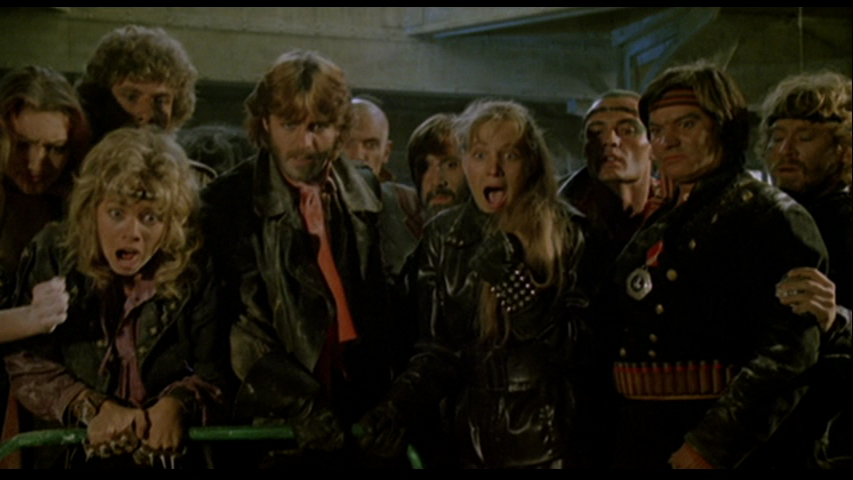
Another pairing of Bruno Mattei and Claudio Fragasso, and considering how many times they worked together, one wonders if their relationship went beyond merely collaborating on a film set to a friendship. Imagine the kind of bond, the conversations at lunch between film shoots, that would've forged making films like Hell of the Living Dead (1980) and Rats: Night of Terror. Here, in the meantime from that thought, Fragasso touches upon a theme that does scare and creep many people out in the figure of rodents. Mostly this is due to symbology - a pet rat, for me and for others, would be exceptionally cute, whilst the fear of them is due to their centuries old image as disease carriers in the wild. Wild rats present a sense of unease, suggest general decay, their ability to breed quickly and even go as far as cannibalise their own to survive disturbing in how they spread in rundown environments, their cultural legacy as spreading the likes of the Black Plague still potent centuries on because, even if it was technically their fleas with spread the illness, it killed millions.

Instead of merely an animal attack film however, which would've continued on the seventies tradition of nature being vindictive and trying to kill human beings constantly, Rats - Nights of Terror takes on an unsuspecting twist that was clearly influenced, as many Italian genre films, by the success of the Mad Max films, setting itself in a post apocalyptic sci-fi future. Set long after society has blown itself up with nukes, a group of marauders male and female, trying to survive on their own as explained in a very complicated opening narrative, find an abandoned building. At first finding crates of still edible food is a joy to them but they immediately find rat chewed corpses littered around the place as well. Soon they'll eventually learn that the rats are only just responsible for cleaning the meat off the bodies' bones but have more than likely killed them beforehand too. The result is even more peculiar considering the style and tone of the material.

I had been tricked by Zombi 3 (1988), itself "special" in some of its dialogue exchanges, that Fragasso was more conventional in his screenwriting style than I had come to learn, something clearly wrongheaded of myself when you get to Rats. Far from a detraction, it does mean that you have characters with very unconventional names - Lillith (Moune Duvivier), Video (Gianni Franco), Chocolate (Geretta Geretta with possibly the biggest hair even seen in an Italian post-apocalyptic film) etc. Than beyond those names, at least in the English dub, to the type of dialogue his characters have, such as Chocolate promise the geeky Video that he can make her pregnant if he fixes a computer they find in the building amongst such brief moments strangeness. Fragasso's obsession with environment issues throughout his career is found here too, Biblical proportions even when you get to the dumbfounding final twist, the group discovering the likes of plants being carefully grown in the basement with a water purifier and realising that a project by scientists was taken place in there, only to be found abandoned with rats on mass everywhere.

From http://1.bp.blogspot.com/-T2oN4Bt6m1w/TV7F4ODkz5I/
AAAAAAAABZ8/j3YA2u7n-0E/s1600/ratscast.png
I have to confess though that, for all its moments of entertainment, Rats does suffer from being surprisingly conventional and repetitious at points. Were it not for the little details, from the groups' military vehicle to the rats being made intelligent through radiation, this could've easily been made an animal attack film set in the regular day. It's a severely restricted film in terms of plot too - the marauders sleeping in the building only to find themselves having to try to survive the night from the rats - meaning that it does repeat itself constantly, from people being slowly picked off to a lot of screaming particularly from the actresses filling the soundtrack. Eventually, despite the idiosyncratic nature of Fragasso's characterisation, where everything borders between the profound to the absurd, it eventually lacks the outrageous nature needed to make up for its sluggish moments, not completely able to have the same strange aura of other Italian horror films from this period. Certainly it has the gruesome practical special effects - an un-PC incident with a woman naked in a sleeping bad, rats exploding out of people let alone out of their mouths - but baring the sub plot where a cowardly member tries to undermine their leader to save his hide, its boiled down narrative does feel lacking in the excitable madness that some of the best of Italy, the legitimately great works of genre let alone the fun ones, had. In fact I prefer Hell of the Living Dead out of Mattei-Fragasso's period here from what I've seen, even in spite of how shambolic it is next to this one's more polished appearance, because of how wider in scope its ambitious story was.

Of course, Rats does have one of the best, most delirious ending twists of any Italian genre film of this period, worthy of seeing Rats and redeeming it greatly, but I cannot ignore that considering the promise it gives as a post-apocalyptic rat attack film, it does lack the maddened energy of other Mattei-Fragasso films I've witnessed. While being of a fly on the wall for their conversations about making the film would've been wonderful to hear, as would how they dealt will all the stunt rats (and guinea pigs and rubber rats masquerading for them) on set, this does feel weaker as a film even in the context of admiring its failures.

From http://horrornews.net/wp-content/uploads/2012/02/
Rats-night-of-terror-1984-movie-6.jpg