Tuesday, 15 March 2016

Blind Beast (1969)

From https://s-media-cache-ak0.pinimg.com/736x/18/
b1/d7/18b1d7688455900c8525df4dd267b49c.jpg
Director: Yasuzo Masumura
Screenplay: Yoshio Shirasaka
Cast: Eiji Funakoshi (as Michio Sofu); Mako Midori (as Aki Shima); Noriko Sengoku (as Shino)

Synopsis: After posing for a series of erotic photographs and installation pieces, model Aki Shima (Midori) catches the attention of a man named Michio Sofu (Funakoshi). Blind since birth, with his mother Shino's (Sengoku) help he kidnaps Aki while posing as a masseuse, taking her captive in their home. Inside his studio as a budding sculptor, a shrine to the female form and its individual body parts depicted in sculpture, he desires to create art for the blind by the blind, Aki the most beautiful woman to him from touch and form, desiring to use her as his subject even against her will. In a studio with giant prosthetic limbs on the walls, from a wall of eyes to a wall of breasts, and two giant depictions of the female in the centre, Aki attempts to escape by manipulating his naivety with actual women, only to set off what will lead to the ultimate pleasure and the ultimate pain.

Ero-guro, or under its full title erotic-grotesque-nonsense ("ero guro nansensu"), denotes an artistic style that on opposite sides of the same coin the sensual and the horrible exist within the same moment. This could be a troubling artistic for some especially with modern standards of political correctness with its fetishisation of death and sex within one another but at the same time, fitting the apparent paradox of the concept, it could as much fit modern standards of attitude in the acceptance of such concepts and growingly accepted sexual fetishes such as S&M, only taken to its most extreme as fantasy pieces. The most important part - in manga, in music, in art - of this Japanese aesthetic style, as with body horror and transgressive styles from other countries, is that in its perfect state, the ideal, it's not an exhibit for misogyny or crass depictions of atrocity and perversion but depictions of sex (Eros) and death (Thanatos) which purposely cause reactions to provoke the viewer and is inherently gender neutral. Even if it's still offensive to some, the ideal version of ero-guro-nonsense for myself as a fan would be indiscriminate to gender, an equal opportunity aesthetic for male and female audiences to take reactions from without a bias in the content.

From http://4.bp.blogspot.com/-dBiI99q8ZOw/TsgwaSIhaEI/AAAAAAAACnM/
-f6Ykt_RjQA/s320/Yasuzo+Masumura+-+M%25C3%25B4j%25C3%25BB+%2528
Blind+Beast%2529+%25281969%2529.jpg
The other important factor, which Blind Beast also shows, is that it's not necessarily gore and intestines being thrown about that's ero-guro, something that becomes apparent even as an amateur in my knowledge of another culture's aesthetic concept. Deformity, the unnatural and the strange can qualify, which could also be used to disrupt views and biases in social contexts such as disability, something which as a style suited for horror could have a lot of great potential for provoking thought as well as pushing the bar in terms of squeamish content. It evokes as much films like Takashi Miike's satire Visitor Q (2001) as much as straightforward disturbing horror movies and comics. It is also important to note, if I'm to learn how to quote the term ero-guro properly, one individual whose published work is on my reading list and is central for the term, the legendary author Edogawa Ranpo. Ranpo, it must be stated, was famous beyond this genre, writing anything from children's stories to detective tales, all of which including his more grotesque material being adapted or referenced throughout Japanese pop culture. Teruo Ishii's infamous Horrors of Malformed Men (1969) is a great place to start just for trying to cram as many of his more infamous short stories into one narrative as possible, enough in its madness to encourage anyone to find any English translations of even his more sombre, audience friendly penmanship. 

From http://farm4.static.flickr.com/3162/2875409777_d5b66922da_o.jpg
A chamber piece - only three actors, minimal number of sets and the most elaborate, Micho's studio, a single giant warehouse - Blind Beast does exemplify the high artistic quality of even the most lurid of Japanese genre films between the sixties and seventies. Like the best of Italian cinema within the same era, there's a general technical quality that sets a good, competent base with the artistry helping with the story and content immensely. Very professional and talented individuals worked on these films with the best ones, like with the Italians, with no difference between sleaze and art in terms of treating it with the same level of professionalism. This is vital as Blind Beast is still incredibly strong in content, not as explicit as other films from the era but still surprising through subtle emphasis instead, the high artistic quality a necessary for this to have worked. A huge factor as to the best of ero-guro in what I've encountered is not the strength of the content in terms of visceral shock necessarily but strong artistic quality; these tales, despite their depravity and perversions, suit scenarios that provoke elegance, sensuality and high art because of their melding of two seemingly different attitudes, needing either a bold visual richness and/or period trappings such as samurai stories or the 1920s setting of pinku softcore film Marquis de Sade's The Prosperities of Vice (1988). Blind Beast is grim and grimy in places, of blood and food left to rot, but in a darkened environment for most of its mere eighty minute run there's still a tranquil tone to the content despite its transgressions.

From http://s3.amazonaws.com/auteurs_production
/images/film/blind-beast/w1280/blind-beast.jpg
The film's plot is exceptionally dark in content, more so in this decade, though while it includes risky content, such as Aki falling in love with her captor from force, the right balance of the transgressive subject matter means its equal opportunities transgression as ero-guro should be with both genders, where as a pulp sex horror story it's a cycle of the man and woman eventually becoming the equals. It avoids potential gender discrepancies and stereotypes which can affect work like this - see the Hanzo the Razor trilogy, which director Yasuzo Masumura made the first sequel of, for a more problematic example - as Aki manipulates Michio as much as he breaks her down, eventually both of them becoming sightless beings who can only communicate to each other through physical sex, eventually needing pain to be inflicted on each other for a greater sensual thrill.

From http://2.bp.blogspot.com/_pTvIRwDJyBs/TJLbc_ZmpcI/AAAAAAAAAFM/
0x4ochkMjl8/s1600/vlcsnap-2010-09-16-23h01m18s133.png
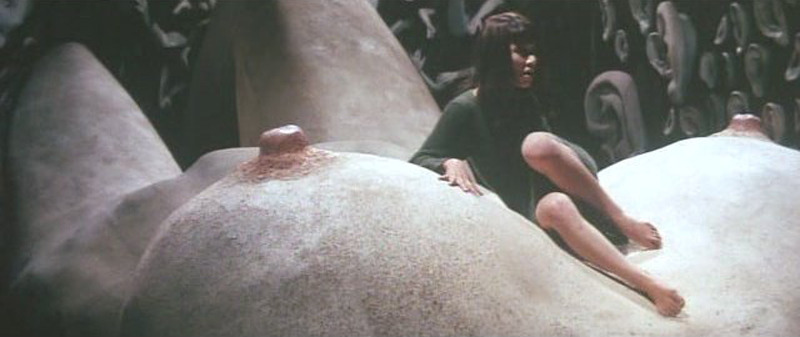
Taking its twisting little story seriously, the build up to this finale is entirely based on Michio's likely virginity and lack of knowledge of women beyond touch. The giant prophetic bodies, which the two lead actors have to crawl past and onto continually, are the infamous part of the film but significantly they also state his distance from actual femininity. Whilst his beloved sense touch lead to him, through his mother's help, to being able to touch women intimately and replicate their bodies in elaborate and accurate detail, his complete and utter lack of knowledge of female sexuality and women beyond his doting and protective mother becomes his hindrance, one which Aki can take advantage of to escape. Though he does dominate Aki and eventually rapes her at one point, starting their relationship after, immediately onwards from this act they switch between the dominant and the submissive continually with no gender being superior in their violence sexual passions, both equally lost writhing around their environments both suffering from their wounds given to each other but also thrilled by them. A triangle in the early part of the film between them and his mother is blatantly oedipal as well, thankfully because of the film's brisk length cutting out the need for teasing the fact; its explicitly said as, seeing the giant female bodies in the centre of the studio, Aki not long afterwards makes a comment about Michio having some form of obsession with when he was a baby held at his mother's breast. This builds up as much a strong issue of gender and relationships being skewered in its small story that prevents the film becoming tasteless without any justifiable reason behind such content.

From http://3.bp.blogspot.com/_pTvIRwDJyBs/TJLbiocYK3I/AAAAAAAAAFc
/tTCcTn8lNFg/s1600/vlcsnap-2010-09-16-23h03m01s194.png
Technical Detail:
The only thing that might've been interesting to see differently in terms of the aesthetic look is if Blind Beast was shot in monochrome rather than Daieicolor approved colour. Screenshots and posters exist that show the film in black-and-white that would've been incredibly bold if you had seen them moving, causing one to wonder whether the visual difference would have had a drastic effect on the mood especially in terms of the story's tone. Yasuzo Masumura would be as gifted in either case, the film as it stands perfect as it is; he was probably one of the only, if the only, Japanese directors to have been able to learn his craft at the Centro Sperimentale di Cinematografia in Italy with the potential likes of Michelangelo Antonioni, Federico Fellini and Luchino Visconti as teachers. The same level of quality to his more sombre World War II drama Red Angel (1966) is found here in Blind Beast, and can even be found in his own aforementioned Hanzo the Razor sequel.

The music is also memorable in terms of the combinations of genres used for effect. From jazz to classical pieces, it mixes and matches aptly for the shifts of tone in the story well. Sound is important especially for the final scene, metaphor with what you, the final grim act of the film only seen implied, the main star's ultimate act of destructive pleasure given a spine tingling edge that's still strong today from what you only hear. So strong in fact, watched on the same day with a modern film (Eli Roth's The Green Inferno (2013)) with over the top gore, that Blind Beast was the one instead that made me cringe more in its suggestion.
From http://40.media.tumblr.com/tumblr_mco6ueFcl51r7k0eco1_1280.jpg
Abstract Rating (High/Medium/Low/None): Medium
Originally this was going to be a "Low" due to how subdued and naturalistic the film is in contrast to its subject matter. However it's easy to ignore, when you've made a diet of films like this, how strong it would be to someone who hadn't encountered films like it before, how startling it is or scuzzy it is at times. Maybe even how absurd and silly it is, as the film openly courts being bizarre for the sake of it despites its clear themes. There's a more explicit and usually more honest viewpoint on the corporal living body in a lot of Japanese pop culture, which is scrutinised with only some censorship in what can be depicted, (mostly in terms of censoring genitals and pubic hair on both genders), but also in context of non physical notions such as sexuality. This would be more of a shock, let alone more profoundly weird, for a first time viewer, particularly as despite being limited in what actual content is seen, what is implied is still strong material in its frankness to digest.

And of course you're dealing with a psycho sexual drama mostly set in a room full of giant, prophetic breasts and arms, lovingly rendered in all shapes and sizes, sticking out of the walls with two individuals writhing around the floor in a state of delirious pain on the lap of a giant, headless woman. That's an image that's strange even for a veterans of this type of cinema and original still to this day.

Abstract Spectrum:  Grotesque/Psychotronic/Weird
Abstract Themes: Distortion and Emphasis of Boyd Parts; Giant prophetic limbs; Mutilation; References to Disability; Oedipal Complex; S&M and Sexual Fetishes; Bondage

From http://3.bp.blogspot.com/_pTvIRwDJyBs/TJLbkON-XGI/
AAAAAAAAAFk/nRvNn82rYxM
/s1600/vlcsnap-2010-09-16-23h03m24s90.png
Personal Opinion:
A real gem of Japanese body horror cinema, immensely stylish and imaginative in its concoction of body horror and drama which can be both treated as a serious, sombre drama but also a perverted erotic film. This blurring of the high and low art is also a factor of the rewarding of ero-guro I've been able to see; while it may seem wrong to find virtue in films like this that reveal in this type of content, and there are probably examples which are just tasteless that I'll thankfully not see, not only does it prove to be more rewarding to do so, but the quality of the best also brings out a real sincerity found in them. The obvious issue that my knowledge on this type of work is limited means that I need to take a film like Blind Beast as an example of learn what ero-guro should be as an aesthetic style in greater detail. It also means that something like this is much more cooler, the right term to use, and memorable as a cult film as its far removed from the words "safe" or "digestible". 

From https://elgabinetedeldoctormabuse.files.wordpress.com/
2010/06/moju-10.jpg?w=620

Monday, 14 March 2016

Archival Review: Next (2007)

From http://1.fwcdn.pl/po/17/22/
221722/7517467.3.jpg
Director: Lee Tamahori
Screenplay: Gary Goldman, Jonathan Hensleigh and Paul Bernbaum
Cast: Nicolas Cage (as Cris Johnson); Julianne Moore (as Callie Ferris); Jessica Biel (as Liz Cooper); Thomas Kretschmann (as Mr. Smith); Tory Kittles (as Cavanaugh)

Unfortunately the site that I wrote for, Videotape Swapshop, is no more. This is sad for me having enjoyed writing reviews for the site, but it also means that there'll be links to reviews from that site which are now dead. I do however have all the reviews I ever written for them, god willing, that can be reposted. The following was supposed to be part of an ongoing series reviewing every Nicolas Cage film (yet) made; instead of rewriting it, like I will do for all the other reviews, I'll leave it in its original form and only add additional notes for any context that might be missing transferring it to this site. I will not add any notes on whether these films are "abstract" either, only with some of them possibly being covered properly for this blog in the future in a new piece.

As for whether I should continue reviewing every Nicolas Cage film ever made, I may continue it on this blog as an additional feature even if it proved at points with some of the films watched to be painful. As much as Cage is one of my favourite actors, the reason why the review series was started, I realise now that like many actors his filmography is far from perfect.

I find myself stuck with trying to write about Next. I wonder why it was ever made in the first place in fact, another in a long list of failed Philip K. Dick adaptations where the comedic punch line is that, beyond the central premise, the adaptations are said to be so far removed from the novels and stories that its laughable to make comparisons. Blade Runner (1982) is that immense exception as most have vanished into obscurity, the only faithful take coming from indie wunderkind Richard Linklater with the strange, rotoscoped A Scanner Darkly (2006). Of course within the recent year or so Dick has had a small resurgence when Amazon Prime decided to make an original programme for its site based on The Man In The High Castle; whether it could succeed in bringing Philip K. Dick into the mainstream again is unknown, but it will immediately have more success than Next, a failure if there ever was one in the Nicolas Cage filmography as well.

Playing Frank Cadillac aka. Cris Johnson, Nicolas Cage is a Las Vegas magician who can see exactly two minutes into the future, able to use it to win modest sums of money and dodge punches before they're thrown. When he is in-avertedly caught doing something suspicious at a casino and manages to flee from the security in a ludicrous and random car chase, it catches the attention of FBI Special Agent Callie Ferris (Julianne Moore) who wants to use his psychic powers to find a terrorist group and the nuclear bomb they've snuck into US soil. Cadillac is more concerned with a mysterious woman who, when she is central in his mind, allows him to see further in time, spending his time in a cafe awaiting the day he finally meets her, a woman who teaches on an Indian reservation called Liz Cooper (Jessica Biel). Unfortunately with both the FBI and the terrorists themselves after him Cadillac effectively puts Liz in danger and will have to rely on his psychic gift to protect her and save the world.

If there is anything of good in Next it's that it does try to be clever with Cadillac's ability to see in the future. A lot of wrong footing takes place with an incident happening only for the film to go back in time and for it to reveal that it was a precognition, something that will feel like a cheat for many but for me actually made the film vaguely interesting. This is definitely the case with the ending, which could feel like an utter cop-out, but was fun. There's even some moments of inspiration such as Cadillac trying out various pick up lines to greet Liz only for all of them to fail and having to try something much different, or when very later on he has to find where the terrorists are by literally splitting into duplicates to follow each route.  In the perfect world this could've easily made the film great, even as a silly action sci-fi, if it had a good backbone behind it.

Unfortunately, as the last paragraph warned of, an inspired idea cannot save a film if the rest is so badly compromised. Over ninety minutes the rest is a terrible, bland waste where the first warnings of its failings are when he has to do an opening monologue over himself doing things to explain the premise1. Despite critical acclaim for Once Were Warriors (1994) in his native New Zealand, Tamahori does sadly hold the mantle of the director of the worse James Bond film so far made, Die Another Day (2002), although I suspect that was as much compromise from the producers that lead to the disaster it was. Next is just as bland, barring its clever use of its premise a complete and utter waste of time. You can imagine a more entertaining Cannon Pictures adaptation from the eighties which would run with the premise and its comically Euro trash villains, but made in 2007 the result is un-dynamic and drab.

Probably the most ludicrous aspect of the film alongside some of the most dreadful CGI effects I've seen in a while, including a train, is the cast it has. Biel and Cage have some charisma, but Moore really does feel like a sore thumb amongst the trio, to the point you could've helped the film out if you excised her scenes and added more drama in her place. In a world where Cage's ability is under suspicion without context for others to believe her, you wouldn't follow her beliefs to pursue Cadillac if you were a senior member of the FBI, not only wasting man power and money but leading to potential embarrass and cheap jokes likes for those in the US military who thought they could weaponize psychic powers by killing goats through the power of staring2. That the only way his power can be of any use is through Liz Cooper being a deus ex machina makes Special Agent Callie Ferris not only too big in her britches with her orders but useless.

The film feels too brisk in plotting to the point that its twist ending is far from being an embarrassment to end all embarrassments but a relief in its cheesiness. So much in the film is lacking of vitality that this review is exceptionally short without padding it like I have [, with this standing]3 up as another of the worse Cage films I've covered4, not technically incompetent but bad in its average nature and waste of existence. Like a lot of action and sci-fi films of its ilk, Philip K. Dick adaptations or not, it's so mediocre one finds difficulty in writing anything about it.

=============
1. One of the more odder discoveries of the Nicolas Cage Project as it was originally called was how many of his films rely on him giving voiceover during introductions to his characters' lives. He has a great voice, for the screen and for radio, but these voiceovers appeared in a lot of bland films I covered and proved to be a warning of the staleness of the final film baring a few exceptions (Ghost Rider: Spirit of Vengeance (2012)) where the monologue given to him had more spark to them.

2. Unfortunately, like for many amateur and professional writers of film reviews, you read some of the jokes you originally wrote and cringe with embarrassment at how leaden they are. Expect some really bloated sentences from some of these reviews as much as some vaguely interesting insights, the former something I had mostly excised in my reviews over the years but occasionally appearing in clumsy references like this.

3. The review hadn't been completely checked over when Videotape Swapshop sadly ended, so some grammatical errors had to be dealt with without compromising the original text.

4. Unfortunately there'll be some terrible films being brought up as I post these old reviews and maybe cover more of them anew. Cage is a great actors, as I'll defend in this reviews, better than the films themselves in many cases, but the post Wicker Man material is going to exhibit a lot of pain on my part...

Wednesday, 2 March 2016

Piercing Brightness (2012)

From http://i.jeded.com/i/piercing-brightness.16675.jpg
Director: Shezad Dawood
Screenplay: Kirk Lane
Cast: Houda Echouafni (as Mask); Chen Ko (as Jiang); Tracy Brabin (as Maggie); Samantha Elizabeth Edwards (as Nikki); Paul Leonard (as Warner); Jennifer Lim (as Shin); Bhasker Patel (as Naseer Khan); Derek Siow (as Lee)

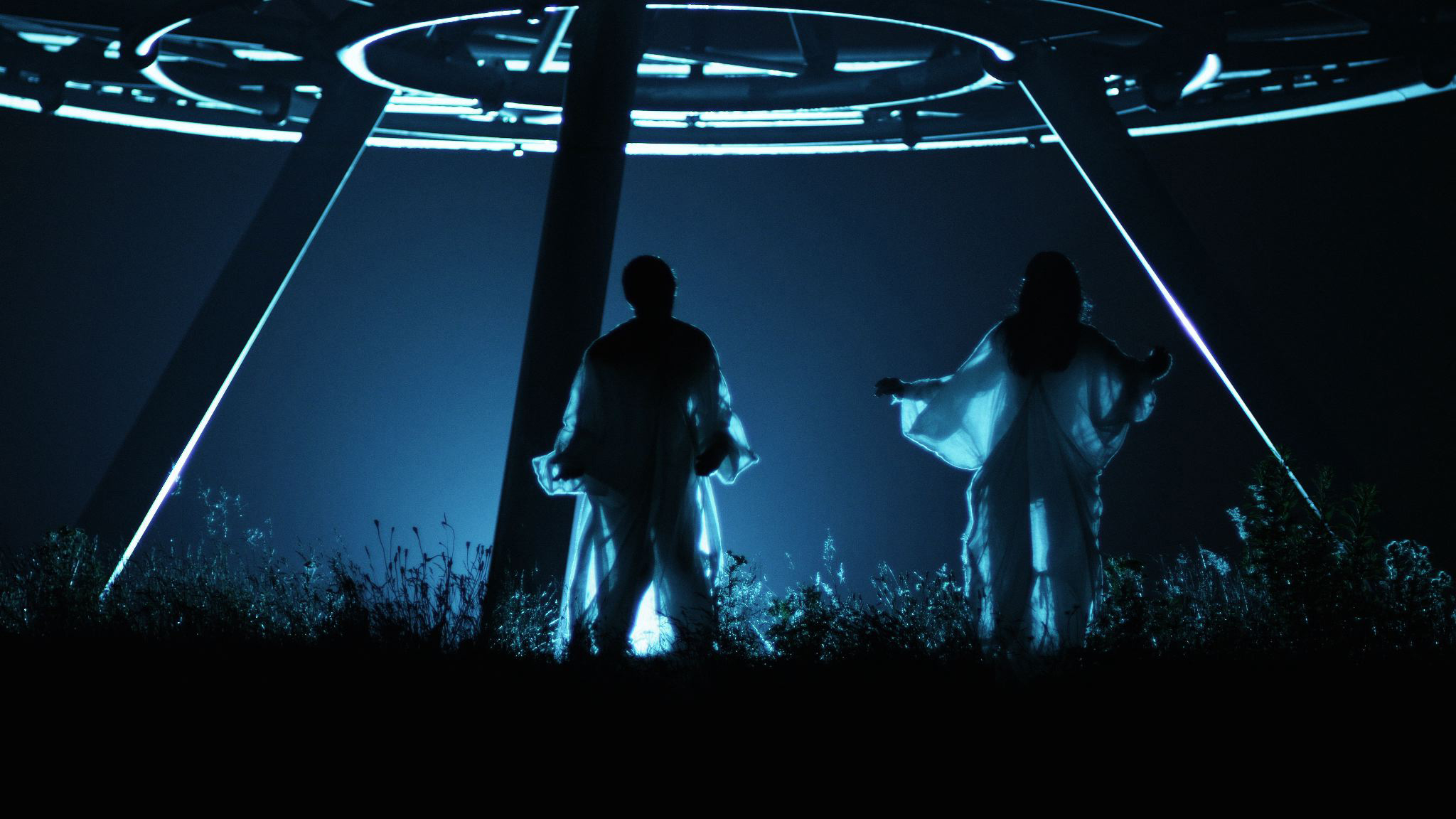
Synopsis: In the city of Preston, aliens have for decades lived hidden amongst humans disguised as the Earthling's own. Two more aliens, disguised as a young Chinese brother and sister (Ko and Lim) appear and meet a veteran who has been on Earth for a long time (Patel), disguised as an older Pakistani man who runs a corner store, who is both incredibly glad to see them and offers a pure white room in his home for them to stay. Their appearance is timely as aliens who live in the town are in debate in-between finally revealing themselves to mankind and trying to return back home. Amongst those who are caught up within this are a single mother (Brabin), a UFO enthusiast, who realises that she may not be who she thinks she is, her adult daughter who meets a bald, Chinese guy around her age and strikes up a bond with, and an alien disguised as an older male counsellor who is the one instigating the idea of revealing their true forms to humanity. As sinister hoodies stalk the aliens, and Acid Mother Temple acid rock scores the scenes, it's culminates in transcendental revelations.

From http://i.imgur.com/f35aiUg.jpg
Piercing Brightness from that synopsis does sound awesome, only for it to have plenty of great ideas and a lot to like but a structural flaw that cripples it, it's presentation deeply flawed from the beginning. The best thing to take from the film is its premise, the alien placed into the ordinary environment, in this case an English city. Something innately about an English environment, both the countryside or an urban landscape, is so drastically different from the American cities and countryside of their sci-fi that to imagine a UFO over a Spar shop in my neck of the woods, even in London, is strange because of me being fed on Hollywood science fiction and their locations for years. Especially if you depict the England as here of corner shops and nightclubs, cups of tea and breakfasts  in cafes, it's incredibly odd as does setting it in Scotland or any other member of the British Isles, something which was as much the reason why Jonathan Glazer's Under The Skin (2013), with Hollywood star Scarlet Johansson stepping out of her comfort zone and becoming an alien, was so eerie and unique. Piercing Brightness takes advantage of these cafes and nightclubs, soaking in the pleasant, sometimes frankly bland mood of such environments in bright, crisp cinematography, the kind of environments where it's the people within it that really give it some much needed colour, an advantage this has in its cast and because it's all about aliens and can get away with an unconventional use of such locations.

From http://creativebench.tv/assets/Piercing-Brightness-001-Jason-R-Moffat.jpg
While the aliens are revealed to be of all shapes and sizes, the film can almost work as a metaphor about immigrants entering a new country and having to adapt to the environment, not in a crass jokey way, though the brother alien tries asking for cigarettes in a cafe once, but in terms of the adaptation to the new place followed by the hindsight, the moments of wonder whether it was better to be there or go back to their home world, or whether it's better to revealed oneself as an extraterrestrial being.
When the film succeeds, it's when the aliens express their disappointment with their long waiting, originally part of a project to study the humans, to be sent back home after the promise they had this would be the case, of their position stuck amongst the humans and having to accept their position, rewarding as the initial synopsis suggests it would be. The cast in general helps with this, and there's one single individual, Bhasker Patel as the alien posing as a corner shop owner, who brings the quality of the film up a bar in how he is both charismatic and how this best aspect of the film comes from a lot of his scenes and dialogue, the man more than happy to be amongst the humans, excited like a young man when new aliens like him appear, but melancholic if found in a corner and opened to discussing the position of his life.

From http://www.scifinow.co.uk/wp-content/uploads
/2013/06/Piercing-Brightness-DVD-review.jpg
Technical Detail:
The music as well helps greatly with the film, both from the original score by Alexander Tucker and the choice cuts picked from cult Japanese acid rock group Acid Mother's Temple. Known for being able to release up to four albums minimum a year since they started in 1995, side projects with other bands, and their clear love of psychedelic rock of the sixties from the title puns of their songs and albums, Acid Mother's Temple is the kind of band you'd imagine aliens being scored to, archive footage of UFOs scored in montages to their druggy guitar riffs and making a perfect union together. Especially when the film starts to improve in structure by its middle half to the end, when the music is of greater importance than visual trickery, it helps reach a good build-up to the climax immensely.

From http://static.wixstatic.com/media/77eca5_
0b975a7a3f561c883e9a3f46b93c7740.jpg_1024
Abstract Spectrum: Expressionist/Experimental
Abstract Rating (High/Medium/Low/None): None
The problem, when all the following sounds spot-on and great, is how debuting director Shezad Dawood, originally an artist, decided to put together Piercing Brightness visually and in style. He decided to purposely make the film abstract in tone, intercutting shots of birds at unexpected moments between incidents in a single scene, using colour filters and distorted frames, noises mixing with the music. The result is incredibly clichéd, the stereotype of what an experimental movie is, which becomes distracting rather than abstract in terms of presentation. This is worse as, with only eighty minutes of running time, these techniques and inexplicable shots of birds, strange as a choice when the real UFO footage at least makes sense in context, waste precious time that could've gone to adding more plot about these aliens and their lives. More to the relationship between the adult daughter and her bald headed, quiet friend, at least some explanation to what the hell the faceless hoodies are, chasing the aliens sinisterly on bicycles and molesting one in the least threatening way possible by merely tugging her top and then leaving her alone, at least in the logic of a weird movie plot. The film drastically improved when it gets to the middle of its running time, when its night and the whole plot finishes within this timeframe of one night, the score taking over and being far more effective with some choice editing of snapshots in creating a tone. Unfortunately by this point, despite the improvement, the film has very little of its own character in tone beyond the essentials, the great idea in the centre of the film, even Patel's memorable performance, squandered by the lack of interesting structure.

From https://d28zjewj6xjjqr.cloudfront.net/api/file/LRbErieQmKWOVZ9PjU7h
Personal Opinion:
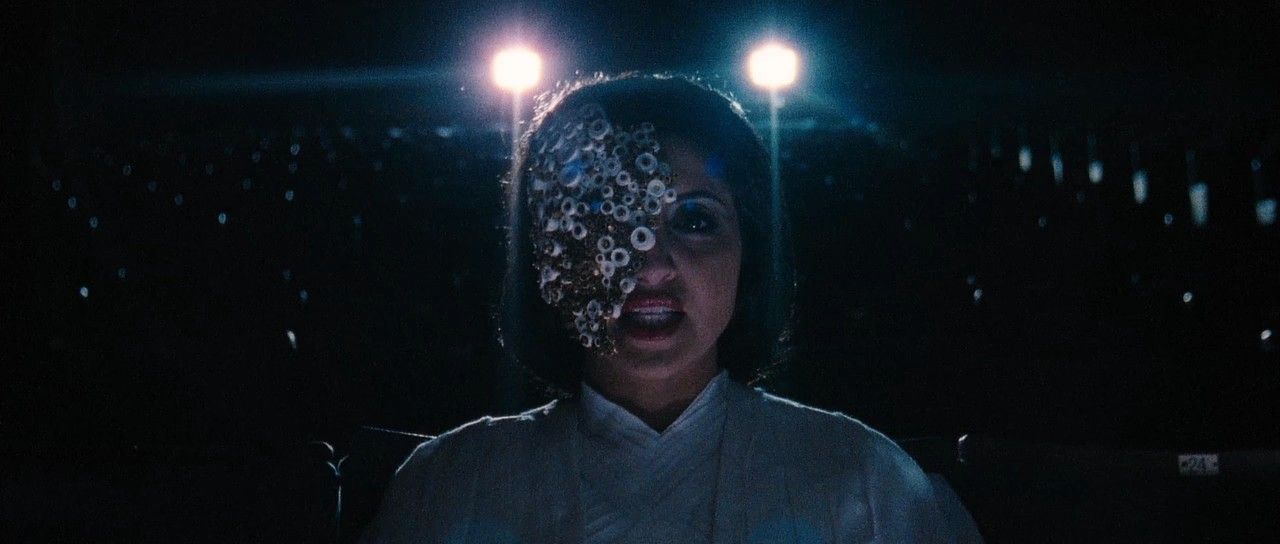
Piercing Brightness as a result is the heartbreaking example of something that could've been cool or great, but is instead a testament to the dangers of trying too hard, to a detriment, in being an alternative film. Considering the director's art installation origins, the film based on a script from a cult novelist, this is the same mistake that one finds in modern cult genre films particularly the ones trying to be neo-grindhouse movies. I cannot believe I'm comparing this to something like The Man With The Iron Fists (2012) but it's the exact issue paralleled, the tone and style compromising the greater premise and ideas that occasionally survive the structure forced upon them and poke their heads up from the ill-designed surface to shine from brief moments. These moments, like those neo-grindhouse movies, aren't enough to save Piercing Brightness; just when you fancy a trippy sci-fi where two sibling aliens see a female alien with computer chip parts stuck to her face on the TV instructing them with esoteric words, such a delight is spoilt by the packaging being detrimental to the point it effects the quality of such moments.

From http://i133.photobucket.com/albums/q80/trungcang/
h5/56708114303224232242_zps873a8122.jpg~original

Saturday, 27 February 2016

Two Or Three Things I Know About Her (1967)

From http://s3.amazonaws.com/auteurs_production/post_images/
19813/1967_TwoorThreeThings_Italian.jpg?1446724861
Director: Jean-Luc Godard
Screenplay: Catherine Vimenet and Jean-Luc Godard
Cast: Marina Vlady (as Juliette Jeanson); Roger Montsoret (as Robert Jeanson); Anny Duperey (as Marianne); Raoul Lévy (as John Bogus, the American); Jean Narboni (as Roger); Juliet Berto (as Girl talking to Robert); Christophe Bourseiller (as Christophe Jeanson)

Synopsis: For over eighty five minutes Jean-Luc Godard depicts the cultural climate of Paris and France in 1967, following a housewife, Marina Vlady (Jeanson), who has to moonlight as a prostitute for additional income. Following primarily women who cross Marina's path, an unseen narrator voiced by Godard himself assesses how language has changed, in brightly coloured scenes, now advertising and magazines exist.

After years of transitioning from viewing Jean-Luc Godard as an overrated director for me to being a highly admirable one I hold highly, a huge point to make from my perspective after having to work hard viewing his films originally is that it's not a good idea to try to explain every theme, quotation and image in a single Godard film in terms of having a single, complete connection and meaning, as if they are solidified quantities in only one form. Godard not so long after starting his career, at beginning with Contempt (1963), decided to make his films even if they had plots hung over them the cinematic equivalents of his personal journals; the quotations and techniques meant to interconnect with every other one in the films but, like a stream of consciousness if you wrote whatever came to mind in a diary, his work gladly jumps to each one by what felt appropriate for the mood at the moment of each scene. When he claimed cinema was dead with Week End (1967), and went onto the Dziga Vertov group and then onto the video made essay work with his future collaborator and life partner Anne-Marie Miéville, not even his "second debut" Slow Motion (1980) would be like the films he made before as he continued diving further into the deep end of his style, refusing to come back.

From http://designobserver.com/media/images/Two_or_Three_Things1.jpg
In depicting the life of a wife, happy in her life with two children but working on the side as a prostitute, over a small span of time, Godard is able to weave in the many things that exist within her timeframe, the clothes shops and cafes in their colourful details to the words found on both billboards and spoken aloud by people around her. The Vietnam war is looming over the film, as if the state of France at the time which Godard is heavily critical of in his narration.  With Two Or Three Things I Know About Her, like Godard's other work, a huge factor with viewing them is continually having to absorb materials and ideas that are thrown in rapid quantities every minute. A lot has to be absorbed in his films, and baring the time dated content of France at the point this film was released, a year before the May 1968 riots that shock the country, Godard wanted to tackle the state of modern society in full detail in only a very short length. He does however sum the film's point early on, helping the viewer, when a character says language is a house people live in. Language and its use, and misuse, is a huge theme for his work that would continue onwards, the barrage of visual and audio stimuli in his films at this point in his career as much a permanent, ongoing obsession with the vagueness of language, culminating decades later by the time of Film Socialisme (2010)  reduced to a YouTube clip of two kittens making noises as if they're talking to each other in the middle of a work saturated in language.

From http://deeperintomovies.net/journal/image14/23things6.jpg
Parodies of Godard's filmmaking style and French art cinema eventually fail when you go beyond his obsession with shooting actors speaking obtuse proclamations whilst smoking, as from the moment he used jump cuts in his debut, originally seen as mistakes due to bad editing, he discovered how to manipulate everything within a film and what made such a film in creation. He could even manipulate the opening and ending credits - finding words in the middle of others, playing with their colour and font - and took a swan dive into using anything visual or audio related, everything with a film itself, in his work to explain his views and how language could be distorted.  (A testament to this is that his last film in his eighties, Goodbye to Language (2014)  was made in 3D with a camera he had built personally to be able to do so). As a result of this, not only does this film still have relevant moments to the current day, the level of visual stimuli in billboards and advertisements worse with the internet, but his almost pop-art colours and inventiveness help were the ideas may be difficult to understand clearly on a first viewing, the depth of the little games he plays expansive. Allusions in allusions, double meanings and references, a break taking and prolonged sequence with the bubbles in a black coffee becoming like stars in a galaxy, as Godard as the narrator admits language has become vague and difficult for himself to use, next to moments that are clearly absurd and humorous such as the man who checks the water meter appearing when the female occupant is in the bath.

From http://www.unsungfilms.com/wp-content/uploads/
2012/08/2-or-3-things-i-know-about-her_03.jpg
Technical Details:
The scope in how much Godard manipulates his film texture could compile a whole book just to chronicle this single film. Important for this film thought particularly is editing, particularly as within the content of each scene being depicted he is careful to make every detail, every passing comment made by a bystander stand out, all coming together for the theme of a very consumerist world. Moments when he lets the camera slow move across a scene without the heavy editing, such as a scene when Juliette takes her daughter to day care, allow both the film to breathe but still have a lot of details in the background to pay attention to too.

After his debut Breathless (1960), a scrappy and energised work where the tracking camera shots were memorably created by using a wheelchair the crew got hold of, Godard would take advantage of how he became successful and had access to what Orson Welles called the "giant train set" in the type of technical quality he had at hand by using everything from the CinemaScope lens to the colour to a greater end than with other directors. The dynamic nature of his films, particularly when they get to the colour entries, have a greater pop than a lot of his contemporaries, paradoxically the most esoteric director of the French New Wave besides Jacques Rivette also being the most colourful and playful of many in terms of how energetic he could be. A reason why I grew to admire Godard eventually, which you see in this film through its ability to pack so much into its short length, is how he is able to convey a message both concisely but offer multiple meanings in one image or statement within a single moment.

From https://farm4.staticflickr.com/3570/3798000394_3c1bec6d3e.jpg
Abstract Spectrum: Experimental/Expressionist
Abstract Rating (High/Medium/Low/None): High
Godard managed to make films entirely of his own genre, Godardian, but it depends on which particularly films which are the most "Godardian" of the lot. Détective (1985) [Reviewed Here] was a narrative feature which was still primarily influenced by its plot despite its many tangents. Week End on the other hand, even though it has a narrative thread, takes its lead from Alice In Wonderland and entirely throws its protagonists into an extreme direction, a series of jokes, political provocations and absurdities that wash over the viewer forcing them to follow its logic completely. With Two Or Three Things I Know About Her, while a later work like Film Socialisme would take its structure and style further, the older film from the sixties is still completely unpredictable in how it manipulates and changes directions in what it does, its theme of language and popular culture filtered through the many issues and mediums that were there at the time; aptly, shots of two men behind a giant pile of books, one of them recording down a random paragraph the other reads from various types of literature to make one text, is an appropriate metaphor for the film around the duo  as a whole, the scramble of tones and words around the characters shown in unfiltered form with Godard himself trying to make sense of it for himself as much as for the viewer.

It is a film where a random female bystander, one of many, can suddenly talk directly to the camera about her life, forcing the viewer to engage with her about her life, where an incredibly young Juliet Berto can suddenly appear in a cameo scene as well as if a prequel to her character in Celine and Julie Go Boating (1974). Bertolt Brecht is immediately quoted in the opening and Godard already undermines the forth wall soon after this when the narrator introduces the female protagonist played by Jeanson twice as two people and describes head movements that he later says are pointless to inform the viewer about. For Godard, in the early beginnings of his career, there was already a disregard with conventions about what tone and style in conventional filmmaking should be, leading to films like this one which he would build upon throughout the decades after.  

From https://farm3.staticflickr.com/2489/3798002994_bb2610490a.jpg
Personal Opinion:
A difficult film, one I don't recommend as the first Godard you see, but the rush of invention once you get used to his style makes it certainly one of the most memorable. Personally I find Breathless, his most known film, to be pretty inadequate and lacking in comparison to what he would make onwards, a debut that Godard would drastically improve upon when he could manipulate everything seen and heard onscreen. Now that I can appreciate the director's work I anticipate viewing a Godard film I've never seen before because nearly every one of them, including shorts without any subtitles, are going to bring something unique in how they are made and, importantly, in the ideas and content within them. As he's dissected politics over the years in films like Two Or Three Things I Know About Her, he's done more with cinema in one film compared to a handful from other directors in terms of invention and scope, and that he has made many films of this quality is an even more impressive feat. 

Wednesday, 17 February 2016

1000 Anime Crossover: January 2016

From https://lh3.googleusercontent.com/-qGLS6IF2OIA/ThKammPmh4I/
AAAAAAAAP8I/MxX37K1fc64/s800/Mahou%
252520Shoujo%252520Madoka%252520Magica
%252520-%25252002%252520-%252520Large%25252032.jpg
#15: Puella Magi Madoka Magica (2011)
Director: Akiyuki Shinbo
Screenplay: Gen Urobuchi
Voice Cast: Aoi Yūki (as Madoka Kaname); Chiwa Saito (as Homura Akemi); Emiri Katō (as Kyubey); Ai Nonaka (as Kyōko Sakura); Eri Kitamura (as Sayaka Miki); Kaori Mizuhashi as Mami Tomoe and Tatsuya Kaname)

Abstract Spectrum: Fantastique/Surreal
Abstract Rating (High/Medium/Low/None): None

Finally seeing the series that caught people by surprise, taking the magical girl trope into darker and more existential territory, it doesn't matter in this case that it's not an abstract work at all. It does have some very unconventional and inspired ideas aesthetically which have importance in telling the story and adding to the emotional content, especially the surrealistic edge of having the monsters of the show based on innocent, childish motifs such as food or the circus. Unbelievably grim, I don't recommend watching Madoka in a  low mood, but after hearing about the show over five years the surprising emotional punch I had from it will be one of the best things of 2016 in terms of first viewings.

For my full view, follow the link HERE.

From http://vignette2.wikia.nocookie.net/galerians/images/b/b2/
Art3.jpg/revision/latest?cb=20120801224958
#16: Galerians: Rion (2002)
Director: Masahiko Maesawa
Screenplay: Chinfa Kan
Voice Cast: Akira Ishida (as Rion); Shiho Kikuchi (as Lilia); Akira Ishida (as Cain); Kenichi Suzumura (as Rainheart); Ryoko Kinomiya (as Dorothy); Takehito Koyasu (as Birdman); Yuka Imai (as Rita)

Abstract Spectrum: Grotesque
Abstract Rating (High/Medium/Low/None): None
One of the last early 3D anime before Shinji Aramaki's Appleseed (2004) brought up the quality visually of this sort of thing and it became more common - just from Aramaki deciding everything he would make afterwards would be 3D animation - Rion is certainly a forgotten oddity, a videogame adaptation that does suffer from its visual and storytelling limitations. The most compelling thing about the anime is this struggle, although it does have the strange back-story of its Western DVD release including an alternative soundtrack including Slipknot and Mudvayne, thus bringing back memories from my childhood without having even listening to that alternative version.

For my full view, follow the link HERE.

From https://image.tmdb.org/t/p/original
/jsmRA0E0iKdi24sk0edB3m4h0EF.jpg
#17: You're Under Arrest! - The Motion Picture (1999)
Director: Junji Nishimura
Screenplay: Masashi Sogo and Seiji Soga
Voice Cast: Akiko Hiramatsu (as Miyuki Kobayakawa); Sakiko Tamagawa (as Natsumi Tsujimoto); Bin Shimada (as Ken Nakajima); Etsuko Kozakura (as Yoriko Nikaido); Ikuya Sawaki (as Inspector Tokuno); Issei Masamune (as Chief)

Abstract Spectrum: None
Abstract Rating (High/Medium/Low/None): None
After being introduced to this popular franchise through two terrible anime spin-offs, this was a better way to get into a long running series by way of a beautifully anime, fun action comedy that never gets bogged down by its more serious plot but never becomes mediocre fluff.

For my full view, follow the link HERE.

Tuesday, 16 February 2016

Hot Love (1985)

From http://www.joergbuttgereit.com/
typo3temp/pics/a12a5d5af5.jpg
Director: Jorg Buttgereit
Screenplay: Jorg Buttgereit
Cast: Jörg Buttgereit, Norbert Hähnel, Marion Koob-Liebing, Patricia Leipold, Bernd Daktari Lorenz

Synopsis: A man falls in love with a woman, only for her to start a romance with another man and break his heart to an irreparable degree. Pregnant, the woman's child nine months later from this event will be a personification of the scorned love at its most extreme.


The short film Buttgereit made before Nekromantik (1987), it does reflect the enthusiasm of genre and horror film fans who would make their own films in response to this passion. In the eighties this proved to be a mine for directors who would develop cult reputations and even go to Hollywood - The Evil Dead (1981) for Sam Raimi and Bad Taste (1987) for Peter Jackson perfect examples, whilst Nekromantik for Buttgereit himself gave him notoriety and a cult following to this day. The enthusiasm is enhanced in these particular films, from this era, by the desire to improve in technical skill and push what they could do in terms of ideas they could put onscreen, and while Hot Love is less polished than Nekromantik, it already establishes a desire for invention not to mention Buttgereit's far from conventional use of genre tropes by wrapping them around  a drama. As Nekromantik is actually a black comedy drama about a man obsessed with death, Hot Love is the depiction of a relationship breaking down exaggerated to its gooiest point.

It starts as a sweet romantic affair between two people, complimented by a montage of a relationship building up you'd find in Hollywood films of the era and still today, only for an ominous voice of a God-like force to speak in second person and reveal that the relationship will be doomed. That Buttgereit decided to make a short film like this, when the short he made a year before Horror Heaven was a compilation of horror and kaiju film tributes that embraced their lo-fi effects, showed an interesting side of Buttgereit wanting to bring potentially personal and idiosyncratic material to his work. It immediately brings out a lot of virtue in Hot Love, as it plays out as a melodrama for half its length, going as far as having the second boyfriend admit to a doctor with awkwardness the child isn't his, only to switch tone soon after in a graphic suicide. That it turns into a splatter film is not a jarring change in tone; it's reminiscent of the films of the Kuchar Brothers and Jack Smith from the sixties and seventies, which were melodramatic works that could suddenly surge into content from x-rated b-movies out of the blue. The different is that in Hot Blood you get something out of a Japanese body horror film from this era, a toy baby spewing foam and someone getting stabbed with a broken bottle.

Technical Detail:
Part of its charm is the improvisation that was used in lieu to obvious budget restrictions, such as the decision to depict the birth of a child with the spread open bottom half of a woman being made of paper-mache, a toy baby pushed between the fake legs with what appears to be oat meal pasted onto it. This improvisation is as much the reason why films of its ilk can be so entertaining. Also significant is the music, which is a memorable part of Hot Love as a short. This as well would continue on in the next Buttgereit project and is a huge virtue of Nekromantik.

Abstract Spectrum: Grotesque/Psychotronic
Abstract Rating (High/Medium/Low/None): None
The one disappointment with Hot Love is that, unlike Nekromantik, it's pretty straightforward in tone and couldn't be added to the Abstract List. The events in the short escalate to an unconventional tone, especially when a grown man grows from a place they shouldn't, covered in solid goo, and starts rampaging about, but it isn't weird enough.

Personal Opinion:
To have access to Hot Love, on the UK Nekromantik Blu-Ray, is a good thing. While it may seem unsubstantial compared to the later feature film, it wins you over with its original slant on its subject and avoiding becoming predictable or sloppy in its creation. It's a reminder of the joys of fan made films whilst its moments of seriousness do catch you unexpectedly.

From http://41.media.tumblr.com/be160b28c22c1bd4e30caf3f5b5e701e/
tumblr_nhdhwfu7nq1qa934fo1_1280.png

Friday, 12 February 2016

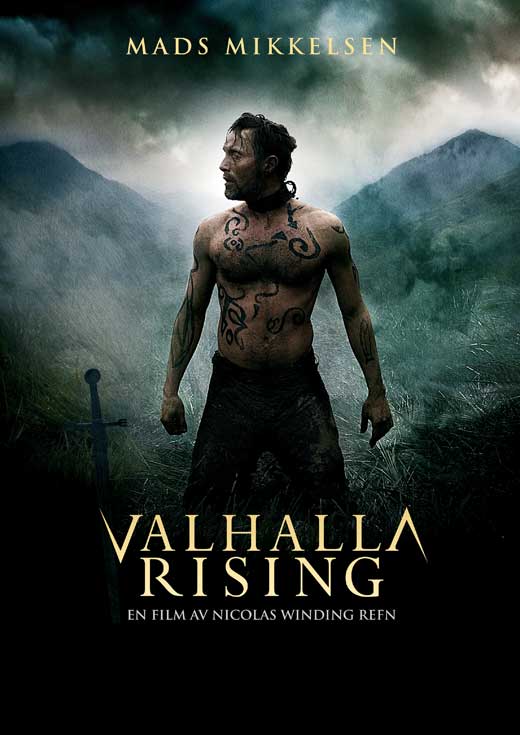
Valhalla Rising (2009)

From http://www.juansky.net/wp-content/uploads/2015/10
/valhalla-rising-movie-poster-2009-1020554869.jpg
Director: Nicolas Winding Refn
Screenplay: Nicolas Winding Refn, Roy Jacobsen
Cast: Mads Mikkelsen (as One-Eye); Maarten Stevenson (as The Boy); Ewan Stewart (as The General); Gary Lewis (as The Priest); Alexander Morton (as The Chieftain); Jamie Sives (as The Son)

Synopsis: In ancient Britain, when the Vikings are being driven into the wilderness by the growing followers of Christianity, such a group of Christian warriors encounter the mute, hulking man named One-Eye (Mikkelsen), an escaped fighter for a pagan tribe who with a young boy join the warriors on a boat trip to take back Jerusalem. Able to see into the future, One-Eye is aware of the doom they are all drifting towards, starting with their way on the ocean being completely blinded by fog...

Nicolas Winding Refn is a curious modern day auteur, one I have not ever given a decisive opinion on but in hindsight to this review may grow more and more respect for finally. To give you the interest the man offers in his filmography, another film that could be covered in the future was the one that sabotaged his first attempt to conquer American due it's sad failure commercially,  Fear X (2003) with John Turturro and music by Brian Eno, blatantly in debt to David Lynch to a possible flaw but an elusive creation that showed a unique filmmaking vision. His success, from the Pusher trilogy to Drive (2011), alongside his rollercoaster of a career, where after licking his wounds from the Fear X experience he even directed a Miss Marple one-off, makes him a fascinating character and his filmography itself is the same, continually subverting and playing with genre cinema in unpredictable ways. Out of what I've seen, if he becomes a great director for me it's not going to be because of his most well known film Drive, which feels generic compared to a filmography that includes the controversial follow-up Only God Forgives (2013), his unconventional biopic Bronson (2008) and Valhalla Rising itself.

From https://demonsresume.files.wordpress.com/2011/09
/valhalla_rising_2009_1280x639_8708701.jpg
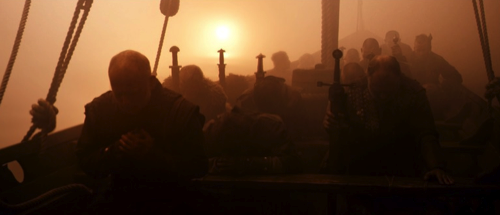
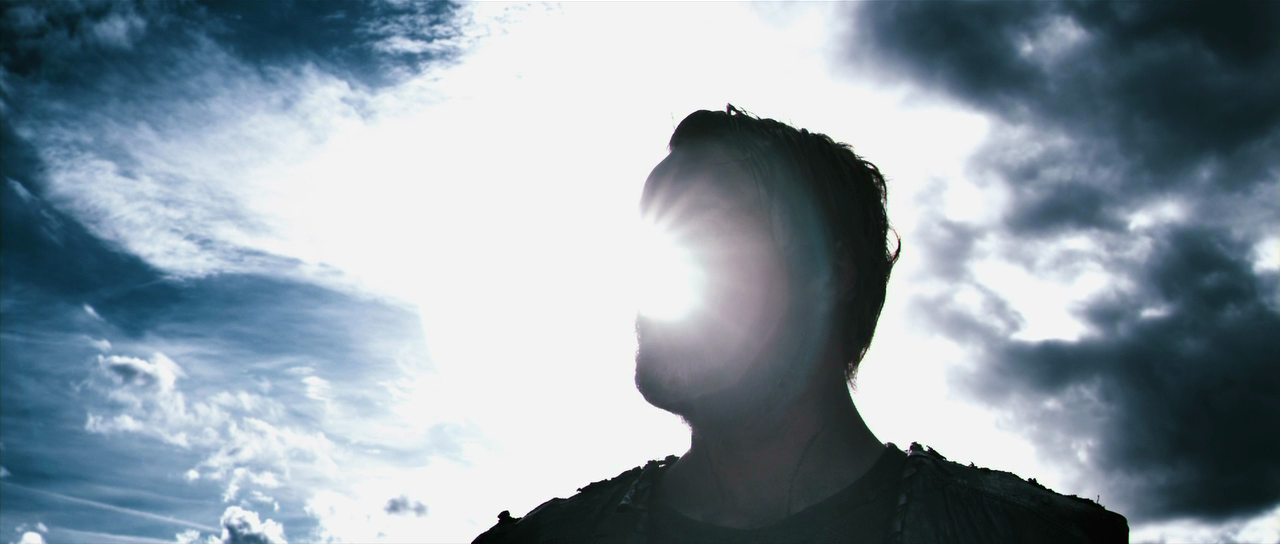
An incredibly low budget mythical film whose surface appearance is that of a Viking movie, Valhalla Rising as it starts drastically contrasts from this with its minimalist tone. It takes on the nose with pride its artistic aspirations and pretensions. A film shot in the massive, full landscapes of Scotland but contrasted by the claustrophobic close-ups used for most shots of the actors. A spiritual journey to Hell but rather than Dante's Inferno it's a very small cast walking amongst mud sodden fields, the excessive violence of many of Refn's films contrasted here by an emphasis more on mood to dictate the narrative, the story told in many places through visuals only. Only Only God Forgives may have taken this film's tone fully rather than the others which change things around. Completely mute in the role of One-Eye, Mikkelsen as a living personification of brutality is also a soothsayer, his prophecies blood red flashes hazy at first to understand but ominous of what will come, Mikkelsen conveying as much as possible through only his body language as the dialogue spoken by everyone else is nearly obtuse, concise dialogue adding to the unnerving tension that seeps more and more into the film as the narrative goes along. The result is an art house genre film but the mixing of the genre qualities and the tones defined stereotypically as "art house" creates a blurred line between the two into uncharted territory. The vibe of the film's tone is comparable to Apocalypse Now (1979), where as the natives are completely unseen but completely threatening, the warriors fall apart and most of them go insane, reducing them less to holy warriors but scared animals.

From https://ajaylee.files.wordpress.com/2014/05/valhalla03-big.jpg
One fact that shouldn't be ignored is the subplot of Christianity; set in the era where Christianity would eventually drive away the pagan religions, its yet fraught with conflict as the Christian warriors become disillusioned and broken down just from the prolonged, agonising boat trip in the centre of the film, fog blinding their way and undrinkable seawater all around them as they slowly go mad. As one suggests the young boy who tags along with One-Eye is responsible for the fog and should be killed, it's not said accusing the boy of being a demon or witchcraft being involved but in the tone of a superstitious pagan, the deconstruction and collapse of the Christian groups taking place as One-Eye stays back and only has to be involved if someone threatens him or the boy. Barring the few glimpses of giant crosses, the Christians are still new, still part of the old tribes as they're first seen with a group of completely naked women who've clearly been captured from warring with Vikings, the Christian cause to liberate the Holy Land of Jerusalem less the desire to preserve the message of peace in Christ's sacrifice for humanity but territorial. This could be seen as cheap, anti-Christian rhetoric but it should be remembered that Refn is Scandinavian, from the region where the Vikings would be his real ancestors and Christianity despite its later dominance still a foreign influence on the land as it would on Britain with its Celtic heritage. Subconsciously, even if it's by coincidence, the contradictory states of mysticism and religion without fully evoking them is central to the film, all boiled down to the only clear minded person, without doubt or conflict, being the mute beast of a man who can gladly go to his doom willingly and breaks peoples necks with the chain he's attached to.

From http://40.media.tumblr.com/3579755ca82a2815a844222efa5198a5
/tumblr_mn7u1vSBox1qixuo1o1_500.png
Technical Details:
A very low budget production, made around the time of Bronson, the small cast is dwarfed by locations which fill in the grandness required for the tone to work. Britain, bearing in mind my bias as a native, has incredible outdoor environments. Because of the visual age of such landscapes, you can still feel the history and mythology that has soaked into the rock faces, where the backbone of paganism and British mysticism can be felt and adds to the atmosphere of a film instantly if shot properly on camera. Even under grey skies, with the right mindset they can be powerful and vast in their scale and distance. Even when the Scottish locations masquerade for the landscape the group get to by boat, the advantage taken by the cinematography using them sets the methodical tone required perfectly.

The music by Peter Peter and Peter Kyed only gets to the post-metal guitars and tribal drumming you'd expect from a modern Viking film by the final act, but in general alongside the emphasis on visuals only, depriving viewers of obvious plot explanation, the music generates the needed emotional tone that the mere images may not have by themselves. When the score finally explodes into its most bombastic part its epic.

From https://maql74.files.wordpress.com/2012/06/valhalla-rising.png
Abstract Spectrum: Expressionist/Mindbending/Psychotronic
Abstract Rating (High/Medium/Low/None): Medium
With clear influence from Werner Herzog and Terence Malick, Valhalla Rising nonetheless is its own film, the violent gore contrasting immensely from the minimalistic presentation. Its economic in this area which adds to its elliptic tone, the minimal adding to its unconventional tone as one is forced to experience the story from the characters' perspective rather than as an outside viewer. As the madness that inflicts the group takes place the film takes on a more editing heavy, chaotic tone when the unforeseen enemy appears and eyes are watching off-screen at the warriors. Because of the presentation the sense of building dread is pervasive and increases throughout the film, culminating into a finale that leaves the end on a sombre note.

From https://shutupandwatchthemovie.files.wordpress.com/
2011/11/valhalla-sword.jpg
Personal Opinion:
It has been six or so years since viewing Valhalla Rising for the first time, and it's still as dynamic and impactful since that last time. While openly, brazenly, artistic it never becomes hollow and attempting to decorate itself in such art house tropes, making sure that everything done onscreen and in presentation is meant to build up the tensions felt by the characters. It's not a traditional Viking film, which would've disappointed some, but instead it's an incredibly alien experience like many of Refn's films.