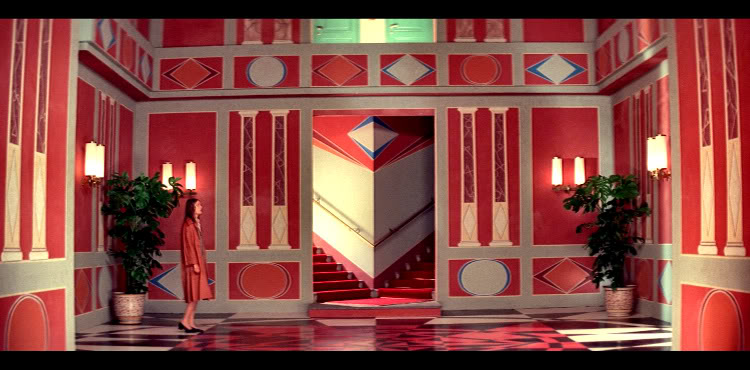
Wednesday, 24 June 2015

Lifeforce (1985)

From http://filmsmusic.ru/_nw/184/73039455.jpg
Director: Tobe Hooper
Screenplay: Dan O'Bannon and Don Jakoby (with Michael Armstrong & Olaf Pooley)
Cast: Steve Railsback, Peter Firth, Frank Finlay, Mathilda May, Aubrey Morris
Length: 116 mins

Synopsis: A US-UK co-mission into space to investigate the passing Hailey's Comet, on the space shuttle Churchill, encounters an alien spaceship, bringing back on board three humanoids housed in crystal cases. They turn out to be space vampires, the beautiful female of the three (Mathilda May) awaking and escaping from a British space facility. It is up to Col. Colin Caine (Peter Firth) and the only surviving member of the Churchill Col. Tom Carlsen (Steve Railsback), the later connected psychically to the female vampire, to prevent them at least decimating London.

From http://1.bp.blogspot.com/-cvJcysBrcZg/Tzl1FrWK59I/
AAAAAAAAJWI/ewHknzkT7gw/s1600/lifeforce3.jpg
I'm a Tobe Hooper fan. This means not only liking The Texas Chainsaw Massacre (1974), Poltergeist (1982) and Salem's Lot (1979), but willing to put up defences to other films or even admitting to liking them. The common conception is that The Texas Chainsaw Massacre happened and after that everything went downhill, which is what a Hooper fan like myself will strongly disagree with. For starters, not only was there a film before as his debut Eggshells (1969), but there are a strong number of films, already mentioned, that stand out in his career. I won't disagree with the fact that, honestly, he suffered over the decades but I will defend a film like Spontaneous Combustion (1990), and even a film as bad as Crocodile (2000) is strangely watchable and certainly couldn't dismiss the quality of an older work like Eaten Alive (1977).

From http://2.bp.blogspot.com/-UCZ8Tp6jtPg/UcMwz2RUT_I/
AAAAAAAAOC8/mHdDz_ZUp58/s1600/LF03.JPG
The three film deal with Cannon Films should've be the best moment in Tobe Hooper's career, when Menahem Golan and Yoram Globus gave him carte blanche for three movies, but I feel it's the moment where his career would be drastically affected from then on. Unfortunately while an exceptional sequel that gets better the more I watch it,  The Texas Chainsaw Massacre 2 (1986) didn't do well because people were excepting the same as the first film and its graphic gore would've severely limited its potential audience. I've yet to see Invaders From Mars (1986) and the original fifties film, but Hooper's remake didn't succeed either. Finally there's Lifeforce, the most expensive Cannon Films production and not a box office success either. It was a film with a hellish production history including going over budget and having a shorter US theatrical cut said to be incomprehensible. Viewing this film for the first time, in its longer International cut, it had been built up with a reputation good and bad of a bizarre folly.

From http://postmodernbarney.com/images08/lifeforce.jpg
The result is a b-movie sci-fi flick, literally a sexed up Quatermass, set in contemporary Britain including very notorious amounts of nudity from Mathilda May and gore. The b-movie is capable of rich material, but the stereotype is that of a movie which is lean in the content around the plot, minimal in anything barring the essentials like thrills, and hopefully has charm, charisma and maybe excellent technical virtues. Lifeforce is definitely one of those sort of films, not a philosophical work though analogies can be suggested. "Pulp" is apt, and as well as updating films like The Day That Stood Still (1951) into a lurid interpretation, it also possesses undeniably opulent production design and special effects. If there's a potential issue with this film's story, it's not the danger of incomprehensibility but when it confuses its sense of scale. A large middle portion of its length is the hunt for the female vampire but, to limit the spoilers immensely, this becomes a red herring and, rather than an Invasion of the Body Snatchers (1956), it becomes an elaborate disaster film in the ending.

From http://www.containsmoderateperil.com/wp-content
/uploads/2011/08/Lifeforce-1.jpg
Technical Details:
If Lifeforce shows off anything, its pride as a British film viewer at the work of countless special effect and production designers, though when you have people who worked on the likes of James Bond films to Star Wars, that's not a surprise. Adding to this is optical effects from the best of the USA, hired during the protracted production shoot, adding a further and peculiar air to Lifeforce. A great deal of why Lifeforce is able to work is because of this production design, filling out and adding character to the story. When the astronauts of space shuttle Churchill enter the alien spaceship, its actors are in accurate spacesuits floating on wires, travelling through a complex full scale set with bat humanoid husks dangling in mid-air in an environment designed by someone with a fixation on anatomy diagrams. When the vampires take action, sucking the literal life-force rather than blood physical substances, you get into a zombie subplot where animatronic dread husks that still look great today try to suck the life-force from a bystander in a vicious continuous cycle like a chain letter.

When the film becomes more of an end of the world scenario, it becomes more of a standard zombie breakout with a lot more exploding double decker buses. But there is still a consistency in production even if the film has skipped through various forms of sci-fi. The biggest advantage to this, not just the incredible craft and hard work, is that they add further personality rather than merely completing scenes left. In this case the spectacle not only stands out whether one feels Lifeforce has any worth or not, but despite the confusion it does keep a consistent tone for the film. It's a very physical narrative. Alongside a lot of nudity and explicit sexuality, there's also a level of the corporal and kink that you don't see a lot in other science fiction the production emphasises. It's apt the alien spaceship looks like a H.R. Gigar designed dildo with an umbrella at the end. The crystal cases the space vampires sleep in are as sleek and alluring as the figures sleeping in them. The optical for the sucked out life-force adds a great deal of colour and the ethereal to the content, and even something as gruesome as a vampire reforming from a victim's blood has a sensuality and a surrealness not just from the actress involving in the scene.

From http://bmoviebffs.com/wp-content/uploads/2014/10/
LIfeforce-1985-still.jpg
The cast adds gravitas that also helps immensely. While Steve Railsback is good for a shell shocked lead, and Mathilda May shows bravery in willing to walk around sets completely naked, the real weight, not just a bias of mine for fellow countrymen, is from the British character actors. The decision to set the film in Britain stands out, a different tone in the British stiff upper lip and quirks adding to the content, Hooper's desire to make a "70mm Hammer" movie paying off. I admit to being very cold many times to my country's genre output but I could never dismiss the quality of the acting. Aubrey Morris as Sir Percy Heseltine who tags along being unnerved by what he witnesses. Frank Finlay as the main scientist trying to find a preventative cause against the vampires. Patrick Stewart in a memorable role in one of the oddest scenes which included his first onscreen kiss, the least expected you could have in cinema. While Steve Railsback has a significant role as a person haunted in his dreams by an alluring female vampire, its Peter Firth whose the lead, the tough no-nonsense SAS officer who yet, because of the actor, does show moments of horror and disbelief even if he gets the job done. As much as one would wish for the alternative version of this film with Klaus Kinski in Frank Finlay's role, credibility to the film is mostly from the cast, able to make the more absurd plot narration and dialogue have tangibility to it.

From http://40.media.tumblr.com/tumblr_m6v6zr6Lsh1rae5vno1_1280.jpg
Abstract Spectrum: Psychotronic; Pulp
Abstract Rating (High/Medium/Low/None): None

One of the best aspects of Tobe Hooper's films is their delirious tones. The Texas Chainsaw Massacre is as much iconic from its soundtrack and pace as well as for Leatherface, while the sequel's change to comedy managed to amplify the content further. Films that would've been muted in tone depending on who directed them have a manic tone that is his trademark. The Funhouse (1981) ramping up its tone by its end, Eaten Alive with sets and bold coloured lighting Hooper was forced with when on-location shooting was impossible, even a film like The Mangler (1995) with its expressionist tone and Robert Englund's maniacal performance. This is why I've never believed in the theory Steven Spielberg directed Poltergeist, because while moments do show the fact he helped in the production, the intensity of certain scenes is far from Spielberg even at his most ghoulish. Lifeforce in hindsight to this should be as heightened in tone, especially with its reputation and what the narrative is about.

From http://www.rotaryaction.com/images/lifeforce1.jpg
It's disappointing to say, for its virtues, Lifeforce is one of the least delirious films in his CV despite its reputation. It's likely the US cut cemented that reputation, the film very much a straightforward sci-fi narrative. Hooper usually has a heightened, exaggerated tone to his work that's not present here. The Quatermass reference is apt because, while the plot ideas are elaborate and the ending is fitting a Cannon Films production, the film is methodically paced and avoids very off-kilter ideas. Moments undoubtedly show Hooper's trademark, such as the exorcism of Patrick Stewart, but for most of the film's length it's pulp updated for a more mature audience.

From http://3.bp.blogspot.com/-GUyNO048bzA/Ulkdb7-fZwI/
AAAAAAAABx4/H-x6hgsH8Fk/s1600/lifeforce00041.png
Personal Opinion:
But that doesn't stop me from enjoying the film. It's a romp that, despite its production history and tonal shifts, never deteriorates in structure. Any sense of real disappointment is more in my preference in lesser known films like The Funhouse. The strength of the production, one of the few times where I see it as a huge virtue, unlike where even an Indiana Jones film can leave me cold, really helped protect Lifeforce from the problems that were taking place in plotting. And I can't help, relishing flag waving for once, but feel pride that this was definitely a British production as well as an American one.

Saturday, 20 June 2015

Music of the Abstract: Riots by FM Einheit


Decoder (1984), by the one named Muscha, is the kind of film that should've been a wider known cult movie but isn't that easy to see unless you look to European DVDs and online. Set in a totalitarian cyberpunk metropolis where subliminal music used in a fast food franchise is subverted by anarchists to change the world, its a unique work that's stuck with me since viewing it in a fuzzy pictured form years ago. Its more of a mood piece than an elaborate narrative but its stayed with me for its colorful, dank atmosphere and how different from other sci-fi dystopia films it was. 

Alongside a cameo by William S. Burroughs, the onscreen and musical contributions by the likes of Genesis P-Orridge of Throbbing Gristle and FM Einheit alongside bands like Einstürzende Neubauten is probably the most distinct aspect of Decoder. As of June 2015, the original soundtrack by these individuals and more is available on British and American iTunes, and I give you the following as a nice taster of its electronic hamper.

Saturday, 13 June 2015

Music of the Abstract: The Lilac Hand of Menthol Dan by Marc Bolan (1967/68)

Someone cannot just live off cinema only. There has to be other hobbies, and there are plenty of areas where the term "Abstract" appears quite frequently especially in music. Its fascinated me, through podcasts, blogs and interacting with people, how individuals can be cold to "difficult" cinema yet it is easier to for many to accept and love the more unconventional sounds and genres of music, to the point they can even become Top 10 songs and albums. It can''t be denied music is more universal, and it feels like even the membrane between the mainstream and the experimental is very, very thin, vast sub-genres to trawl through and enough musicians who could fill an entire asylum band on offer in your local media store. It feels apt to indulge in a track a week, and the first perfectly encapsulates the above view, a musician my own mother grew up loving but fitting the site at the same time:


Even as the figurehead of T. Rex, a band that I have fallen in love with as my mother and many in the seventies did, Marc Bolan in his brief tenure in life was magnificently odd in his music, where even hit number 1 and 2 songs in Britain like Ride A White Swan are lyrically and musically unconventional as you hum along with them. The following above, while not directly connected to T. Rex, is unbelievably catchy even with breaking glass as a percussion instrument. 

Sunday, 7 June 2015

Suspiria (1977)

From https://billydunleavy.files.wordpress.com/
2015/04/suspiria1.jpg
Director: Dario Argento
Screenplay: Dario Argento and Daria Nicolodi
Cast: Jessica Harper, Stefania Casini, Alida Valli, Joan Bennett, Flavio Bucci
Length: 92 minutes


Synopsis: An American student Suzy Bannion (Jessica Harper) enrols in a German ballet school only for a murder to take place the exact same night she returns. From then on, the school is plagued by further deaths and Suzy discovers the building may be under the influence of a malicious and supernatural force.

From http://i0006.photobucket.com/albums/0006/seaofshoez/Image2k.jpg
Going from a simple to digest synopsis, Suspiria even in its moments of quietness and exposition is a relentless feature in tone as individuals start to die and Suzy is dragged further into the mysteries of her new school. It's a plot that could've be fashioned into many a type of horror film, from a classic thirties black-and-white entry to a Hammer production to a modern day work like Lucky McKee's The Woods (2006), from the subtle to even softcore titillation if you cast the ballet student with Playboy Playmates. What Dario Argento's first full foray into supernatural horror because, adding flourishes of the fantastical into the previous film Deep Red (1975) after a string of giallo murder mysteries and one attempt at a political drama since his debut work, was one of the most critically acclaimed horror films of all time, one of the most acclaimed from the seventies genre boom in Italy and one of the most divisive, rarely from what I have seen online leading to mediocre reactions but between those who adore it and those who absolutely hated it. It's relevance is enforced when I was encouraged to revisit the film when it was brought up in a divisive debate on a Facebook profressional wrestling forum, as far from the cineaste and horror movie fan community as you can get and showing how Argento's take on a simple one-line premise spread its wings into popular culture. Currently David Gordon Green's remake, as of June 2015, is still not in production, and there were rumours of an anime reinterpretation which was fitting since the film was incredibly popular in Japan.  The fact these examples exist, even if only the original film exists itself, shows Suspiria's significance.

From http://3.bp.blogspot.com/-BlSZBanUJSs/VAOhaUX7NsI/
AAAAAAAAAjs/hXDYeeZYm5g/s1600/vlcsnap-2014-08-28-02h36m43s240.png
The Italian genre films in their heyday, not just the seventies output but before in the sixties and to its decline in the late eighties, has an aesthetic and logic to itself where for every clear cut work that could enter the mainstream, like Sergio Leone westerns, many that even become popular have idiosyncratic details as a result of their creators, and the type of film production in technology and practice which took place in the industry, that feel more and more radically different as time passes. I see Suspiria as a masterpiece but its effect really does depend on how a viewer reacts to its style whether they will be gripped by it or not, explaining its divisive nature. Its story is a jumping off point for Argento to play with style and try to scare his audience with heightened emotions, as with the help of a fellow student Sara (Stefania Casini) Suzy learns more and more about her school. Most of this narrative is dispensed with, when other films would elaborate on them beyond an exposition scene near the end with Udo Kier, and concentrates of the visceral events as a result of what is hidden in the school. Whilst there are narrative points - the suspicious individuals who are at the school such as the headmistress Madame Blanc (Joan Bennett) and teacher Miss Tanner (Alida Valli), and the deaths that appear to cover up the mystery taking place - they're depicted more for their shock and for hypnotic effect, the narrative in the background and the story being depicted by visuals instead.

From https://thatwasabitmental.files.wordpress.com/2014/03/suspiria-1.jpg
Italian films can be an acquired taste with their post dubbed voices and occasional limitations in budget or resources, even a luxuriously designed film like Suspiria having a ghostly roughness hidden with its elegance and artistry. Alongside such beautiful uses of the camera, its still a film where Jessica Harper, with her own voice, is dubbed post production having a ghostly effect and there's a bat attack depicted with obvious strings moving it along. Alongside this Argento makes a dreamlike film that is less interested in a elaborate or even logical story, the unsubtle and ludicrous next to the mesmerising. Suspiria is not a film about lingering, quietly set up horror scenes but continually forcing your senses to be on continual alert, as much in the quiet moments absorbing the production design and music. This practice absolutely depends, more so than with other horror films, on the concept that ultimately affects cinema the most, whether an individual viewer reacts well to the content or not subjectively, as much on preference or for odd reasons, something which is more of an issue when a film like this concentrates on concepts like visceral effects that are affected by this directly. It is about being a continuous effect to the emotions and senses of the viewer as a score by prog rock band Goblin is blasting into your ear. With each scene of murder, there is a jolt whilst the visuals are heightened to over saturation, scenes where the close-ups of characters are soaked in blue or red lighting which engulfs their faces. There is a paradoxical nature where none of Suspiria is subtle but it causes one to feel on edge nonetheless through its intensity. Maybe a subconscious rejection of mine of the cleanliness of modern filmic aesthetic - CGI, digital video - but also my sensitivity to sound, colour etc., I've found myself drawn to older films especially between the Sixties to the end of the Seventies, finding myself closer to the idea of a "Total Cinema", where every aspect stands out from the acting to the music, even when it comes to b-movies and maligned genres like horror.

From https://isaacspictureconclusions.files.wordpress.com/2012/11/suspiria4.jpeg
Also of interest, its own paragraph, with this film is how distinctively female orientated it is in emphasis even in comparison to other Argento films. Women have stood out as strong characters and have been protagonists in his work, but with mainly male centred works in the beginning, this noticeable distinction with Suspiria stands out especially when there are only a few males on the sidelines and every other character is female. While it's been argued who exactly came up with the film's premise, the importance of Argento's than life-partner Daria Nicolodi as a co-writer for the script cannot be ignored. How Argento films women even in their death scenes also factors into this alongside the strong casting choices because they are always larger in life onscreen in his films. Jessica Harper as a strong central figure is never sexualised yet not completely juvenile as she is always opinionated, confined into a bedroom with a strict plain diet and red wine every night, and shows moments even brooding over a lit cigarette that effect the original idea Argento wanted of much younger female characters until the producers baulked at it. This strong femininity, contrary to accusations of misogyny thrown at the director, is as much a factor of why Suspiria stands out, for the simple reason that it makes the film even more distinctive when the usual idea for supernatural horror films is include a strong male lead who settles everything straight.

From http://cdn.bloody-disgusting.com/wp-content/
uploads/2012/04/4suspiria-30406.jpg
Technical Details:
Suspiria was a film made to be seen on the biggest screen possible but also belongs to a small group of films as well where even the complete opposite type of viewing experience, on a tiny TV on a bootleg  videotape, would not take away from the ethereal effect of the movie, sucking a wide eyed viewer into its aesthetic world if fully engaged with. The cinematography is complete horrifying ecstasy, director of photography Luciano Tovoli managing to access exactly the presentation Argento had pictured in his mind for the look of the film. Between Suspiria and Inferno (1980), the sequel which increased the emphasis of the "Three Mothers" mythos between the films and the finale Mother of Tears (2007), every colour in the spectrum fills and covers the screen, some of the only films where colours instead of shadows hide an unseen force that could swallow up and destroy characters. The elaborate camera movements that sometimes occur are amazing from the same man who did the cinematography of Michelangelo Antonioni's The Passenger (1975) and its incredible final sequence done in one single take, the gliding camera and elaborate movements in Suspiria, including a swooping "bird" POV, hard work which pay off for the movie's style. (In this highly productive period of Argento's career, Tovoli would only work with him again on Tenebrae (1982) but considering that film's septic sci-fi white palette and memorable uses of camera movement you appreciate how much it was worth it.) The production design sells the film's majestic look further, proof of this in how detailed it is to the point there are art references in the designs, such as a M.C. Escher motif on blood red walls where the first murder of the film takes place. Against the brutality, stabbings the usual M.O. which call back to the director's giallo against the supernatural tone, the sets seen in front of the camera are both utterly beautiful in vast contrast and also still terrifying when the sets are allowed to become more sinister or archaic by a switch of location or even a mere change in lighting in the same set as before.

It would be sacrilege not to mention the score. The music by Goblin is legendary by itself. Even as a fan of progressive rock of the period like Yes, Suspiria's score as with all of Goblin's work for Argento avoids all the worst aspects of the subgenre, always more direct, more atmospheric and, here especially, as avant garde as it is rock music. Hair raising utterances under a being's breath in a diabolical language, electronic synth throbs and rock cords were melded together into a score that is at ear drum breaking volume that is ungodly in its power but also adds the final touch that takes the unsubtle excess of Suspiria and causes it to work as a creepy, ethereal horror film.

From http://www.dvdbeaver.com/film2/DVDReviews49
/suspira_blu-ray_argento/large/large_suspira_blu-ray4.jpg
Abstract Spectrum: Fantastique; Psychotronic
Abstract Rating (High/Medium/Low/None): High

Controversially, I did consider only giving Suspiria only a Medium rating because, originally, I viewed it as being still heavily dependent on its plot.  But like The Cabinet of Dr. Caligari (1919), there is only a simple plot that could be encapsulated in only a few words - witchcraft and a ballet school - which is just a catalyst for everything else that you leave the film with. Dario Argento is a commercial director in Italy, but especially when he added the supernatural and tangents in the original Italian cut of Deep Red onwards, he went from very straight forward if knotted murder mystery narratives to ones where the unexpected and irrational take centre stage. Only Inferno (1980) is more abstract than Suspiria out of all his films, going further by displacing the notion of a single, clear protagonist to the story.

Many of the scenes have a complete artifice which takes the film out of conventional reality. The events that take place work by their own logic, characters who are never explained but make their prescience known and scenes stepping out of convention. (For an obvious example, the appearance of a room full of metal coils that, despite not being of the razor variety, still cause a shock in seeing their sudden appearance). The result is abstract in taking tropes of classic horror films and pulling into moods and presentations that are still unconventional decades later.

From https://horrorhothousereview.files.wordpress.com/
2013/01/suspiria_bannion.jpg
Personal Opinion:
The Italian genre films around when Suspiria was made, with their technical flaws and plot irregularities as much as their virtues, have an unearthly tone that, to avoid dipping into insipid pseudo-talk on cinema, cuts through my normal conscious viewing and hits an emotional register that is the closest to a dream in cinema. The protagonist is the only anchor in this Technicolor horror fantasy, originally meant to be a fairytale with much younger characters that, even when that was rejected, still has that effect alongside the brutality, lashing of poster paint red blood and a vicious dog attack amongst the various horrible sights seen. From the moment Suzy goes out of an airport lobby in the first scene, the sight of the automatic doors opening and closing in extreme close-up is the sign for a nightmare for the rest of the movie that will take place. Suspiria also rejects the convention of narrative being of central importance. Narrative is not an inherent part of cinema, cinema itself visuals and sound, the visuals only and further in fact when you get to experiments by the likes of Stan Brakhage. Horror is not necessarily more interesting if there's more narrative, only when the narrative is very good, whilst other factors like the visuals and tone can have a greater power especially in the genre. For me, Suspiria is an incredible pinnacle of this. I can watch it twice without one or two weeks and it never loses its luster. 

Friday, 15 May 2015

Vertigo (1958)

From http://upload.wikimedia.org/wikipedia
/commons/7/75/Vertigomovie_restoration.jpg

Director: Alfred Hitchcock

Screenplay: Alec Coppel and Samuel Taylor 
(Based on the novel D'entre les morts by Pierre Boileau and Thomas Narcejac)

Cast: James Stewart; Kim Novak; Barbara Bel Geddes; Tom Helmore; Henry Jones

Length: 129 minutes

Synopsis: When he develops acrophobia and vertigo, San Francisco detective John "Scottie" Ferguson (James Stewart) is forced to retire from his career, but is asked by an old friend to follow his wife Madeleine Elster (Kim Novak) under the belief she has been possessed by one of her late ancestors. The results of taking this job leads to Scotty becoming detached from reality chasing after a woman he falls in love with who might not be all she seems.

Vertigo was once a critically maligned film from Alfred Hitchcock only to grow into one of his most critically lauded, so much so it knocked off Orson Welles' Citizen Kane (1941) off the top spot of the Sight & Sound magazine poll for greatest film ever made, not exactly an easy achievement to have completed when Citizen Kane was number one before it for five decades. The fact Vertigo has gained this stature is actually strange when viewing the film because it is such the opposite of the kind of films you'd imagine a stereotypical film critic, not necessarily a real one, would love, a ripe melodrama with vaguely Gothic tinges and where suspension of disbelief is very much required. You have to accept a lot of poetic licence. That Scotty's vertigo is a MacGuffin. That a major plot twist is shown earlier than it would in any other film, turning the rest of the movie into a type of psycho-dramatic character piece that roots itself into a direction detached from the rational. That it is a hammy film in tone but isn't undermined by this because if you "get" Vertigo's tone and appreciate its crafted elegance. Its place on that magazine poll would not help it as it would also lead people to seek it out, many of the films on the last poll in fact quite subversive but the potential mausoleum effect of the poll's nature in danger of undermining their power. Vertigo is at odds with the kind of film you'd picture on a great film poll, which are honestly for the most part very neutral and for the widest audiences for many such lists, because its full of troubling subtext easy to read into and has a very exaggerated tone that stands out.

Its elegance doesn't mean cover its intentional un-subtleness, close to being ridiculous. It dares to be a blatant supernatural film that does not follow rational conventions, and even when it becomes the Hichcockian tale of betrayal and deceit, this stays as the tone to the ending nonetheless. It's a slower paced film for Hitchcock, one where its plot cruxes are more to do with the emotions of two characters, Scottie and Madeleine, who become more emotionally disconnected from reality and pull the rest of the film with them into their heightened worlds. For the moments of lightness that take place, screwball comedy with Scottie's friend and ex-fiancée Midge Wood (Barbara Bel Geddes), who still loves him, most of the film is connected to Scottie almost entirely, onscreen for most of the film in the centre during his descent into dark obsession.  When the film shifts to its second half, the already mentioned plot twist which would usually happen at the end of another thriller is suddenly revealed halfway through with half the film left, leaving Vertigo in uncharted waters where one is disturbed by Scottie's increasingly erratic behaviour after he is briefly hospitalised but is still pulled into the break from reality that takes place too with him, where a character can enter a stranger's hotel room without warning and manage one hour later to go out with them for dinner as a sudden romantic couple, hidden emotions or not, pushing the movie into the illogical.

Vertigo hinges itself onto an area of disbelief that is drastically different from any other Hitchcock film I've seen except The Birds (1963). Even the dream sequence in Spellbound (1945) is safeguarded by the fact, despite being designed by Salvador Dali, that it's a dream whilst Vertigo, despite also having a dream sequence, is entirely in the vague and mysterious. In Vertigo the characters are drawn along narratively by emotions and unseen forces, not elaborate plots of other Hitchcock films, locations such as flower shops, woodlands and a mission called Mission San Juan Bautista, that plays a key narrative role, all becoming imbued with ghosts of many forms, literally in an image at the ending in the bell tower of the mission. The use of striking colour especially, usually in interiors, emphasises the ghostly air, from the red walls of a restaurant that is repeatedly entered by the characters and the reoccurrence of the colour green for a supernatural metaphor. The emotional centre of the film dictated by Stewart and Novak manages to keep the film's melodrama in the right groove, despite the apparently and significant age difference, Stewart able to switch himself from the stereotypically jovial and charming man he is seen as in cinema to someone almost shell shocked or a walking comatose, while Novak also has to juggle a complicated role when the film pans out in the end. One has to be patient with this film, jarring against one of the more quicker paced or elaborate Hitchcock films, and if it succeeds for the viewer the result sucks them into a peculiar headspace of deathly romance that's perverse.

From http://theredlist.com/media/database/settings/cinema/
1950-1960/vertigo-/033-vertigo-theredlist.jpg
Technical Details:
Shot in lush Technicolor by director of photography Robert Burks, Vertigo is as much able to work because the aesthetic of classic Hollywood that the story is depicted through, the studio system style of Hollywood always evoking for me the sense of the elaborate and stylish, literally the "Dream Factory" creating dreamy films, even when shot on location, because the passing time distance from this era to today means a drastic change in look, aesthetic and mood. The rear-screen projection for actors driving cars to the colour palettes now become unintentional tools for creating heightened dreams. The San Francisco locations, especially the gorgeous panoramas of the sprawling metropolis, add a sense of scale, keeping a Gothic tone for the plot but setting it in a modernist urban environment thus proving it could still work in such an environment as it would an ancient castle.

The biggest contribution to the film is Bernard Hermann's orchestral score, the drama contained in it solidifying the characters' emotions and the lions share, not to dismiss the hard work of everyone else who made the film, to why it's able to actual work as a movie, a lush but far-from-generic score that adds further to the mysterious air surrounding all Scottie encounters and does. That it can switch from the legitimately romantic to the unsettling, and you can pick up the difference in the orchestral instruments and the notes they play, is evidence of its success as a score.

From https://www.dkit.ie/sites/default/files/styles/full_screen/
public/vertigo6.png?itok=4jiwF16n
Abstract Spectrum: Expressionist; Mind Bender; Weird
Abstract Rating (High/Medium/Low/None): Low

The most openly unconventional aspects of Vertigo are specially created animated sequences. The first is the opening credits by Saul Bass, the title emerging from a woman's eye in extreme close-up, the very modern design of Bass' work for Hitchcock still to this day incredible for their craft but also unique compared to modern title designs still, the use of colour and shape almost avant-garde especially as the credits don't portray anything that takes place in the movie but sets up an unnerving mood it has. The other is the mid-film dream sequence designed by abstract artist John Ferren that takes the same route, flower petals spiralling outward and a figure falling into the void, one of the most iconic images of Hitchcock's career being James Steward's disembodied head staring straight at the viewer as he is sucked into a mental abyss of his own psyche that he is chained to for the rest of the narrative.

Baring this, Vertigo structurally is a very narrative driven melodrama. Barring its style, including the innovative depiction of Scottie's vertigo, a distortion of our perception as well as his as its always in first person, cinematic space growing in size without any seemingly actual movement, the rest of the film's unconventional tone is internal. Alfred Hitchcock was a Hollywood director who made commercial films but Vertigo does reach its tendrils into the expressionistic, with its languid pace, in that it's all induced and effected by its characters' minds not the other way around. When it gets to the second half as Scottie meets another woman similar to Madeleine, the ghosts of the first half change from historical ones to psychological baggage of sexual and gender issues. It would be crass and miss the point to say that it's a metaphor for cinema's dreams when it's about a man's memory and view of others becoming distorted and affected as he tries to control and groom this second woman to be Madeleine. Hitchcock was completely blunt about the sexual meaning of this in his interviews with Francois Truffaut but as well the notion of idealism and how it can become poisoned is noticeable.

From http://hitchcockzone.com/1000/Vertigo%20(1958)/0853.jpg
[Spoiler warning. Skip italicized text if you do not want the film to be spoilt for you]

Adding to this is knowing the woman Scottie is obsessed with is a mere image, a fake stand-in for his friend's real wife in a twist Italian giallo filmmakers would've ran with. The woman he loves manages to die twice in fact, his love only existing for the form of Madeleine, wearing a certain flower, a certain way to their blonde hair style tied up in the back, a certain grey suit dress designed for the film by Edith Head, and an image created based on the real wife, the individual Kim Novak's character actually is and Carlotta Valdes, the ancestor Madeleine is said to be possessed by, amalgamated together. The image of femininity he adored is a mere picture, while the stand-in who promises to love him is rejected for admitting how she is not the Madeleine he wanted and that she was used to trick him into a murder scheme. The "abstract" for this site, how I use the word, is as much about the questioning of subjective reality, and the theme of Vertigo of an idealised image, a beautiful woman, being both impossible to be reach and not even existing is a good example of this type of questioning, when the symbols of femininity for Scottie not the woman herself is what he desires. As an entertainment film, this makes the film a cautious tale of this obsession, and read further, this is a theme of mistaken perception that Hitchcock ran with continually and here concentrated on fully.

[Spoiler ends]

Whilst the film for me is not any more abstract than 'Low', The Birds more stranger and chilling in the baggage it evokes, Vertigo is haunting as an entertainment feature and art because its conceit is about the image one has overtaking reality as Scotty is chasing after a phantom in many a sense.

From https://eclecfreak.files.wordpress.com/
2011/11/vertigo-1958-720p-mp4_005093171.jpg
Personal Opinion:
I am gradually warming to Vertigo. It does meander significantly halfway through, noticeably slower in pace to other Hitchcock films and once very sluggish and dreary for me. If one is not engaged with the film it's not going to work at all. I am not surprised Vertigo was originally a very unpopular film, as it isn't easy to digest needing time to soak in. Why it's become beloved by filmmakers like Brian De Palma, who openly took the plot but also riffed on the same theme of perception in Obsession (1976), the title spelling out the themes openly, and film critics is likely because one can dig deeply into its subtext but still have a very unconventional and rich melodrama, not just a study piece around it, to watch. The themes couldn't have been as enticing if you didn't have great central performances, the skill of Hitchcock and the technicians behind him, and the Hermann score, and it wouldn't have worked if the plot, hammy as it is at points, wasn't as enticing as it was. I still prefer other Hitchcock films but I wouldn't be surprised if I find more and more virtues as I think about Vertigo and revisit it. 

From http://theredlist.com/media/database/settings/cinema/
1950-1960/vertigo-/026-vertigo-theredlist.jpg

Monday, 27 April 2015

Tetsuo II: Body Hammer (1992)

From http://teniesonline.ucoz.com/_ld/109/97184257.jpg
Dir. Shinya Tsukamoto

Having never written a thing about my thoughts on the Tetsuo films on any personal blog or film community site, and this is bearing in mind I have yet to see the third film Tetsuo: The Bullet Man (2009), the obvious way forward would to cover the original Tetsuo: The Iron Man (1989). But revisiting the films it's the second that I was compelled to see again first. The Iron Man is a film that I hold highly, having seen many times. Body Hammer is a film I've only seen once many years ago, the more mysterious to visit as it took on a very different tone as a continuation of the first. The film could be seen as a remake but it becomes a vastly different work. What effects viewing it is that Body Hammer lifts plot tropes from the first film, but the results are different altogether. Shot in colour and with a more structured narrative, a salary man Taniguchi Tomoo (Tomorowo Taguchi)and his wife Kana (Nobu Kanaoka) are terrorised by two bald men who shoot the husband with a mysterious gun that causes mutation. After a tragedy with their son, the husband transforms into an Iron Man like in the first film, an experiment lead by Yatsu (director Shinya Tsukamoto) with a scientist and his lair of musclemen to make a gun that can unlock the Iron Men in anyone shot with it.

From http://www.cineoutsider.com/reviews/pix/t/te/tetsuo22.jpg
The original Iron Man is, to nick the title of a film podcast, a "no-budget nightmare", a 16mm film that pushes as far as it can as an experience in terms of practical effects and camera and editing techniques on a low budget, the nightmare being the result of depicting a man transforming into machine and metal with gruesome results. With Body Hammer, as the husband and wife are continually molested until the former transforms into a violent entity with gun barrels sticking out of his chest, the result is an entirely different creation. I had always thought Tokyo Fist (1995), the film I hold as the director's best alongside The Iron Man, was the transitional feature In Shinya Tsukamoto's career. Tsukamoto has depicted the brutal and visceral, but his films continually changed in tone. Greater emotional content was added as well as a greater emphasis on female characters including them being the main characters, whilst not losing the original violence, only filtering it in more psychological or more esoteric forms. After The Iron Man, the director made Hiruko The Goblin (1991), which I might love now but was a commercial mainstream film which has left a dead end in Tsukamoto's filmography, and then came Body Hammer, which is in revisiting it the first signs of what the director's other films onwards would be like.

From http://www.horrorphile.net/images/tetsuo-ii-body-hammer-metal-man1.jpg
The transition shown in Body Hammer's content makes it a more difficult film to digest. One half if the original style of the first film - the stop motion, the rapid editing techniques and extensive use of sound and music - the other is a new emphasis on scenes of drama and moments of serenity, seeing the emotions felt by the central couple as the events take place, the two sides melding further in the later films. All tinged in a blue palette, the use of colour replaces the stark nature of the first film with a more moody tone that includes moments of the first, like a car chase which involves rocket feet that allow one individual to climb the side of buildings. As a Tetsuo film, the inspiration of kaiju films and sci-fi is still felt, in witnessing giant walking scrap heaps with men's faces fight each other, arm cannons and minions with ridiculously large plate metal costumes worn for protective purposes, but this is more than the director's original plan to make an urban action sci-fi. The violence and body horror mutation is effected by added characterisation, a back-story of lost memories of the protagonist which flesh out the world of the Tetsuo films and brings further moods to the piece. The emotions of the main characters, including the greater emphasis on the wife's position in the film, adds further. The sexuality of the first film is as well given a further tinge with a homoerotic tone of bare chested, sweaty bodybuilders in Yatsu's iron foundry lair. The aspects this film has to share with the first, including how the final fight plays out in places, do affect it, weighing it down with comparisons to The Iron Man, but the new emphasis on drama has an immense effect in changing Body Hammer into a very different continuation of the premise.

From http://megashara.com/screenshots/1332881
__tetsuo_ii_body_hammer.avi_003106680.jpg
Abstract Rating (High/Medium/Low/None): Low
Because of the tonal shift, there is less emphasis on an abstract tone, especially as the content of the first Tetsuo movie was as much about the abrasive filmic structure and the visceral being married together, whilst the emphasis on drama and calmer sequences between the action changes Body Hammer significantly. But that doesn't mean it completely ditches the abstract content. There are still scenes where the visuals and audio content, including the score by Chu Ishikawa, take over and create a total sensitory effect on the viewer like with the first film. The most significant example is near the end with a "mind meld" sequence that goes to a molecular level, rapid images of biological and psychological images that are so carefully structure that the clip was used in Mark Cousin's film documentary The Story of Film: An Odyssey (2011) and compared to Abel Gance. The more quiet sequences also have a dreamy mood to them, such as a tranquil scene at a gym swimming pool, which evokes the later more drama based films like A Snake Of June (2002) and Vital (2004). The final scenes of Body Hammer also become more abstract than The Iron Man, whose meaning will tease my thoughts for a while.

From http://static.kinokopilka.tv/system/images/screenshots/
images/000/155/500/155500_original.jpg
Personal Opinion:
Tetsuo: The Iron Man is the best film of the two I've seen, (Tetsuo: The Bullet Man notwithstanding yet to be seen), but Tetsuo II: Body Hammer proved to be underrated, a minor work in comparison but still very strong considering the context of when it was made. It marks the moment where the director I admire went from The Iron Man and continued to be as good as that film in a very different way onward.

Thursday, 16 April 2015

Celine And Julie Go Boating (1974)

From https://webtoolfeed.files.wordpress.com/2011
/09/celine_and_julie_go_boating_poster.jpg
Dir. Jacques Rivette

It shows how complex one's tastes can be when a lot of my film viewing involves trangressive films, very violent and confrontational films, films likely to shock or cause strong divisive reactions, that one of the few films I've seen multiple times is Celine and Julie Go Boating. This is as far as you can get from those films. It's still a film that challenges, but not in brutality, instead through stretching the medium itself into new directions in the form of an amusing frolic. The fact it's a frolic furthers its goal of going into new directions.  In three and a touch hours of concentrated whimsical magic realism, red haired librarian Julie (Dominique Labourier) meets performing magician Celine (Juliet Berto) by accident, bond and bond further over a mysterious house where a self-perpetuating story takes place involving two women (Bulle Ogier and Marie-France Pisier) vying for a widow (film director Barbet Schroeder) while his ill daughter (Nathalie Asnar) is caught in-between, one which continues to repeat on and on the more times Celine and Julie witness it or enter the house. Its evokes Věra Chytilová's Daisies (1966) instantaneously only not as a psychedelic and pyrotechnic rush of visuals, but an elaborate film which mixes cinema vérité with fantasy in a quieter tone, which has an innocence on one hand but on the other reflects that the protagonists are adult women. These women are charming and absurd, but they will gladly castrate any male mentally that tries to antagonise them. The film is as diverse; blood is split in the melodrama and a serious plot takes place even if Celine and Julie mock the theatrics occasionally.

From http://iv1.lisimg.com/image/2345217/600
full-celine-and-julie-go-boating-screenshot.jpg
What the film does differently is emphasise itself as a comedic and light hearted work, which plays everything that takes place as an adventure or of intrigue. Where suddenly a Les vampires (1915) tribute raids a library and involves roller skates. It's a film that involves two exceptionally strong female protagonists when I'm usually watching very male centric films, which is worth reminding myself of in how potentially patronising my thoughts can be, in an accidental retroactive way, when I worry about not viewing enough films that show strong female influences but neglect films I love like this one or Daisies. Women like those in Daisies are in the centre of this film, who can be eccentric, very childish but always in control, possessing a manic energy through Labourier and Berto's performances that is emphasised by the fact that with director Jacques Rivette they had direct involvement in creating the film's story as they did the characters, the result promoting two protagonists who don't shrivel up in any encounter with any patriarchal interaction and trundle through their adventure with abandon and the grace of two mischief makers. As a fully collaborated project between the main actresses and the director/co-writer, the result is both freewheeling and improvised, as if the narrative is still being built before it gets to the next scene, but carefully put together in production to not because pointlessly random. The film's imposing three hour length actually tricks your senses upon actually watching it. Three hours is a lengthy viewing experience even for ravenous cinephiles. Three hours, unless you go into the territory of super long films including a few Rivette works, still have the magnetism to them of being immense viewing experiences; barring Michael Bay films and attempts by blockbusters to undermine their status, they usually evoke historical epics, and mean encompassing and elaborate narratives.

From https://magnoliaforever.files.wordpress.com/
2012/03/celine-and-julie-go-boating.jpg
An hour suddenly passes by in Celina and Julie Go Boating without me realising it because I was distracted by the impish charm of the leads pratting about. Barring some tangents to do with the titular duo's lives - Julie's cousin from her childhood reappearing and Celine potentially becoming a celebrity magician - the narrative is entirely about the mysterious house, filled in with a great depth for the characters and the general charm of the film because of its length. Neither is this a "difficult" film which requires some mental dissection of the content. Jacques Rivette could be seen as a poster boy for very dense art films because a) his films can be exceptionally long, including thirteen hours for his mythical white whale Out 1 (1971); 2) he usually tackles serious subjects, serious drama and/or plays with the form of his work by way of theatre and pulp genres that do need mental dissection to them; and 3) as someone who has been lucky to see films of his many can't, most of his filmography is impossible to find, which adds a status of an "Art" filmmaker even if the third point is not connected to what is in the films. Celine and Julie Go Boating is a lovable marriage when an art film, comparable to similar films like Le Pont du Nord (1981) and Paris nous appartient (1961) in Rivette's filmography, also happens to be the comedic romp in the director's CV. For one of the more under seen members of the French New Wave compared to a Jean-Luc Godard or a François Truffaut, this is one of his most commercially successful movies, thankfully not having had to sacrifice the director's distinct trademarks in the process but meaning the stars were aligned for once for its success.

From http://www.internationalreview.co.uk/wp-content/
uploads/2013/02/celine-and-julie-go-boating.jpg
Obvious film viewing metaphors abound, as every time one of the protagonists leaves from a trip to the mysterious house they have a sweet in their mouth that lets them "watch" the events within when the sweet is sucked, but it's not interesting to view the film just in this light. The film is about the concept of storytelling in general - its title "Go Boating", though it doesn't translate fully from French to English, means to be engrossed in a story being told and the phrase in English immediately brings about going for a lark. Celine tells Julie, from the bathroom to another taking a shower, of a journey through Africa. She tells friends of an American female friend. The protagonists tell each other how the melodrama in the mysterious house will play out. A character in the melodrama tells a macabre fairytale that reveals the divide and conflict between the two women of the house. The stories intertwined with it are those within theatre, within children's fairytales, and much more, willing to make jokes at the expense of them, even have Celine damage a children's book in a library by tracing her hand within it with a felt tip pen, but also celebrate it as the protagonists are in awe of what could happen in the tales told. Magic is interconnected to it, magic in fairytales always allowing for more of the tale to be told by taking it into a new direction. A magic circle drawn in the soil kicks off the film and it is intertwined with the storytelling from there on.

From http://26.media.tumblr.com/tumblr_lzaxtexVaA1qegbs4o1_500.jpg
It's far too fun to watch Celine and Julie go between being rapt and mocking of the film-within-a-film that takes place in the mysterious house and in their general adventures, men mostly assigned to a few minor character or an extra with lines of dialogue. It makes no sense to view the film as a ode to "smartness" as Armond White calls it when the tone of the movie makes the entire notion of even bringing that concept up in any context laughably pretentious, pretence the only thing that the protagonists mock with any cruelty in the melodrama when they are mostly rivet(t)ed by it sincerely. The notion, whilst there is an immense intelligence with a meta-commentary within this, that you'd only read the film as an intellectual piece would've be mocked by the characters themselves and rightly so. The only thing that one has to contend with, when its completely breezy for the most part, is that it's not "funny ha-ha", a comedy that doesn't have punch lines. The pleasure is as much found in how it aesthetically weaves together its content, shot in a real urban city where bystanders aren't extras but watch on with curious fascination as the viewer does at what the actors are doing in front of the camera, but in a tale where the ordinary environments of libraries to dressing rooms develop magical properties.

From http://www.jonathanrosenbaum.net/wp-content/
uploads/2012/06/cj-whiterobes.jpg
Lengthy dialogue scenes that are Rivette's trademarks populate the length of the film, with Rivette always feeling like drama which has been allowed to breath, are matched by its irrelevant tone. Its apt that the dialogue heavy melodrama in the mysterious house that engages us and the characters with its more arch yet fascinating tone, visually compelling through the ornate beauty of Bulle Ogier and Marie-France Pisier as well as the frayed emotions seen on their faces, is matched by a more anarchic and spasmodic energy of Labourier and Berto. You can be assured that the more difficult aspects of Rivette the director which you will have to work with is the structures, while the drama in his films is almost always rich and emotionally driven, as much in this irrelevant romp too or you would've wanted to strangle the protagonists for their excitable energy instead of loving them. The dialogue sequences give way to a fantasy tale where the solution to the narrative is through a homemade potion, dinosaur eye rings, and a farcical undermining of a theatrical melodrama. It is an arty film but games are being played by the film itself as well as the characters. Everything I adore about the film is in its complete lack of pretension but without becoming conventional and stolid, having what I would find to be Rivette's trademarks seeing more of his films. I think this was the first films of Jacques Rivette I saw, seeing it at university in the library DVD shelves and renting it out no less, amongst the art books and literature on the above floors, so it does mean a lot as the first impression was as good as on the multiple viewings.

From https://lisathatcher.files.wordpress.com/2012/04/cj-7.png
Abstract Rating (High/Medium/Low/None): Low
Celine and Julie Go Boating is a very low key in terms of its fantastic nature, the lightness of tone and presentation meaning that it never becomes a completely unconventional film in terms of a dream logic and similar areas. A more likely candidate for a higher rating would be Rivette's Duelle (une quarantaine) (1976), a tale of warring witches in mortal reality which takes the unconventional presentation of scenes to each other and the dynamic of realism with fantasy further than with this film. That's not to say aspects of Celine and Julie Go Boating don't stand out though in this area. The film-within-the-film is set up as fragments, eventually interconnecting and becoming one cohesive narrative, watching it alongside the protagonists as if it is being recollected from memory, including sudden cuts to black for a few seconds comparable to recollecting said memories. One sequence, which I didn't pick up until this viewing, has the protagonists, when they both go into the mysterious house for the first time, interchanging in the role of the daughter's nurse, which both play at various times beforehand. Repetition abounds in the film, from the moment the intertitle "Usually it begins like this" starts the film to how scenes between the protagonist repeat but with them switching places. The film itself, after seemingly breaking the pattern, repeats itself in the final scenes; if the movie had been six hours long, it would've imagined how things might've played out differently or the same if the ending gives any inclination. The result means that, while not the most abstract film I've seen of Rivette's, it still stands out for how its tone matches the fun content.

From http://1.bp.blogspot.com/_v27hJrrgr_A/STW9I9UCyaI/
AAAAAAAAVg4/Dha8Kcf0hg0/s1600-h/Celine-00040.jpg
Personal Opinion:
It's amongst my favourite films and one of the few I've watch a few times. Because its playful. Because its charming. Because it's still an unconventional art film, but never becomes pretentious. Because like Daisies it's proudly feminist but not through a forced artifice which sacrifices being a good movie to promote a good message, but as a good movie which also happens to have a good message inherently within it without having to make a song-and-dance about it, the inherently nature meaning its allowed to be absorbed without distraction. Because it blows raspberries at dour dramas. An Alice In Wonderland vibe is understandably felt, though it feels more inclined to the trait from the story of games and the energy rather than the content, anarchism in the form of coarse language and sexual frankness that occasionally breaks through felt, not to mention frank pride in women. It's a film where the title is a metaphor but the characters do eventually go boating which is a perfect way to encapsulate its qualities.

From https://magnoliaforever.files.wordpress.com/2012/03
/celine-and-julie-go-boating1.jpg
Everything is quaint right down to the real locations themselves, becoming a labyrinth of places where new discoveries can be found, able to suddenly bump into a long missed person or get into brief hijinks, possibilities all over the locations to be tripped over alongside all the cats that seem to populate every frame and even have the final shot of the film in tribute to them. Apparently they were just there in the scenes when Rivette filmed in the locations they are found in. Film critic Jonathan Romney once pondered, in an extra for the film's British DVD release, that the aforementioned cat you see in the final image may have dreamt the entire film that takes place. It doesn't feel that absurd an idea. Cats are interconnected to the history of magic and they are actually good luck charms when kept as pets in theatres, the mysterious house when the finale starts becoming an elaborate theatre production, right down to what is called the "three knocks" found in French theatre to tell the audience when the curtains were about to be raised, a cat standing guard outside its front door almost all the time. It also feels appropriate because the film is so carefree, so drastically contrasting, even against, the stereotypical notion of an art film, usually seen as dour and glum, that the idea a cat has been asleep imagining this scenario is as appropriately silly as the content.